With Alamance County leaders considering a tax increase affecting homeowners and businesses this year, we sat down with County Manager Heidi York to get more details on how the municipal budget shapes local government services and how taxation policy is made.
A proposed 2.25-cent property tax raise to meet a projected $13 million shortfall was met with disapproval from some taxpayers and commissioners alike earlier this month. York presented to commissioners her manager’s recommendation on revenue and spending on May 18.
For the average homeowner (assuming a property value of $289,000), the proposed tax hike would raise their property tax bill by about $65 annually, or a little over $5 a month. This would generate $142.6 million in revenue for the county, The Alamance Fabric previously reported.
After York’s presentation to county commissioners, the response from residents was swift on social media outlets like Facebook, where they expressed concerns about how the tax hike will impact their families. Some claims – at times misinformative – have created confusion about the county’s budget process and its ability to levy taxes on property and sales.
The Alamance Fabric hosted a virtual Q&A and fact-check with York on Thursday, May 21, to ask questions.
Here’s some of the key information from York’s answers, which have been lightly edited for clarity and brevity. Watch the full conversation here.
The tax burden
The Alamance Fabric: Some residents feel the tax burden is falling disproportionately on homeowners. A common question or claim we are seeing online is: “Why not increase the tax on corporations or large companies?” So, how are large businesses and corporations taxed here in Alamance County? Is commercial and industrial property taxed differently from residential property?
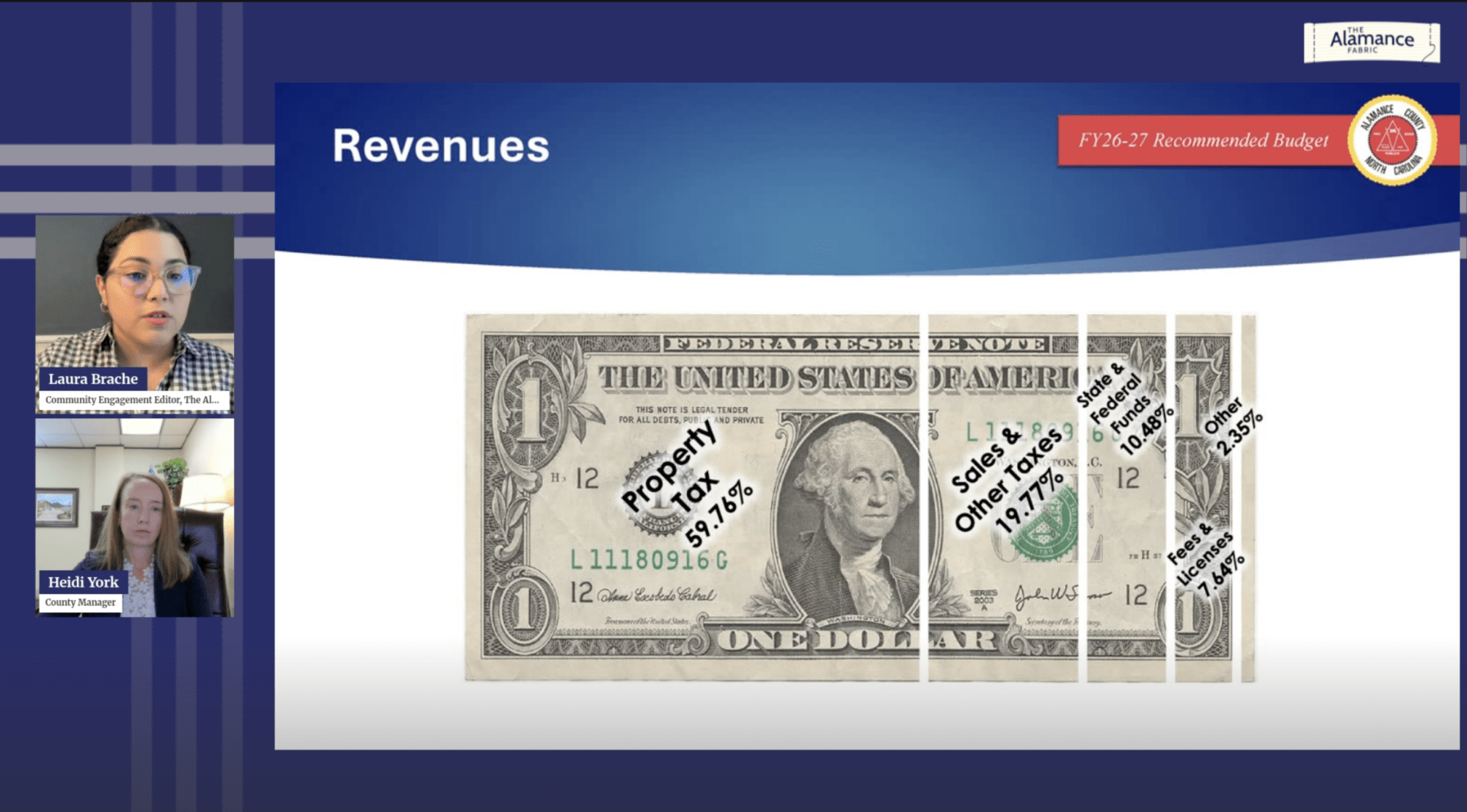
Heidi York: Yeah, that’s a great question. So local governments are limited by the state in terms of how they can tax. The only tax that we have any control over is the property tax. We can assess fees for some services, but really, it’s just the property tax.
We also have the ability to do a sales tax referendum, which would allow us to pick up a quarter (1/4) of a penny. A quarter-cent sales tax referendum is something that we’ve tried here in the past unsuccessfully.
But the property tax rate is set. It’s one rate that applies to both residential and commercial and industrial. Those are all taxed at the same rate.
The only ability that we have to redistribute the residential versus commercial proportions is when we do a revaluation. That allows us to take a snapshot of all values. So residential, commercial, industries, corporations – all of those property values get assessed at that time. And sometimes that helps redistribute the tax burden from residential to commercial. That gives us the chance to pick up some of these new commercial developments that are coming along. So it’s important to do that so that we can make sure that we have an accurate snapshot of the market and the market values.
AF: And 2027 is a reval year.
HY: That’s right. That’ll be a reval year. Our last one was in 2023. So that’ll be four years since we’ve done one.
AF: Another major point of frustration online revolves around development. Residents are asking why new housing developments aren’t taxed more heavily to offset costs. When a new major subdivision comes in, exactly how is that property taxed? Is it treated any differently?
HY: New developments are taxed, especially once they are selling the properties. As a buyer, you’re paying a tax once you live there. So we do assess those during the development phase, and then once they come online. It just takes a whole lot of houses to impact the tax – the collection rate – or bring on new revenue. It really takes a lot to move that needle, but we do capture those when they’re built.
AF: In your presentation, you brought up the so-called Blue Ridge Housing Loophole. This stems from the Mitchell County v. Blue Ridge Housing case from 2013, and it essentially allows a property tax exemption for developers of apartment complexes – as long as a nonprofit holds even 0.1% ownership. This is statewide. Is there anything at the county level that can be done about that?
HY: As you can imagine, this is impacting all 100 counties in North Carolina. Alamance is seeing the impacts here [$500,000 loss in 2025-2026 and a projected loss of $650,000 in 2026-2027], but some larger counties are seeing much more significant impacts.
So the legislature has taken up this issue, and we hope that they are closing that. I think it did pass so far in both houses. So we believe that we’ll see some relief from this probably next fiscal year. We don’t know the details yet.
I understand that there’s an application process that apartment complexes can apply to to remain exempt. And I think they have the ability to apply for that in December of this year.
So we may not see relief right away, but at least down the road, we expect that this loophole will be closed.
But a lot of the apartment complexes that are being built around our community are taking advantage of this tax exemption. And that’s something I hear all the time from folks: “There’s so many apartment complexes going up every day. How are we not seeing more tax revenue?” And it’s this exemption that is hurting some of that.
AF: Some residents have suggested raising the sales tax rather than property taxes. Data from the North Carolina Department of Revenue shows that the last time we had a use tax increase in Alamance County was in 2009 to 2%. Local sales or use tax increases are usually by referendum and appear on the ballot in a primary or general election. If the county wanted to rely on a sales tax increase instead of property taxes to help cover the projected $13 million shortfall, what would that legally require?
HY: That’s a great question. And I do hear a lot of folks asking, “Why not just raise sales tax?” Well, we can’t just raise sales tax. It does require a voter-approved referendum on the ballot. And I believe Alamance County has put it on the ballot four times – maybe five times – in the past, trying to get support for that.
The ability to get a quarter of a penny is what you’re asking voters to approve.
We project or estimate that we would see approximately around $7 million of new revenue generated by a quarter of a cent sales tax, and then it’s limited on what it can be assessed on. It doesn’t get put on groceries or gas because there are some limits to what it can be put on. But it does have to be approved (by voters).
Our community just has not wanted to move that forward. So we don’t have the ability to just raise sales tax to offset the property tax.
Community engagement
AF: You cited a community survey to highlight the community’s priorities, but we are seeing from many people online who say they never got a chance to take it. You mentioned at the last meeting that the survey was not scientific. 889 people responded, which is less than 1% of the county’s adult population. How was this survey actually conducted and distributed? If the survey wasn’t scientific, what are the actual cues and metrics that you and your staff use to develop a budget? What other engagement points are important?
HY: Typically, the public input into the budget process comes after the manager’s proposed budget. We have a required public hearing, where anybody can come and talk to the board about the budget.
Then the board uses that feedback to help shape any adjustments that they might make to the recommended budget when they are getting ready to have an adopted budget, which is their budget that takes into account all the changes that they’d like to make.
And so we thought, “Wouldn’t it be great to hear from the public as we’re developing the budget, a little bit earlier?”
The opportunity to speak to the board in a public hearing – it’s kind of one shot (chance). If that’s not a good night for you, you’ve missed that chance. And it can be intimidating to get up in this room. It’s in the historic courthouse. So it’s, you know, a large room with a lot of people.
And so we wanted to just create another tool or provide another avenue for input. And so we didn’t seek to have this be scientific or random. Anybody who was interested in taking it, we welcomed the opportunity for them to give us input.
We made it available online. We had paper copies at our libraries. As I went around the community talking to civic groups, I would take copies with me, or I would ask them to go online and participate if they wanted to.
So that was kind of our intention in developing it. It was really just to give folks another chance to weigh in.
And so we asked things about community priorities. What is important to you? What services do you value most with Alamance County? We explained that if we were having to make service cuts, can you offer some insight into which places you would suggest cuts be made? And we listed, you know, an array of county services.
We also asked the question whether or not folks would support or oppose a property tax increase just to keep and maintain our current service levels. So it gave us some insight into maybe hearing from a different segment of the community than those who would have come out to speak at one of our meetings.
AF: One of the biggest claims online from community members is that county funds are being “mismanaged.” Last year, the county dipped into its reserve fund for $11 million to cover expenses, leaving less than three months of reserves for emergencies. How do you respond to taxpayers who view that as mismanagement, and does this current budget fix that vulnerability?
HY: It is a claim I hear a lot of.
If I had the chance to have a little deeper conversation with somebody who is saying that funds have been mismanaged. I’d want to know what they mean by that on a couple of levels.
We do something here when we’re developing our budget, called zero-based budgeting, where departments are having to justify, very detailed, every single dollar of every single line of their budget.
We have a lot of oversight in terms of what is being spent on every department. There are about 25 departments here in Alamance County.
We have a lot of scrutiny on what is in their budgets, where it’s going, whether or not there’s a more efficient way or a better way to fund those things. We spend a lot of time on that analysis. So that helps me think that we do have some good oversight in terms of spending.
Now, if they’re talking about where we’re using fund balance to offset recurring expenses, that is a concern that I have had with the board. And we have seen, particularly since our last revaluation in 2023-2024, that we have appropriated our savings account.
That’s basically what a fund balance is. We have appropriated that to balance our budget instead of adjusting the tax rate. And just like in your own household budget, if you’re dipping into your savings account to buy groceries or gas or pay your light bill, eventually you get to the point where that’s not sustainable.
And so that’s where Alamance County finds itself today. We have continued to use our savings account for recurring expenses, and so at some point, we either have to cut services so significantly that we are only providing services that we have recurring revenue to support, or we have to figure out a way to do that.
So this budget that I proposed Monday does not use their savings account to fill in this deficit. It’s the first time that we’ve had a budget that uses zero dollars of fund balance for recurring expenses. But what that does is put a lot of pressure on us to continue to make cuts, and so we’ve made at least $23 million from what was requested worth of cuts in this budget to get us in a place that gives us some stability and a sustainable course moving forward, where we’re not relying on our savings account.
What’s next?
The board will hold a public hearing on the proposed budget on Monday, June 1, at 6:30 p.m. at the Alamance County Historical Courthouse. A budget work session follows on Tuesday, June 9, at 9:30 a.m., and the final vote is scheduled for Monday, June 15, at 6:30 p.m.