
Overview:
New rules passed by the North Carolina State Board of Elections would require more from voters in some situations. Critics say more ballots could be tossed out.
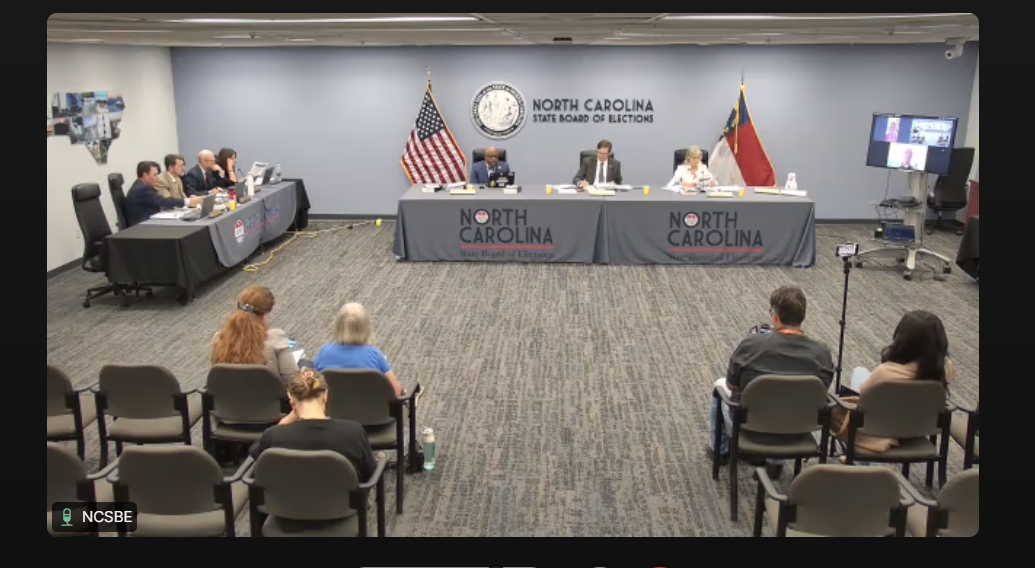
The North Carolina State Board of Elections voted to change rules that could affect November’s midterms.
The changes passed this month still need to be approved by the Rules Review Commission. If they are accepted, less noise will be allowed at polling places, the mail-in ballot process will be stricter and it will be easier for county elections boards to toss some provisional ballots.
The three changes were passed along party lines, with the board’s three Republicans backing them and two Democrats opposing.
“Where do you draw the line for ballot security versus access? That is an inherent tension, and I think we’re seeing that tension play out time and time and time again in these board of elections conversations,” Western Carolina University Political Science Professor Chris Cooper said of the debates over the new rules.
Here’s how the changes might affect you.
Limits on noise near polling places
Under a new rule, sound amplification devices, like portable speakers and megaphones, are not allowed around polling places. If someone uses such a device during voting hours, an election official overseeing the polling place is supposed to tell them to stop and remove it from the area.
Also, if someone is loud enough to be heard from a voting enclosure for more than a minute or repeatedly, an official is supposed to tell them to quiet down.
What’s not allowed specifically is “any sound, or vibration that is caused by sound, that can be detected by a person using their unaided hearing faculties” from within a voting enclosure, according to the rule.
In a July 14 letter to the board, nonpartisan voting rights group Common Cause North Carolina said the change threatened free speech rights.
“Common Cause North Carolina’s membership, its HBCU Student Action Alliance, and its coalition partners, have a rich history of organizing nonpartisan, non-disruptive, pro-voter demonstrations and celebrations at polling sites,” the letter said.
The NAACP, local churches and other groups have also organized events like Souls to the Polls, where large groups march to polling places together as a sort of communal, celebratory event.
Republican board secretary Stacy “Four” Eggers IV said during debate over the new rule it would help maintain order and decorum at polling places.
Stricter mail-in voting rules
Changes approved by the state board last week require more from absentee voters if they submit ballots with “irregularities.”
For example, a voter might not properly seal the inner envelope holding her ballot. That would be an irregularity.
In that event, county election board staff would need to document the irregularity in writing and contact the voter. If there were more than three days before the election, they would need to resend an absentee ballot package and allow the voter to resubmit while reminding them that they can vote in person.
Without enough time, they would need to tell the voter that she could vote early or on election day in person.
Before, election staff could simply contact the voter about the mistake and continue processing the ballot.
An easier path to county boards throwing out some ballots
Currently, voters who do not or cannot show photo identification have the option of casting a provisional ballot and filling out an affidavit under the penalty of perjury.
That process, on the voter’s end, is staying in place. What’s changing is the threshold for a county elections board to reject a voter’s explanation — and their provisional ballot.
Currently, a county board has to agree unanimously before rejecting those ballots. But under the state board’s change, it would only take a majority of the board deciding to reject the voter’s explanation.
The revised rule still says a county board needs to substantiate and write out “any findings of falsity” in a voter’s affidavit, and the findings must be based “only on facts and not speculation.”
A voter also still has the opportunity to address the county board before their vote is tossed.
Concerns of partisan bias
Critics have argued that allowing a simple majority to throw out those provisional ballots will insert more partisanship into elections.
“I’ve really struggled to find a reason for doing this other than to make it easier to toss out votes,” Common Cause North Carolina Policy Director Brooks Fuller said.
He noted a recent power shift in the state’s elections.
Republican lawmakers stripped Democratic Gov. Josh Stein of his authority to appoint chairs on county elections boards and create partisan majorities. The lawmakers gave that power to State Auditor Dave Boliek, a Republican.
Now, all 100 counties in North Carolina have Republican-led election boards.
“It is deeply troubling that these rules are being put into play so close to an election — essentially, the first major election following a massive, partisan change in the control of the boards,” Fuller said. “That does not sit right with me.”
State board spokesperson Patrick Gannon said the Rules Review Commission is expected to take up the rules at an Aug. 27 meeting.