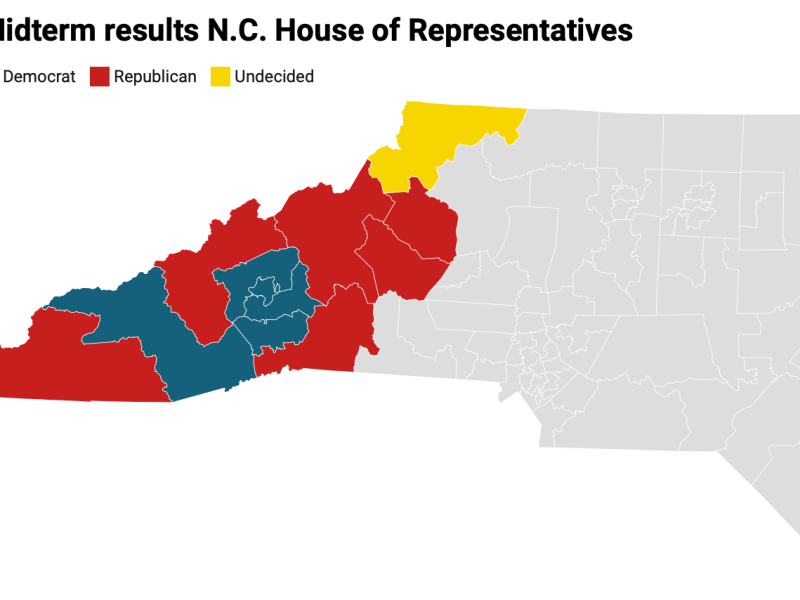

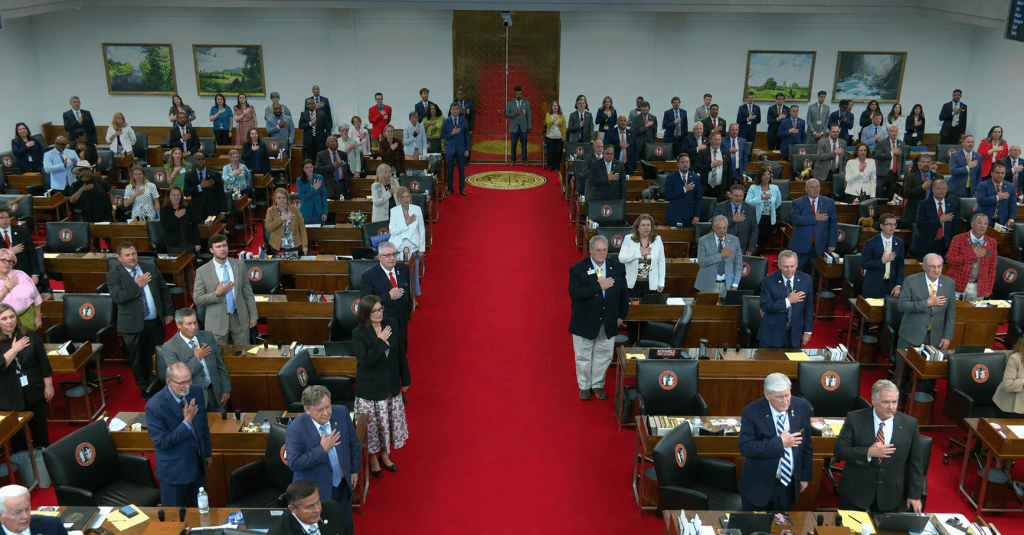
As Democrats prepare to take power in the North Carolina House of Representatives for the first time in more than 15 years, their priorities are taking shape.
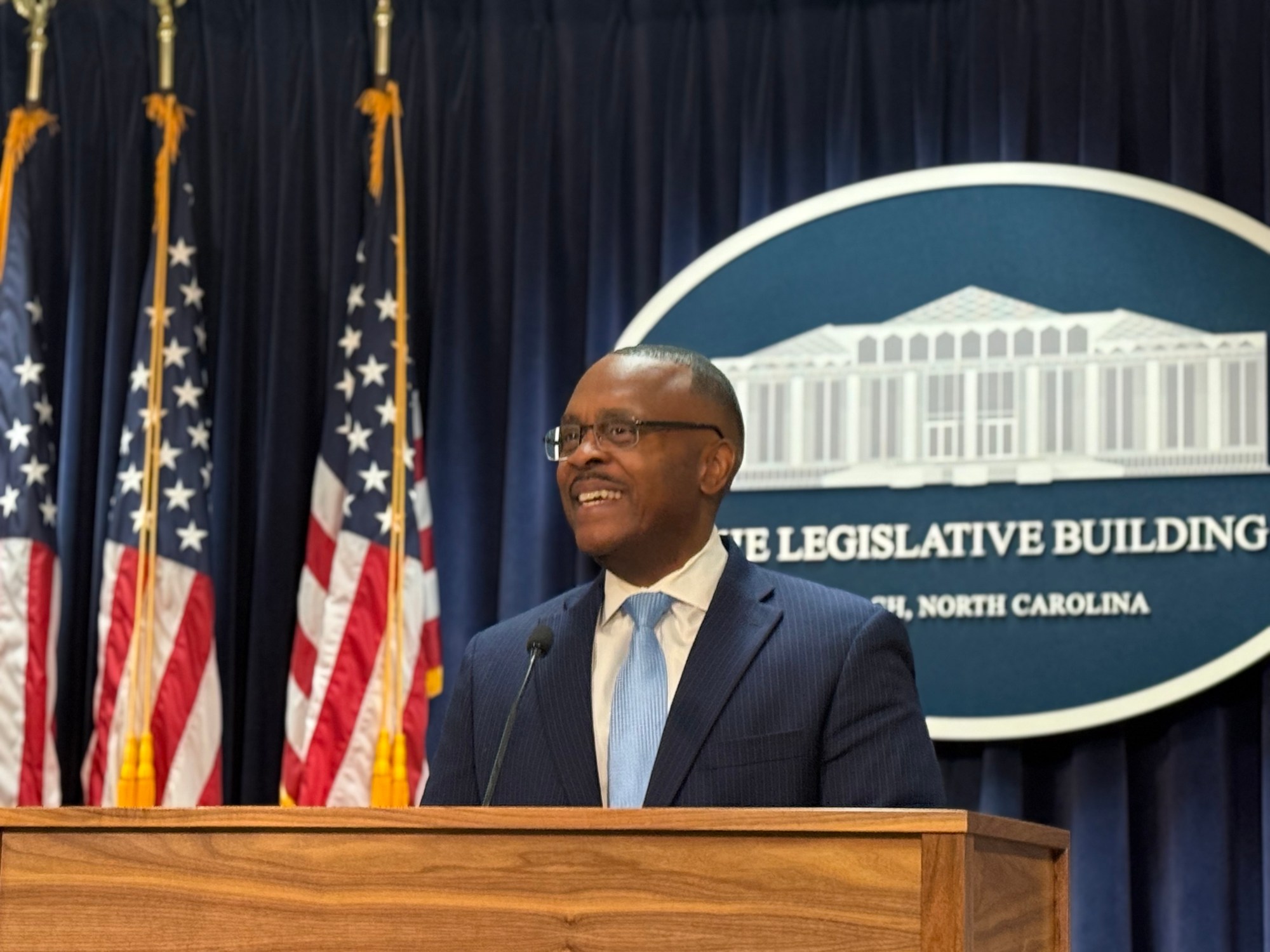
Robert Reives II, who is from Chatham County and has led N.C. House Democrats since 2020, is expected to be the chamber’s new speaker. He has already secured the support he needs for the role, he announced last week.
On Tuesday, Reives spent about an hour answering reporters’ questions about healthcare, school vouchers, congressional maps, medical marijuana, taxes and more.
“Last week, North Carolinians sent a message. Their message was it’s time for a change,” he said of the midterm election results.
It’s still unclear whom Reives will have to work with in the state senate, which Republicans will likely retain control of in January when new members are sworn in. With longtime N.C. Senate leader Phil Berger ousted in a primary this year, Republicans in that chamber are looking for a replacement. One lawmaker vying for the role has said it’s time for more bipartisanship.
Reives stressed Tuesday he was still speaking with members of his caucus, including 22 who will be brand new to the legislature. He said Democrats planned to meet early next week, and that “key legislative leadership roles” would be announced soon after.
Here’s what to expect going into 2027.
Republicans have a choice on redistricting reform, Reives says
The magnitude of Democrats’ wins in N.C. surprised many, in part because the state is often considered one of the most gerrymandered in the country. Last year, Republicans in the legislature again redrew congressional maps with the express goal of booting U.S. Rep. Don Davis, a Democrat who represents the northeastern part of the state, out of Congress.
“The motivation behind this redraw is simple and singular: draw a new map that will bring an additional Republican seat to the North Carolina congressional delegation,” said Republican State Sen. Ralph Hise, who represents Mitchell County in the legislature, just over a year ago. “Republicans hold a razor-thin margin in the United States House of Representatives. If Democrats flip four seats in the upcoming midterm elections, they will take control of the House, and torpedo President Trump’s agenda.”
Instead, Davis won his 1st Congressional District race. In a neighboring district affected by the redraw, a Republican incumbent conceded on Wednesday. Across the state, Democrats beat Republicans in other unlikely places.
Reives signaled that Democrats might put forward redistricting legislation, but said Republicans would have to agree to changes. He said Republicans had two options. He said he heard that they might try to be “the party of no” for the next two years and hope to take back the legislature in 2028.
“Or they can say, ‘This is a time that we can actually put in some real reforms.’ That way, whoever has the gavel in ’28, whoever has the gavel in ’30 — that is a tool that is gone for good. We’ve got that chance, and I think we ought to take that chance,” Reives said.
Unclear if lawmakers will try to undo public records exemption
State lawmakers exempted themselves and staffers from public records law in their 2023 state budget.
Reives noted he was against the change at the time but did not commit to backing legislation to undo it on Tuesday, and said he would first speak with his members about their priorities for next year.
“Our reality is, for 15 years I’ve not agreed with everything that’s happened,” he said. “We’ve got two years to correct what we feel are 15 years of missteps in other areas. It’s just a question of what ends up top of the priority list. After our leadership elections, we’ll have a clear picture of that.”
School vouchers will be under more scrutiny
Once Democrats are in control, Reives said, there will be greater scrutiny of private school vouchers.
“Everybody has a lot of opinions about the Opportunity Scholarship program, the voucher program,” Reives said. “I will tell you this: I think one thing Republicans and Democrats agree on is that it is ridiculous that somebody who’s making millions of dollars gets a coupon from the state when we can’t afford to pay for public education.”
The program helps families pay for private school tuition with state funds. In 2024, the legislature extended eligibility and grew the program by raising income caps. The State Board of Education asked for a moratorium on the program earlier this year, saying the funds should go to public schools.
Healthcare costs and availability are concerns
Healthcare costs have gone “out of control,” Reives said, adding that access is also a concern.
“Healthcare availability in a state that is 80% rural has become increasingly terrible as far as options,” he said. “I mean, you have women living in areas (where) they have to drive an hour and a half for an OB-GYN, things of that sort.”
Lawmakers “shot ourselves in the foot for years” when they did not expand Medicaid, and recent changes by Congress in the “One Big Beautiful Bill Act” further gutted the program, Reives said. (The state did eventually expand Medicaid in 2023. )
“Every gap that we can fill, we should do,” he said.
Despite concerns, constitutional amendments are the law
Despite Democrats’ wins in the state last week, three constitutional amendments that were proposed by Republicans passed with comfortable margins.
Two of the amendments will cement more conservative tax rules. The legislature can now bar local governments from raising property taxes past a certain amount; that limit still needs to be set. North Carolinians also decided that future lawmakers cannot raise the state’s income tax rate above 3.5% without another voter-approved change to the state constitution.
Reives said there was “misinformation” about the amendments. Some North Carolinians would save little in the tax cuts but lose out on millions of dollars in government services, he argued.
Still, he said, the amendments passed and are law now.
“We’re following every law, and those constitutional amendments passed, and we’re going to make sure we have laws to support them and move forward.”
A third amendment that passed adds language to the state constitution about voter identification being required for mail-in ballots. That was already the law, but it will be harder for a future legislature to undo the change now that it is part of the constitution.
Medical marijuana could have a path forward
Aside from Eastern Band of Cherokee Indians lands, marijuana is illegal in North Carolina.
“I think decriminalization of marijuana has been on top of everybody’s minds,” Reives said, adding that he believes medicinal marijuana could be particularly helpful for veterans.
Data centers should be up to locals, Reives says
Data centers have been divisive. An Elon University poll earlier this year found that disapproval for them has grown in North Carolina, with 53% of respondents against one being placed in their communities. Another 27% were unsure, and 20% supported them.
Some local governments have tried to get ahead of the issue. Last month, for example, Beaufort County’s board of commissioners voted almost unanimously to put a one-year moratorium on data center development in place. There were no plans to put one there.
But local control is the issue, not popularity, Reives said.
“There are tons of municipalities and counties that would love to have a data center,” he said. “So, it’s not about agreeing with data centers or not agreeing with data centers. The question is: Who should make that decision?”
Reives open to working with Republicans
Reives repeatedly stressed that he would like to work with Republicans.
“If Republicans have some good ideas about saving money, they’re going to be at the front of the table,” he said. “If Republicans have some ideas about what we can do to make life more affordable, they will be heard. Unlike what we have seen in the last 15 years, we don’t care who gets credit.”
Reives said he has had a good working relationship with current House Speaker Destin Hall, who started the job last year. He was more uncertain about the state senate.