

Overview:
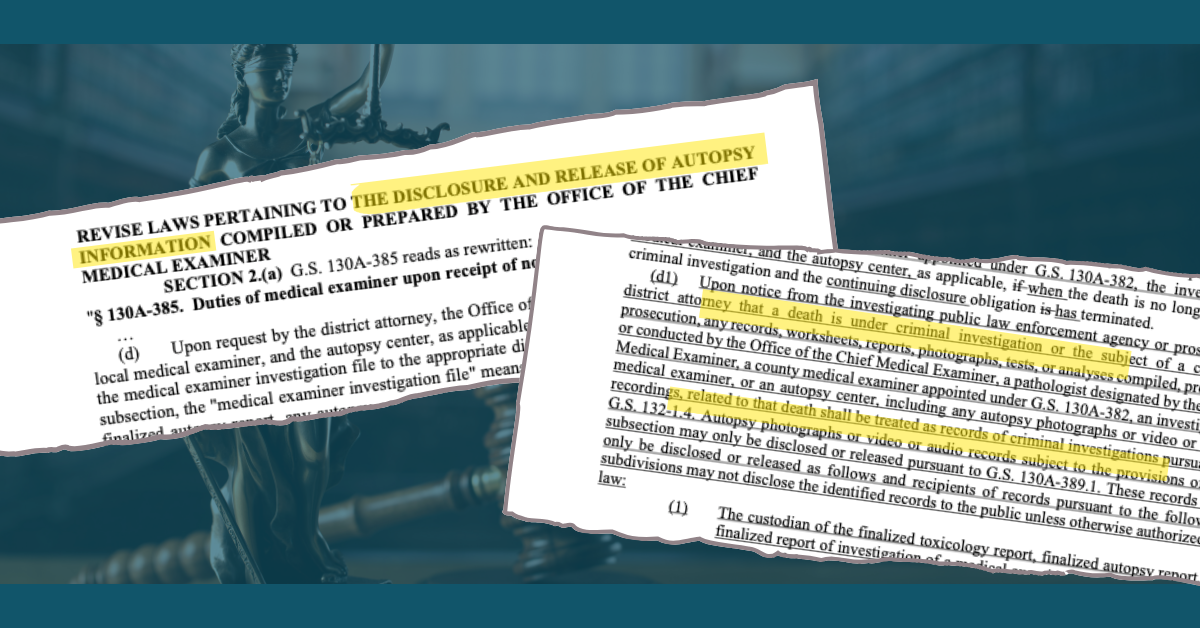
North Carolina journalists have long relied on medical examiner records to uncover wrongful deaths in prisons, jails, workplaces, and other institutions, but a new law will sharply restrict access. Starting October 1, SB 429 exempts autopsy and investigative reports tied to criminal cases from public release until the case is closed, a move media lawyers and press advocates say undermines transparency and public accountability.
North Carolina journalists have long used medical examiner reports for accountability reporting, exposing wrongful deaths in prisons, workplaces, nursing homes and more. But that’s changing October 1.
Tucked into SB 429, the wide-ranging crime bill signed by Governor Stein over the summer, is a provision that rolls back the public’s right to access death records from the NC Chief Medical Examiner (OCME).
“Nobody’s put forth any rationale for me to have a good understanding of why this change is necessary,” said Attorney Mike Tadych, who represents media organizations in public records cases.
Under the new law, medical records for deaths under criminal investigation will largely be exempt from public records requests—until the criminal investigation is closed.
Tadych says it reminds him of the middle-of-the-night change lawmakers made in 2023, exempting themselves from the state’s public records law.
“And the issue is, is it a retroactive application of the law?” said Tadych. “Neither statute are clear. What I mean by that is, if there was an autopsy record from, let’s say, September 1st of this year, you should be able to get it unless they take the position that as of October 2nd, you can’t. I don’t know how it will be interpreted.”
Tadych represented NC news organizations in a five-year-long battle to get records related to the death of John Neville, who died in 2019 in Forsyth County Detention Center after deputies pinned him in a position known to suffocate people. Those 700+ pages of records were finally released in June (read N&O Reporter Danielle Battaglia’s piece here). A week later, lawmakers passed SB 429.
“There are so many solid public service reasons to keep access to these records,” said McClatchy’s Southeast Investigations Editor Cathy Clabby. Clabby shared some other examples of how News & Observer and Charlotte Observer journalists have used Medical Examiner records to expose wrongdoing and broken systems.
- Gavin Off’s reporting revealing how many people who died by suicide in NC prisons were both in solitary confinement and mentally ill.
- Dan Kane’s reporting on deaths inside NC jails.
- Lexi Solomon’s reporting on two teens found dead in their burning home, who had been shot and killed first by their father.
- Ames Alexander’s reporting on construction worker deaths in NC and on how autopsy delays bring pain and financial crises to grieving families:
- Virginia Bridges’s reporting about a fatal crash that occurred after a Highway Patrol trooper initiated a chase and later lied about it.
“North Carolina has a public records law for a reason: residents have the right to observe how its government functions and how well it protects people,” said Clabby. “We’ve got incredible civil servants, but we also know there are cases where things are not handled in a way that protects people. Having records accessible is crucial.”
N&O Emerging News Reporter Lexi Solomon has been using Medical Examiner records for data gathering purposes, including to better understand the extent of violence against women and youth.
“Sometimes these autopsies or investigative reports by OCME are the only way we can find out that a juvenile was suspected of involvement or that it was indeed [domestic-violence] related,” said Solomon. “If we don’t have accurate numbers, we’ll never truly know.”
Lawmakers have tried to get this measure through in previous years, and former Governor Cooper vetoed one of those bills. Both Tadych and Reporters Committee for Freedom of the Press Senior Staff Attorney Elizabeth Soja say they’ve seen no evidence showing that release of these records harmed prosecutions.
“It’s always troubling when the legislature decides to claw back transparency. And it’s always a circumstance under which you want to scratch your head and think, why are we trying to reverse transparency that already exists,” said Soja.
News outlets will now have to go to court to try to get the release of OCME records in criminal investigations. Both lawyers point out that it’s a costly and lengthy process that delays transparency and accountability. Tadych believes the burden of proof will also be higher than what is required to get body camera footage.
“If you look at the public records and open meetings law writ large, we err on the side of openness in North Carolina, and I don’t understand why we’re not in those two circumstances,” said Tadych.
Tadych emphasizes that no court has yet ruled on whether this new law, and the provisions exempting lawmakers records in the 2023 budget bill, applies retroactively.
“What I’m expecting is there will be something of such import, either regionally or statewide, that a coalition will form to seek that out,” said Tadych.