
Overview:
'Habeas Corpus' petitions have increased significantly in immigration cases in President Trump's second term. Several North Carolina residents arrested by ICE believe they’re being held in detention centers unlawfully, and they have turned to federal courts and the “Great Writ” for relief.
What is a habeas petition?
Habeas corpus is Latin for “you have the body.” In the American legal system, people file habeas corpus petitions, or legal requests in federal court “to challenge the legality of someone’s detention,” Jeremy McKinney, a Greensboro-based immigration attorney, told NC Local.
The concept of habeas corpus was designed to keep people from being locked up without justification.
Habeas corpus petitions are not only used in cases when an individual has been arrested by Immigration and Customs Enforcement or Border Patrol — both citizens and non-citizens can pursue relief under habeas corpus, if they believe their detention is unlawful.
“It’s there to protect what is basically our most precious right, and that is the right to liberty,” McKinney said of habeas corpus.
With its origins dating back to the signing of the Magna Carta, habeas corpus is often called the “Great Writ.” The right is also found in Article I of the U.S. Constitution, where it says it “shall not be suspended, unless when in Cases of Rebellion or Invasion the public Safety may require it.”
In a Senate committee hearing in May 2025, Department of Homeland Security Secretary Kristi Noem, asked to define “habeas corpus,” incorrectly said it was “a constitutional right that the president has to be able to remove people from this country.”
The Trump administration said it is considering suspending habeas corpus, though legal experts say only Congress has the authority to take such action.
How often is habeas used in immigration-related cases?
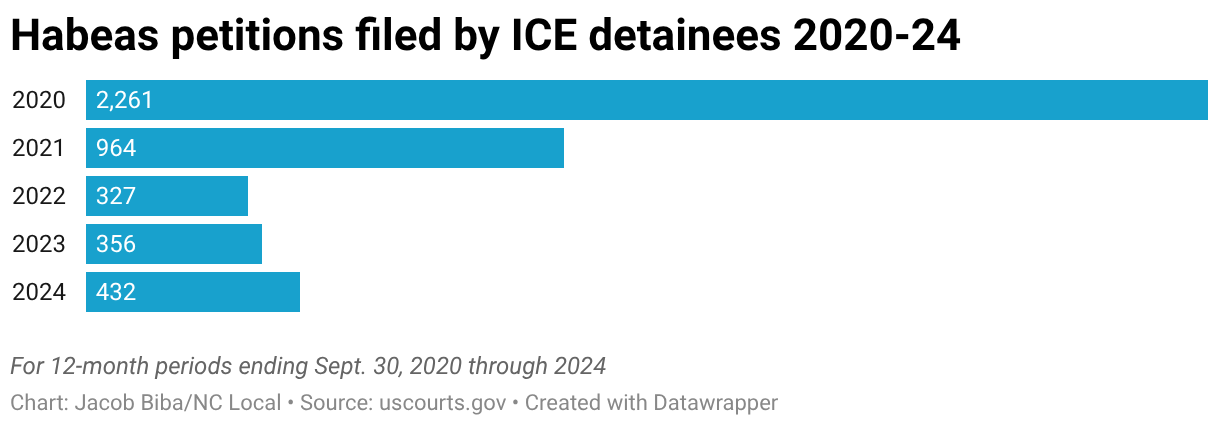
Before President Donald Trump took office in January and launched his mass deportation program, habeas petitions were rarely filed in immigration cases. The petitions were primarily used in criminal cases.
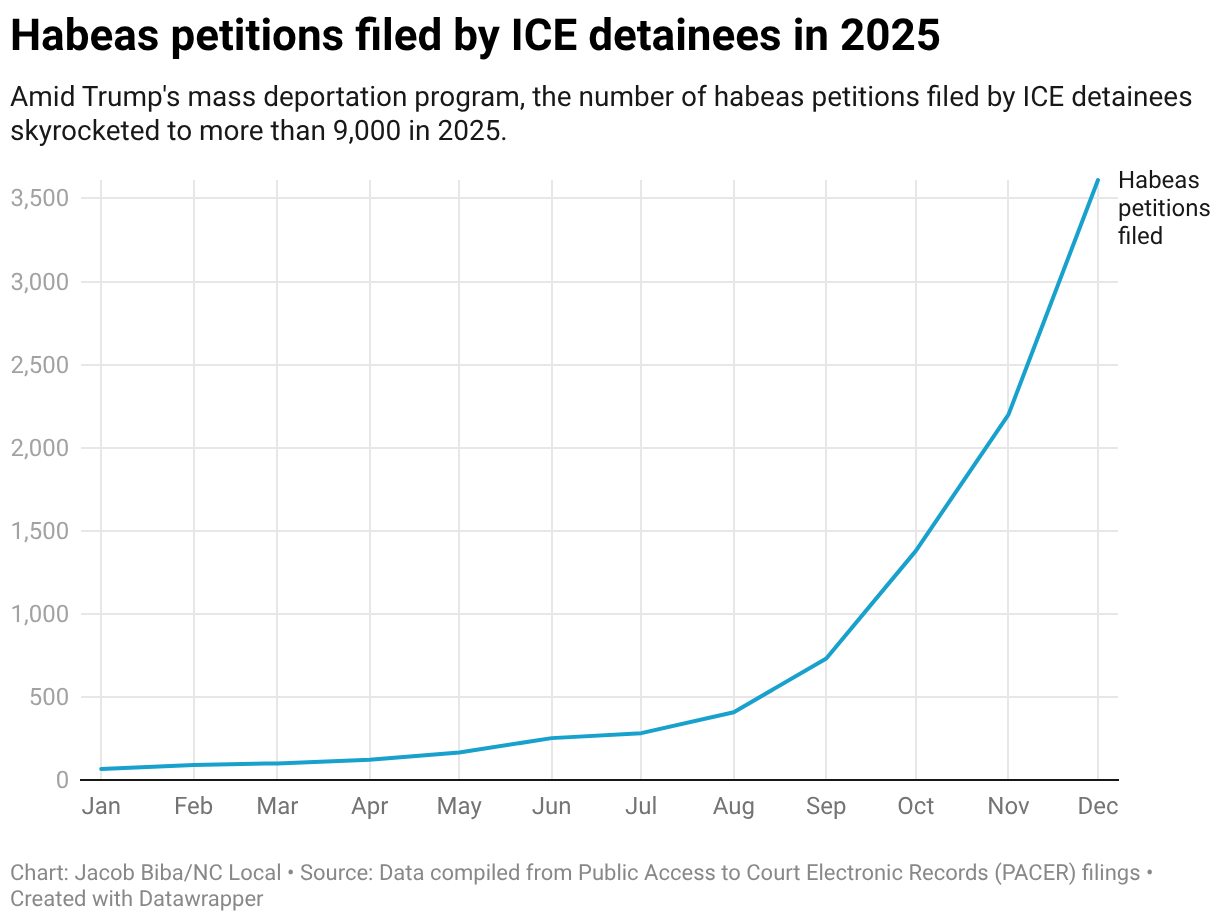
In 2024, only 432 habeas petitions were filed by ICE detainees, according to federal court data. After Trump took office, the number of petitions filed skyrocketed to more than 9,000 in 2025.
One of the reasons for an increase in habeas petitions is an increase in overall numbers of arrests by ICE and Border Patrol.
When Trump took office, about 40,000 people were in immigration detention. Now, a year later, an estimated record-setting 73,000 people were being held, according to a CBS News report.
ICE arrests in North Carolina
During Trump’s first nine months in office, ICE arrested more than 3,300 people in North Carolina. That figure doesn’t include “Charlotte’s Web,” a Border Patrol operation that launched in November and netted more than 400 arrests as of Dec. 3, according to the agency.
It is unclear how many of the individuals arrested by ICE and Border Patrol in North Carolina have filed habeas petitions claiming wrongful detention. Federal rules of civil procedure bar remote electronic access to documents in immigrant-related cases, like habeas claims, making it difficult to determine where detainees resided before their arrests.
But in the last two months, McKinney said he’s filing “at least” one habeas petition a week, describing the situation as the worst it’s ever been in the nearly 30 years he’s been practicing law. The national data reflects McKinney’s experience.
In Georgia, where many North Carolina residents arrested by ICE are said to be held in detention facilities, there are more than 400 active habeas cases pending in federal courts as of Jan. 13, according to Habeas Dockets, a public database that tracks cases. In North Carolina federal courts, there are seven active cases.
A habeas petition can also be filed when someone believes they’ve been deported unlawfully. Deportation, McKinney said, “can be considered a form of confinement.”
‘Secret memo’ keeps detained people from getting out on bond
Individuals arrested at the border and other ports of entry, like airports, may be subject to mandatory detention. But, unless they have certain criminal convictions that call for mandatory detention, most people arrested by ICE or Border Patrol within the United States are eligible for release on bond.
Previously, if ICE refused bond, McKinney and other immigration attorneys could request a hearing in front of an immigration judge, who would then decide whether the detained person was eligible for bond.
But over the summer, the Department of Homeland Security, which oversees both ICE and Border Patrol, issued what McKinney described as a “secret memo” declaring that immigrants who entered the country illegally were ineligible for bond hearings.
Typically, those same people would have never been detained in the first place, McKinney said. If an undocumented immigrant encountered ICE, they would have been served a letter and placed into removal proceedings, the court’s process for determining if they should be deported
“You’re treating grandma who’s been here for 20 years and has eight grandkids the same as a convicted rapist,” McKinney said. “That makes no sense on any level. That should make no sense to anyone, regardless of their politics.”
McKinney said the memo not only runs contrary to established law, but “flies in the face of three decades of practice.”
“But because the Department of Justice controls the immigration courts, then when the White House changed its stance on bond hearings, then the immigration courts fell in line, because, again, they’re not real courts. They’re part of the Department of Justice,” McKinney said.
Unlike federal courts that fall under the judicial branch of government outlined in the Constitution, immigration courts are purely administrative, operating under the DOJ’s Executive Office for Immigration Review.
How successful are habeas petitions?
Citing the memo, immigration judges claim they have no jurisdiction in ruling whether someone is eligible for bond, McKinney said, meaning people could face months or even years of detention, as their case plays out in the courts.
“But that interpretation of the law is unlawful,” McKinney said of the Homeland Security memo. “That detention is unlawful. That’s why we filed habeas petitions.”
Since the memo, judges across the country have since issued hundreds of rulings in favor of detainees’ right to bond hearings. One federal judge in California affirmed eligibility for a nationwide class of detainees, clarifying that the memo should not be followed. Nevertheless, some immigration judges are still following Homeland Security’s “no bond” policy, McKinney said.
“Even after all that success, we’re still having to file,” he said.
Most of McKinney’s cases are still pending, he said, but the first two habeas petitions he filed on behalf of clients were granted.
Even successful petitions that allow a person to return to their community consume time and resources.
“We’ve seen nothing but success,” McKinney said. “But what does success mean? Success means here that the family, or their friend network, had to hire a lawyer to file a federal lawsuit, to then get a bond hearing, to then have to post a bond just to return to the status quo of a person that is still facing deportation but is not being locked up states away from home.