

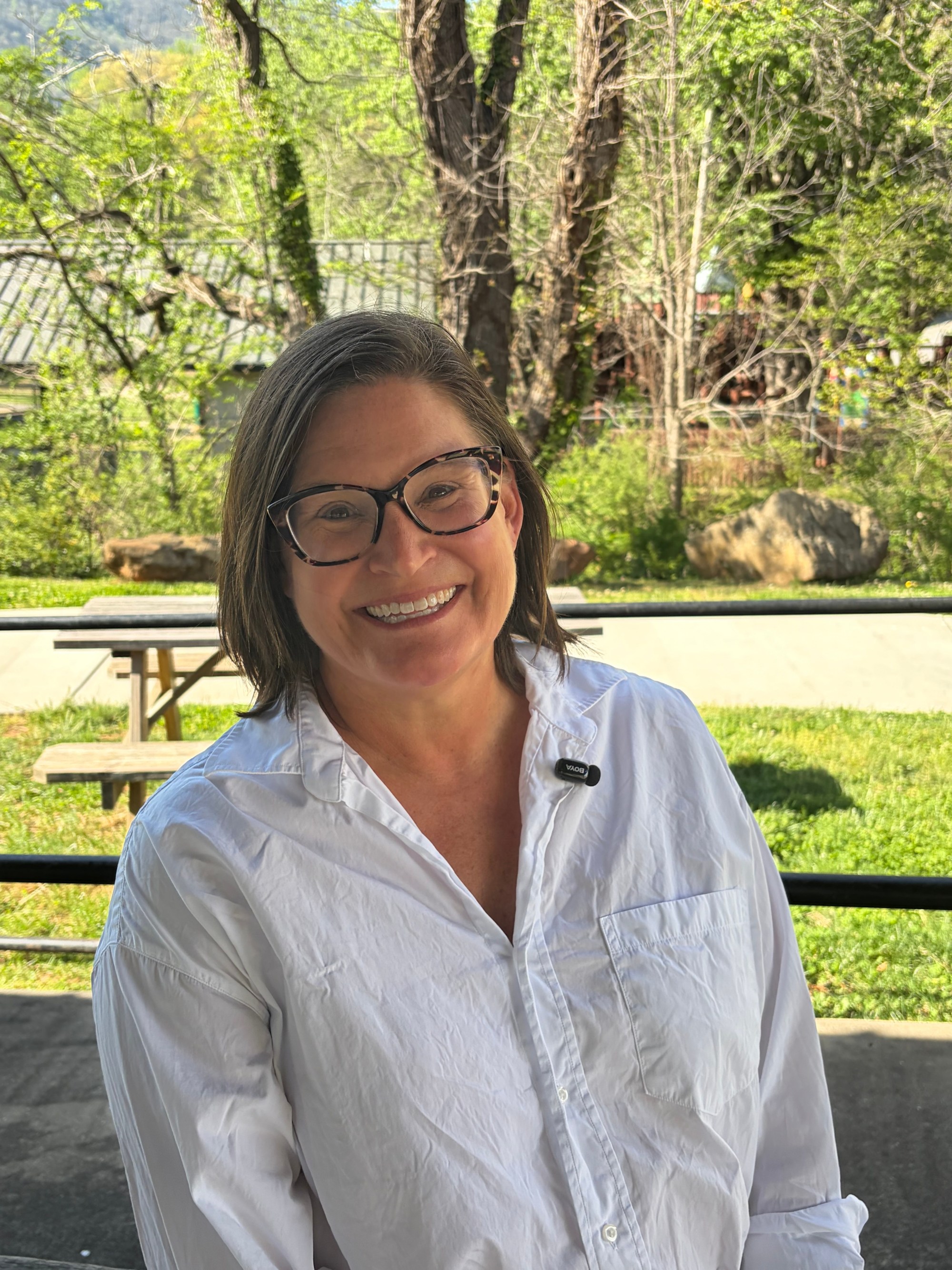
Local Republican leaders chose Anna Ferguson, an enrolled member of the Eastern Band of Cherokee (EBCI) and Jackson County resident, to finish the remainder of the late N.C. Rep. Mike Clampitt’s term in the General Assembly.
Ferguson, a local business owner, is the first enrolled tribal member to serve in North Carolina’s legislature, according to Western Carolina University political science professor Chris Cooper.
“When I think about that, I can almost feel my shoulders get heavy because this isn’t something that happened to just me. This is because of the people who raised me and the people who raised them and my tribe and my county and Swain County,” Ferguson said.
Ferguson lives in Jackson County, less than a half mile from the Qualla Boundary in Whittier.
Principal Chief Michell Hicks congratulated Ferguson on the historic appointment.
“We are proud to see her step forward to represent Western North Carolina, as we remember Representative Clampitt’s service and dedication to the people of this region,” Hicks shared on Facebook. “We wish her the very best in the months ahead.”
Ferguson said it is a critical time for the Eastern Band to have a seat at the table in the legislature, especially because there are now two federally recognized tribes in North Carolina. The Lumbee Tribe of Roberson County was federally recognized by President Trump in December 2025, a move that concerned Ferguson.
“To see them get this passed through a little back door measure like that, it really was a shot in the heart,” Ferguson said. “I mean, I worry that it’s going to weaken tribal sovereignty in general.”
“I want to make sure that our views are heard because I don’t think they are right now. I think we’re out of sight, out of mind, and we need to get back in there.”
Ferguson added that she would be willing to work with the Lumbee leadership.
Although this is Ferguson’s first state office, she has served on EBCI Planning Board and other boards. She said she will resign from the planning board to start her term in the legislature.
Continuing a WNC legacy of electing women
Another aspect of Ferguson’s identity is historic: she is the first woman to represent Jackson and Swain counties in the House, according to Cooper.
Western North Carolina has a long history of electing women. Transylvania County previously had two women representatives in the House, one appointed and one elected.
Thelma R. Fisher, who was appointed in 1955 when her husband resigned his seat, was the first Republican woman in the legislature, Cooper shared. Gertrude “Trudi” Walend was elected and served in the House from 1999-2009 & from 2012-2013 representing the 113th district.
Ferguson was surprised to hear she was the first Jackson County woman in the House.
“Really? That is exciting. I’m starting to realize why this fight’s been so hard. I mean, I’m different. I look different, I sound different. I have different ideas than what people have been used to, and I do think that’s why it’s been so hard to kind of get my point across, because people either want to just assign me to someone who’s already an established politician or just write me off completely,” she said. “And so it’s been a bit of a battle, but I think it is just because people aren’t used to seeing someone like me at the table.”
Jackson County was also home to the state Senate’s first woman: Gertrude Dills McKee who was first elected in 1930 and was re-elected for three more terms. McKee passed away suddenly at the beginning of her fourth term in 1948. The first woman elected to the North Carolina General Assembly was also from Western North Carolina: Lillian Exum Clement of Buncombe County in 1921. She was also the first woman to serve in any state legislature in the American South.
She said Eastern Band of Cherokee Vice Chief Alan “B” Ensley approached her about running in the primary where she was defeated by Clampitt. Nevertheless, she said the experience was an opportunity to learn.
“[The primary] did prove to me what I wanted to do. It helped me solidify what needs to be done and it showed me how tough it can be, and that’s okay. I’ve got the stomach for it,” she said.
Clampitt bested Ferguson in the primary, receiving 57% of the vote to her 38%. Jackson County resident Mike Yow trailed with less than 6% of the vote.
Live in Western North Carolina?
Sign up for The Trailhead, your guide to Western Carolina. Senior reporter Lilly Knoepp gives you a weekly look at what matters in WNC.
How did she get the role?
Ferguson will complete the term of Clampitt, who served four terms in the House and passed away in March after a battle with a rare cancer.
Under state law, if there is a vacancy in the General Assembly, leaders of the representative’s party selects an interim replacement until the next election.
Because NC-119 is made up of three counties – Swain, Transylvania and Jackson – the decision comes from a weighted vote of the GOP Executive Committees from each county in the district, based on county population.
Jackson GOP Chair Justin Castle described the weighting distribution: 48% for Jackson County, 37% for Transylvania County and 16% for Swain County. The executive committees from each county were invited to attend and vote.
Members of the executive committees of all three counties met on Saturday at the Jackson County Justice Center to deliberate between four candidates to fill the remainder of the term.
In March, Senior Resident Superior Court Judge Peter Knight’s position was filled in a similar fashion after he retired from the 42nd judicial district which includes Henderson, Transylvania and Polk counties.
Castle told NC Local that Ferguson, Shira Hedgepeth and Larry Chapman were nominated by party leadership to fill the position. Ferguson was nominated by Jackson GOP Treasurer Kitti Chisholm.
No one received more than 50% of the votes on the first round, so the top two, Ferguson and Larry Chapman, advanced to another round.
Each candidate then shared remarks about why they should be elected.
Ferguson said that during the speech, she addressed her main priorities and answered criticism from community members about not voting in the 2024 presidential election. She said she explained to the executive committee on Saturday that she was out of town on Election Day with her sick mother.
“My mother had multiple myeloma, and she had treatments at Emory [hospital]. She had had a stem cell transplant, and so she relapsed, and we didn’t know it at the time, but that was her final days because she passed away that December,” Ferguson said. “Out of all the criticisms I’ve received, that one got me.”
On issues affecting the region, Ferguson expressed the need for a more equal “distribution of funds across the district.”
“There are some places that have received funds, and they’ve done wonderful things with them, but then there are other locations that had just received nothing and could desperately use it,” she said, pointing to needs particularly in Swain County.
“I think Swain County’s really due for some input from the state. Their infrastructure needs to be built up, and of course, these are things that I will sit down with Swain County county commissioners, mayor, and we’ll see what they tell me that they need and what’s on their priority list.”
The need isn’t necessarily specific to Swain, Ferguson said, referencing other areas in the region that need broadband infrastructure, like Balsam Grove in Transylvania County.
“Let’s work to get infrastructure in place because we’re going to have to start getting new industry in. Tourism is great, but tourism’s like any other market. It ebbs and flows,” Ferguson said. “And so when it’s ebbing, we need to have other resources and other places where people can have income and keep our communities healthy.”
Castle said Ferguson’s primary attempt contributed to his rationale for voting for her now.
The Jackson County executive team met with candidates and N.C. Rep. Karl Gillespie (R-Macon) for more than five hours on Thursday before the vote to consider what qualities were most important in a candidate, he said.
“Who could go up there and basically win friends, give a voice for those of us west of Asheville. A lot of factors went into it,” Castle said. “We wound up feeling like we made the best decision, and we’re hoping that we did.”
Transylvania County GOP Chairman Herschel Johnson declined an interview with NC Local for this story.
Who will be on the November ballot for the Republican seat?
Ferguson’s selection to serve the remainder of Clampitt’s term did not automatically place her as the Republican nominee for November’s general election, where Clampitt would have been the incumbent.
According to state law, if a candidate “dies, resigns, or for any reason becomes ineligible or disqualified before the date of the ensuing general election,” the appropriate district executive committee of the political Party shall appoint another candidate to fill the vacancy.
The GOP Executive Committees held a second vote to determine who would be on the November ballot. Hedgepeth and Chapman bowed out of this round, while Molly McKim threw her hat into the ring, Castle said.
“It was very close. I mean, it was literally one vote that I received both of those,” Ferguson said.
Ferguson will face Transylvania County Democrat Mark Burrows in November. Burrows posted online after Ferguson’s selection that he is focused on the campaign regardless of the other candidate.
“When I filed to run in early December, it was because I knew that many people across Jackson, Swain, and Transylvania counties were and still are struggling. No matter who is running on the other side, I remain focused on you and your family. This campaign is about you,” Burrows wrote.
On key issues
NC Local asked Ferguson about key issues in the upcoming session:
On the state budget
Ferguson said her top priority when she gets to the legislature will be to pass a budget. North Carolina is the only state in the nation to not have an annual comprehensive budget because of unresolved conflict between Republican House and Senate members.
“It’s ridiculous, so that’s something that has to get done right away. But I think even the people that have already been in there, I think they’re feeling the pressure of that too,” Ferguson said.
“I’m hoping that it’s something that people are going to quickly come to an agreement on and get it going. And then we can start working on the next budget, which will be exciting because that’s something I’ll have input in from the beginning.”
She said she is ready to compromise with her new coworkers.
On health care
The state was one of the last to expand Medicaid coverage under Obamacare. The expansion allowed more than 600,000 North Carolinians to access health care. In January, the “Big Beautiful Bill” cut $1 trillion from Medicaid across the country over the next decade. The change means that the state will need to fill in a $319 million funding gap for the 2025-2026 fiscal year.
“There are so many things behind the scenes that inflate medical costs to a point where no person can afford it on their own. So until we figure out what’s not working there and why it’s not a fair market value, we need Medicaid,” Ferguson said.
On marijuana
State laws around cannabis may also be addressed in the upcoming session after North Carolina Gov. Josh Stein’s Advisory Council on Cannabis shared a new report earlier this month.
Ferguson said she would be open to discussions about medical marijuana legalization.
“I’m interested to see where medical marijuana takes us. You know, I can’t say, ‘oh no one can have it,’ when there are people who are seriously ill that are seeing great benefits from it,” she said.
The tribe legalized cannabis on the Qualla Boundary, the sovereign nation of the Eastern Band of Cherokee for medical use in 2021. In 2023, tribal leaders expanded the policy to allow recreational use.
The tribe’s Great Smoky Cannabis Company grows, processes and sells cannabis to tribal and nontribal members.
Ferguson said any state legalization could benefit the tribe because Qualla Enterprises had a head start on cannabis production and sales.
“They’re probably about five to seven years ahead of anyone else coming into the market right now,” she said.
On education
When it comes to education, Ferguson said she wants more funding per pupil statewide.
“Education, that is just the most dubious honor I’ve ever heard, of last in the nation per dollar spent per child in public education,” Ferguson said. “I looked, and there have been some increases given for you know to education, but they’re not making it to teacher pay. So what’s happening in between there?”
She said part of the challenge of education in WNC is the difficulty competing with teacher pay in nearby Georgia.