

Thousands of Duke Energy customers say they’re afraid they won’t be able to pay their power bills if the North Carolina Utilities Commission approves the company’s request to raise home electricity rates over the next two years.
The commission held its final scheduled public hearing on Duke Energy’s pending rate cases on Wednesday in Durham. Nearly 200 people rallied against the proposed increases, some speaking emotionally about not being able to afford their power bills.
“North Carolinians are tired of being treated like revenue streams for a monopoly utility while working families struggle to keep the lights on,” Caroline Sparks of Raleigh told the commission through tears. “Just this week, I watched my dad put a $3 burrito back in the freezer at Harris Teeter because it was too expensive for him.”
Wednesday’s public hearing was the last before the commission decides on the rate proposals from Duke Energy Carolinas and Duke Energy Progress, the company’s two subsidiaries in North Carolina.
The commission, composed of five members, held 11 public hearings over the last three months throughout the state.
How much more would I pay under Duke Energy’s proposed rate hikes?
Duke’s proposals would raise home electricity rates by 18% over two years, with different base rates depending on whether you’re a Duke Energy Carolinas or Duke Energy Progress customer.
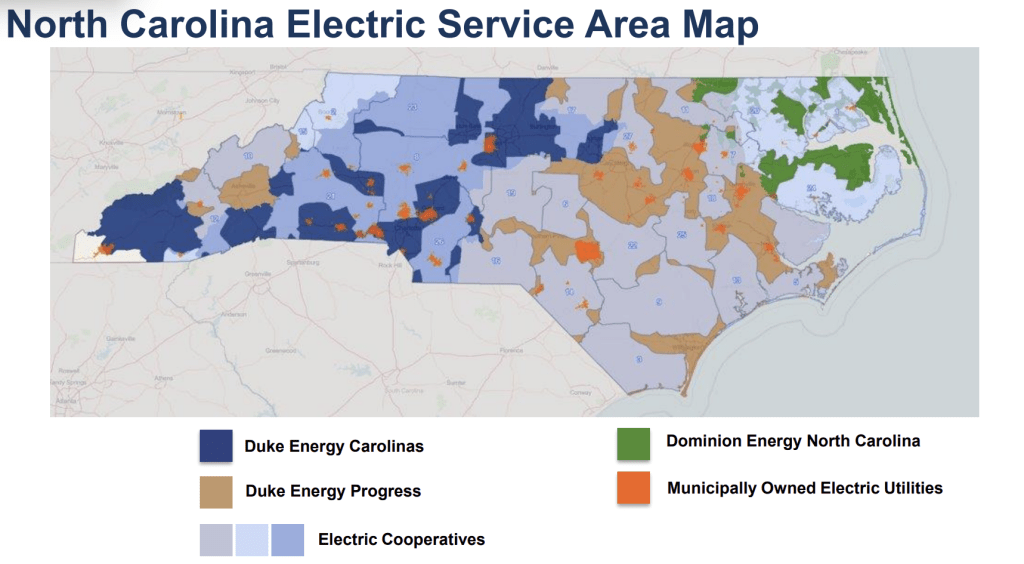
The Carolinas subsidiary covers more than 2 million customers, stretching from rural Western North Carolina, to Charlotte, the Triad and parts of the Triangle. Duke Energy Progress has nearly 1.5 million customers, including homes in Asheville, the Sandhills, eastern North Carolina and parts of the Triangle.
Together, they cover the vast majority of the state as North Carolina’s dominant electricity service provider.
The average American home’s electricity demand is around 899 kilowatt-hours per month, according to the U.S. Energy Information Administration. This data can help put an electricity service rate increase in perspective for residents.
With the requested rate increase, a bill for a Duke Energy Carolinas customer who uses 1,000 kilowatt-hours of energy per month would go from $144.98 to $168.54 by 2028, according to the utility’s filings. For a Duke Energy Progress customer who uses the same amount of energy, their monthly bill would rise from $163.84 to $193.54.
These numbers will be different for each customer, based on usage. Check your power bill to see how much energy you use month by month.
The proposed rate hikes for residential customers are higher than for business customers. Duke Energy Carolinas would only raise rates for businesses by about 11% and rates for large industrial customers by about 13%.
Duke Energy officials said the difference reflects how much it costs to serve each group. Many who oppose the rate hikes describe it as residential customers being forced to subsidize industrial projects, including new data centers that require large amounts of power.
Why does Duke Energy say it needs the money?
Duke Energy said North Carolina’s growth is putting pressure on the electric grid.
At public hearings and in written testimony to the North Carolina Utilities Commission, company representatives have said a growing population and an influx of new businesses mean Duke has to create much more energy, including for data centers.
“[Duke Energy Carolinas] faces substantial capital needs over the next several years to support the safe and reliable delivery of power to customers,” Thomas Heath, Corporate Finance Director at Duke Energy Business Services, said. “These needs are driven by strong economic and population growth in the region and the need to strengthen the grid to enhance reliability and resiliency.”
Duke Energy said it also needs to pay for improvements to its infrastructure, including substation upgrades, higher quality transmission lines and storm resiliency projects, while still making a profit. Duke Energy reported $4.9 billion in profit in 2025.
The company also insists its “large load” customers, which include data centers, will pay “substantial energy bills that are in line with their costs.”
“We believe residential customers should not pay for data centers,” Duke Energy spokesman Jeff Brooks told reporters outside Wednesday’s hearing. “And so the data centers will pay for the cost of delivering service to their sites.”
Brooks said the multi-billion-dollar costs currently driving the rate request are not actually from data centers, claiming that data centers currently “make up less than 1% of our total peak demand in our state” and that the recent infrastructure costs are overwhelmingly driven by the addition of 150,000 new residential and commercial customers over the last two years.
What is the legislature doing about data centers?
In the hours before Wednesday’s hearing, lawmakers in the North Carolina House passed a bill that supporters say is designed to protect residential customers from paying energy costs related to data centers.
The measure would require large data centers to sign service contracts with utilities like Duke Energy that would prevent customers from subsidizing service for data centers “to the maximum extent reasonably feasible.”
State Rep. Dean Arp, a Republican from Union County, framed the bill as a direct response to rising power bills and more data centers coming online.
“Data centers must pay their own way,” Arp said. “They do not get to ride on the backs of residential ratepayers.”
Several Democrats praised the data center provisions, but objected to language that would allow older coal and natural gas plants to stay online until a utility like Duke Energy gets approval to build another nuclear power plant to meet the rising demand for electricity. Most Democrats voted against the bill, saying that the provision could lead to even higher power bills.
“In the same bill where we’re trying to protect ratepayers from bearing the cost of data centers, we’re actually requiring them to bear the cost of outdated coal plants,” N.C. Rep. Brandon Lofton, a Democrat from Mecklenburg County, said.
How are consumer advocates responding?
In written testimony, members of the commission’s Public Staff, a group of consumer advocates who represent customers in rate cases, generally described Duke Energy’s proposals as disproportionately favoring shareholders at the expense of everyday North Carolinians.
The public staff pointed out, for example, that over the course of one year, Duke Energy Carolinas’ Board of Directors flew more than 78,000 miles on corporate jets for board meetings, compared to 20,000 miles in the last rate case, despite the availability of teleconferencing systems like Zoom or Microsoft Teams.
“Many of the flights we reviewed carried two or fewer passengers, raising concerns regarding the reasonableness of utilizing corporate aircraft for such travel,” public staff said.
The testimony also said the majority of Duke Energy’s increases in air travel expenses came from the company buying two new Gulfstream jets to replace two leased aircraft.
“The Public Staff does not believe customers should bear the additional costs associated with this decision and DEC did not demonstrate that the purchases were more cost beneficial than leasing,” the testimony said.
The Public Staff also objected to a portion of the rate increase that would allow Duke Energy to earn a return on customers’ unpaid bills left over from the COVID-19 pandemic and its aftermath.
The company is asking to recover more than $72 million in what’s known as “deferred bad debt,” or bills that customers did not pay between 2023 and 2026. But the utility wants to add that balance to the pool of costs on which it’s allowed to earn a profit.
That means customers would pay nearly $10 million more on top of the unpaid bills themselves, according to the Public Staff, essentially compensating the company for the time it waited to collect the money. While the Public Staff did not object to Duke Energy recovering some bad debt, it called their proposal to earn a return on those funds “unreasonable.”
How are customers responding?
At Wednesday’s hearing in Durham, dozens of people signed up to testify about the proposed rate hikes. Many spoke through tears about how they or their family members can’t afford steeper utility bills.
Michelle Carter, a Durham resident and campaign director at the North Carolina League of Conservation Voters, testified about her work helping customers weatherize their homes or apply for North Carolina’s Low-Income Energy Assistance Program.
“I have literally sat at residents’ kitchen tables and cried with them about bills that they are unable to pay,” Carter said. “Neither Duke nor the commission has to physically see the people that are disconnected. I have to see them.”
As of May 27, more than 4,000 customers had submitted written statements opposing the rate proposals, according to the Public Staff. Dozens of customers have also spoken in opposition at public hearings around the state.
In a review of written comments and hearing transcripts, NC Local found most of the objections focus on concerns about being able to pay future power bills, especially for seniors and low-income households.
“We can not afford another large increase,” Carol Vannoy of Kannapolis wrote in a statement to the Utilities Commission. “We are retired, live below poverty level and simply can’t afford it. We will be in danger of being without power if this passes.”
What happens next?
The North Carolina Utilities Commission will hear expert testimony in its next hearing on July 7.
The commission’s website says commissioners usually make a decision about rate cases seven to nine months after they’re filed, which for this case would be by August.
The Utilities Commission must make a decision about rate increases within 10 months, or Duke Energy’s request can go into effect automatically. The company filed the rate requests on November 20, 2025, so the 10-month cutoff would be September 20, 2026.
Consumers can share their perspective on the rate hikes with the Utilities Commission here. You must include a docket number. The docket number for the Duke Energy Carolinas rate case is E-7 Sub 1329. The docket number for the Duke Energy Progress rate case is E-2 Sub 1380. If you’re unsure about which subsidiary provides your power, you may include both.