
Republicans in the North Carolina legislature moved quickly at the beginning of this week to advance a bill that makes dozens of changes to elections laws, but halted the process amid a protest at the legislature and an indication that party leaders wanted more time to review it.
House Bill 958 would give the State Auditor more power to review elections at the local level, restrict elections officials from promoting voter turnout, and extend the deadline to challenge absentee and early voting ballots.
The bill was posted on the legislature’s website Monday, and passed through the House Election Law Committee Tuesday morning. Lawmakers opened a portal on the legislature’s website for public comment on the bill Monday morning, then closed and reopened it Tuesday after Democrats raised concerns about the process.
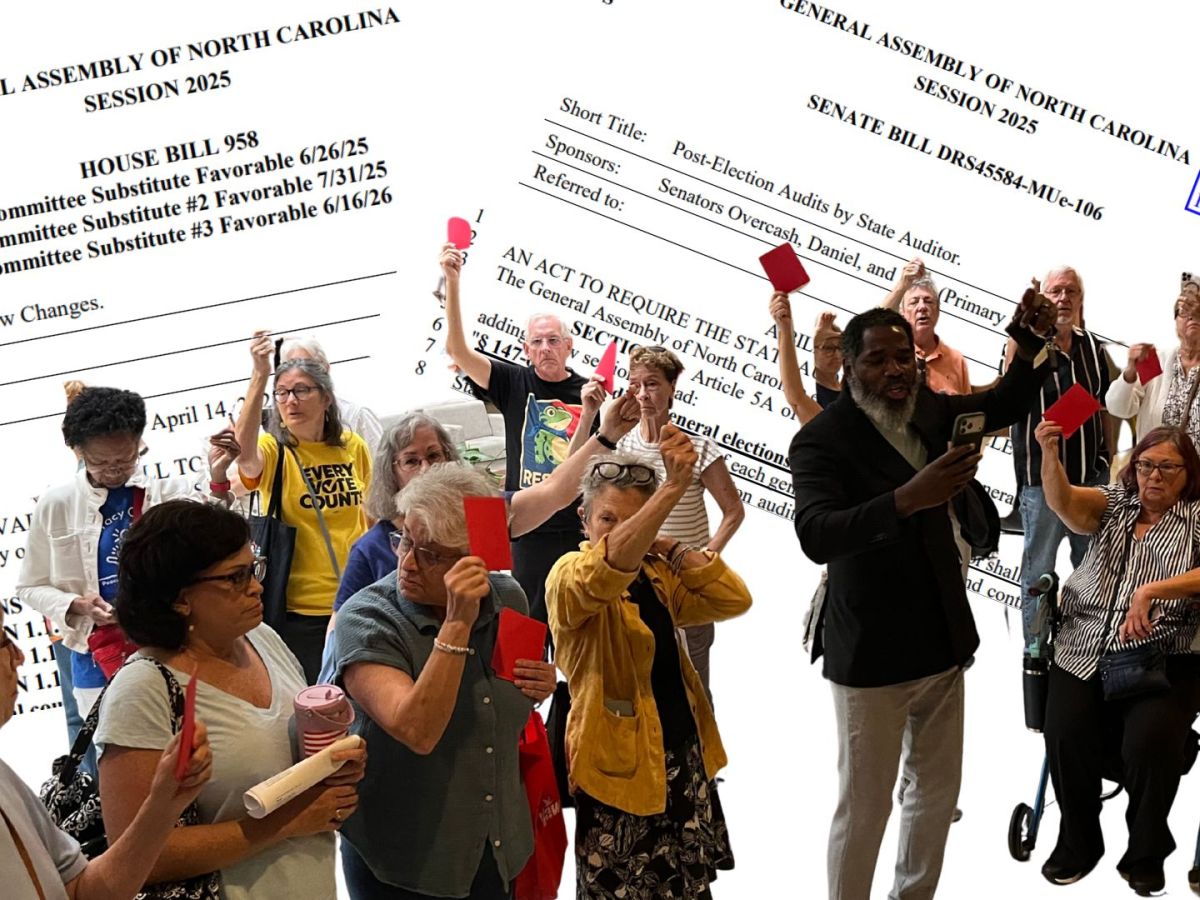
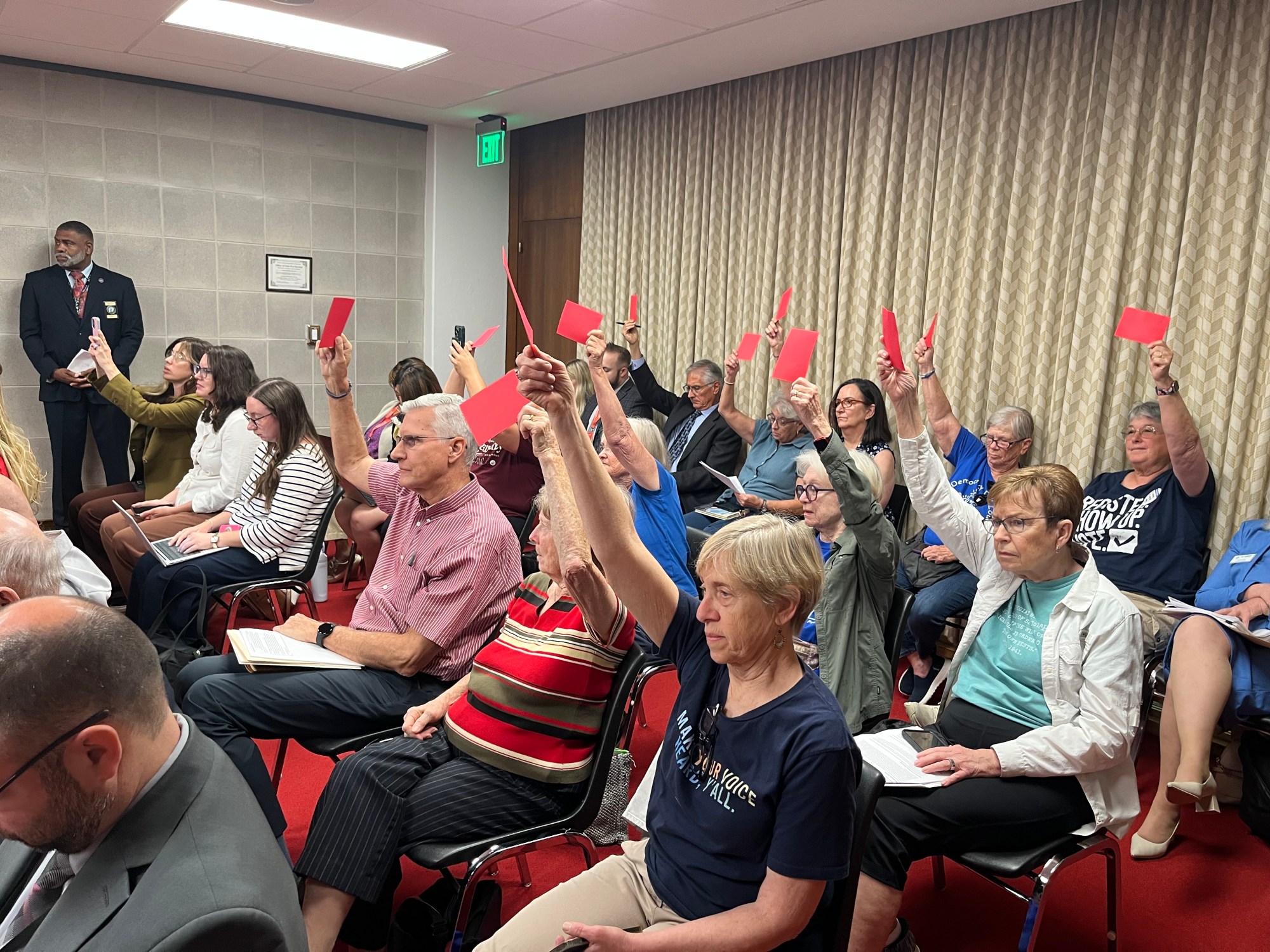
About 100 people assembled inside and outside the legislature Tuesday, holding up red cards like World Cup referees in disapproval and shouting “Shame!” as lawmakers in the House Election Law Committee voted on the measure. But it’s now not clear when legislators will come back to it.
On Wednesday, three Republican senators filed a separate bill that duplicated the House bill only on the provision giving the State Auditor more power. The Senate version does not include any other changes, an indication that Republicans in the Senate might support at least that part of the bill.
How would the House bill change voter challenges?
The 36-page bill overhauls multiple parts of North Carolina election law.
Among some of the most notable changes are provisions that extend the deadline for voters to challenge certain ballots and mandate the use of federal databases to identify and remove ineligible or deceased voters.
Those provisions raised concerns from some Democrats on the committee, who argued the bill could erroneously remove eligible voters from the rolls or toss out legitimate ballots.
“If there’s an issue with registration or ineligibility, it seems like that should be raised when they register at the State Board [of Elections] or at their county boards of elections, rather than telling them after they voted all of a sudden their vote gets kicked out,” state Rep. Pricey Harrison, a Democrat from Guilford County, said during Tuesday’s committee meeting.
Responding to Democrats’ concerns, state Rep. Hugh Blackwell, a Republican from Burke County, presented the bill as a measure that would ensure accurate ballot counting.
“Certainly we’re not trying to put up obstacles so much as to do what we can – to improve where we can – integrity of the voting process,” Blackwell said.
How do the proposed bills change the State Auditor’s powers?
The bill would give Republican State Auditor Dave Boliek the authority to conduct post-election audits at the county level.
The State Auditor could review voter rolls, ballot records, poll books, and equipment testing among other documents related to election security, though the auditor’s findings could not be used to challenge the outcome of an election.
“Post-election audits focused on the processes and procedures of elections will help improve confidence in our system of voting,” Boliek said in a statement provided to NC Local. “This is common-sense electoral policy that will deliver additional accountability and transparency to voters across North Carolina.”
Rep. Blackwell told the committee that provision is meant to be an assessment of the election process, not a tool to overturn election results.
But Democrats, including state Rep. Phil Rubin of Wake County, noted the State Auditor is a partisan official who could pick counties to audit based on where his party’s candidates or Boliek himself did poorly in an election.
“I know the statute says it won’t affect the outcome of an election,” Rubin said. “But going into a county afterwards as a member of the group running for office and grabbing their ballot boxes is going to send a message.”
What can elections officials say publicly and how might that change?
Members of the state or county boards of elections are currently prohibited from supporting any candidate for office or soliciting donations for political committees.
But the proposal in the House would prohibit them from making public statements intended to get voters to the polls.
The measure says state and local board members shall not “make written or oral statements intended for general distribution or dissemination to the public at large encouraging or promoting voter turnout in any election.”
This provision raised questions among committee members about free speech and the duties of elections officials.
“For them to be engaged in turn out the vote efforts runs the risk that somebody feels the board in charge at the time is targeting constituencies favorable to it,” Blackwell said. “But we may be looking at some further revisions to this section to try to make sure we don’t step on the legitimate rights of individuals, especially at local boards, to have freedom of speech, as it were.”
What’s happening now?
Democrats have repeatedly criticized Republicans for how quickly the bill was being pushed through the state House.
“This is a bill that we should have a draft three weeks in advance, two weeks to debate changes and tweaks among members, a week for the public to have notice of the final version of the bill, and then a two-hour or three-hour committee hearing with at least an hour set aside for public comment,” Rubin said.
The House Election Law Committee set aside 50 minutes for Tuesday’s meeting and did not have time to hear public comments, according to committee vice-chair Rep. Ted Davis, Jr., a Republican from New Hanover County.
Democrats were looking to stall the bill through legislative procedural maneuvers that would delay a vote, but they can not block it. House Speaker Destin Hall told reporters he expected the bill to be on the House floor Wednesday, but it did not come up for a vote.
Share your thoughts
You can also reach out directly to your representative. Find out who represents you and their phone number and email here.