

Local election board members across North Carolina have promoted conspiracy theories, including the lie that the 2020 presidential election was stolen from President Donald Trump.
Some who shared false claims even chair county election boards, which make important decisions about Sunday voting, polling locations and voting hours.
Traditionally, election administration in North Carolina was largely a nonpartisan, uncontroversial job. But since Trump repeatedly claimed his loss in 2020 to former President Joe Biden was “rigged,” such conspiracies have become increasingly common — including among some people who now decide how elections are run.
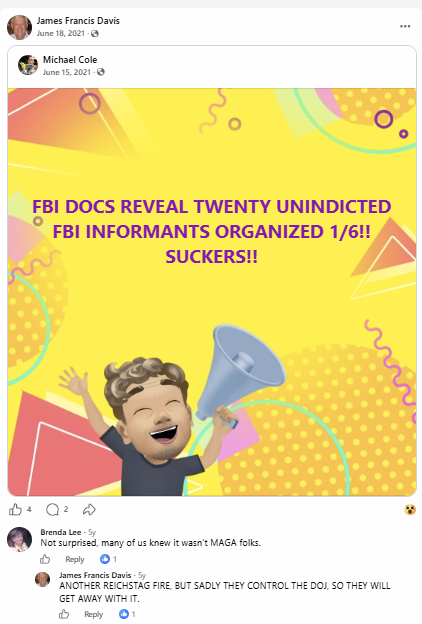
“President Trump understates the massive voter fraud,” Republican James Davis wrote in a December 2020 Facebook post. “I saw how easy it was as a poll observer. Since the civilian courts are too chicken or corrupt to listen to the evidence, he must invoke the Insurrection Act to save this country from the CCP and corrupt judges and politicians. There he can get a hearing of evidence in the military courts and traitors can be tried for colluding with enemies of the USA to take over the US government.”
Davis now serves as chair for the Clay County Board of Elections, a role he was appointed to in 2025 by State Auditor Dave Boliek. Davis was a board member before his appointment as chair, he said.
In phone interviews with NC Local last month, Davis shared that he believed FBI agents in the crowd instigated the Jan. 6, 2021, riot at the U.S. Capitol. He stressed that his post calling on Trump to use the Insurrection Act predated his time on the board.
“Do I believe there was fraud in elections? Yes,” he said. “Have I seen evidence of it? Yes. Do I think that there was an attempt to demonize supporters of Trump? Yes… I imagine you were told to find something on me, you know, to brand me as an ‘election denier,’ which is silly. I don’t deny any elections. I just said there was some fraud.”
While he has looked into “duplicates” on Clay County’s voter rolls, he said he found no evidence of widespread fraud at home.
“I don’t know that now. I have no proof,” he said.
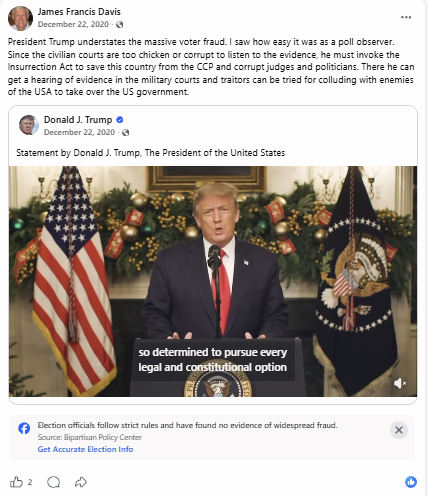
Davis and 17 other county election officials are flagged as “identified actors of concern” by Voting Rights Lab, a nonpartisan nonprofit that tracks legislation and advocates for expanded voting access. The group’s file on Davis included his Facebook posts.
Voting Rights Lab considers all 18 officials it listed election deniers, a spokesperson for the nonprofit said in an email. (One official who was listed is no longer on his county’s election board.) Voting Rights Lab applied the label to people for a range of reasons, from promoting the claim that the 2020 presidential election was stolen to having an American Patriot Party profile picture.
The 18 officials cited by the group include chairs of local boards, a position historically appointed by the governor. In 2024, the Republican-controlled legislature passed a law moving the appointment power to the state auditor. In June 2025, Boliek switched local board control to Republicans in all 100 counties.
Voting rights groups and Democrats have accused Boliek’s office of injecting partisanship and political scheming into North Carolina’s elections, especially after one of his then-employees — Dallas Woodhouse, a longtime state Republican Party operative — instructed county election board members to take certain positions on early voting plans and Sunday voting.
For this story, NC Local requested an interview with Boliek, a request which his office did not grant.
Boliek’s spokesperson, Randy Brechbiel, also did not answer emailed questions about whether the state auditor was familiar with Davis’ and other chairs’ beliefs before appointing them, his vetting process or whether Boliek himself believes the 2020 presidential election was stolen.
“Since taking office as state auditor, I’ve made increasing transparency a top priority,” Boliek said in a recent video address to the North Carolina Press Association.
What other board members said, did
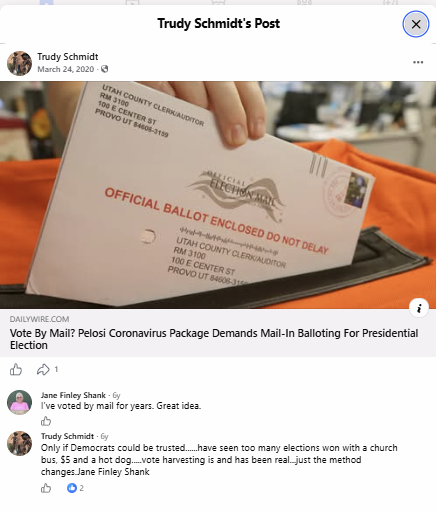
Haywood County Board of Elections Member Trudy Schmidt shared Facebook posts that claimed someone drove “thousands of ballots” from New York to Pennsylvania, and that social media censored right-wing commentator Dinesh D’Souza’s documentary that claimed Democrats conspired to steal the 2020 presidential election, “2000 Mules.”
The film was debunked widely. Arizona’s then-attorney general, a Republican, recommended that federal law enforcement investigate the group behind data that was cited in the film. The documentary’s publisher apologized to a man featured in it who was falsely accused of voting illegally. D’Souza also apologized to him.
Schmidt declined to comment for this story.
Henderson County Board of Elections Chair Linda Rebuck was listed as an identified actor of concern by Voting Rights Lab after she claimed in an email to lawmakers that a statewide effort to undermine the 2024 election in favor of Democrats was underway. Rebuck was a board member then, not chair.
The director of the state board of elections at the time reprimanded Rebuck in an email and told her the claims she made were false, misleading and partisan enough to perhaps violate provisions under state law.
During a meeting in January 2025, the state board ultimately declined to order discipline for Rebuck, The News & Observer reported. In June 2025, Boliek, the state auditor, appointed Rebuck chair.
“It is true that a complaint was filed against me with the State Board,” Rebuck said in an email to NC Local. “I had written a letter as a private citizen using my private email to my state representatives expressing my opinion about possible legislation. I have that right based on the First Amendment as long as the appropriate rules and laws are followed. In fact, the complaint was dismissed by the State Board without reprimand or comment.”
Another official in Mecklenburg County, who did not respond to a request for comment from NC Local, was flagged by Voting Rights Lab for once voting against certifying an election’s results.
Election administration became politicized in the controversy surrounding Bush v. Gore, and then “ramped up” in 2016, Western Carolina University Professor Chris Cooper said.
“We just didn’t see anything like that before,” Cooper said, commenting on the phenomenon generally and not any particular board members. “That didn’t mean that people didn’t make claims. There were claims of stolen elections going back to the history of the country, but it just didn’t have the same clear partisan sort of lens that it does today.”
It is not unique to North Carolina, he said, and there are more extreme examples of it in places like Arizona. There are also more people paying attention now and thinking to check county election officials’ social media posts, he said.
Activist spent years questioning NC elections before appointment
Lee County’s Jay DeLancy spent more than a decade as a “voter integrity” activist before he was appointed to his county’s election board last year. He also wrote a book, “Aliens Among Us: How non-US citizens have infiltrated America’s electoral process and what you can do about it.”
In a recent interview with NC Local, he said he believes that voter fraud in North Carolina is common enough to sway the results in at least some elections. He pointed to the narrowness of the 2020 state Supreme Court race, which was decided by just over 400 votes.
“Do I think there’s enough fraud to exceed that gap?” he said. “Absolutely, just in terms of, you know, pick your fraud. Is it non-citizens? Is it interstate double voting? Is it people who registered here and pass the registration off to somebody else to impersonate them? Things that the Wizards of Smart say never happens — but I have enough data points, enough evidence to suggest it does happen. And the only question is: How widespread is it?”
While 2020’s presidential election was not stolen from Trump in North Carolina, it “probably” was stolen elsewhere, he said.
Large-scale voter fraud is extremely difficult to pull off, The Elections Group CEO Jennifer Morrell said. Her organization partners with and advises election offices.
“Multiple layers of safeguards for every aspect of election operations and election administration are in place,” she said.
The exceptions often don’t look like the theories DeLancy and others have promoted.
In 2018, a notable outlier case of voter fraud occurred in Bladen County — an absentee “ballot harvesting” scandal in a congressional race. A new election was called, and multiple people involved in the scheme were criminally charged, including a political operative working on Republican Mark Harris’ campaign. Harris was not charged.
DeLancy’s methods for challenging ballots have long drawn criticism.
In 2012, his organization, Voter Integrity Project, brought the Wake County Elections Board 550 challenges of what he claimed were noncitizen voters, pulling from DMV and jury duty records.
Then-Chairwoman Aida Doss Havel said the board dismissed all of DeLancy’s challenges “for failure of the challenger to carry his burden of proof,” WRAL reported at the time. The meeting ended dramatically when DeLancy snatched his microphone off the board’s table in the middle of the meeting before kicking glass doors and exiting abruptly, according to WRAL.
Four years later, volunteers working with DeLancy sent hundreds of postcards to voters in Cumberland County and Moore County. When some of the postcards returned as undeliverable, it was used as evidence by DeLancy’s group that voters were not at their listed addresses, and county boards agreed to remove names from voter rolls.
A judge later found the decision violated the law and, in 2018, blocked the part of North Carolina’s law that allows the state to remove voters based on challenges without also following the federal waiting period or conducting individualized inquiry into the voter’s status, according to The Assembly.
In a text message to NC Local, DeLancy said the ruling was a “grave injustice to the citizens of NC.” “Leftists” sued the state but not his group, and they never had the opportunity to argue in court even as “our work was being used as evidence” against the state. Those who sued were lucky to have an “activist federal judge,” he said.
“I would add that all of our voters selected were in a complete colored blind and party blind manner,” he said in another text. “Somebody else, whom we never met, took similar actions in a totally partisan, and Race based manner that actually triggered the lawsuit. Then in a strike of brilliant deviousness, the plaintiffs added our actions to those of that other individual.”
DeLancy takes “severe umbrage” when people think his goal is to disenfranchise anyone other than “illegal voters,” he said in a phone interview.
He and the rest of the Republican majority on Lee County’s election board recently tried to eliminate Sunday voting. The local board could not unanimously agree on a plan, sending the final decision to the state board. The three Republicans and two Democrats there ultimately compromised, opening the polls on one Sunday in this year’s early voting process.
DeLancy told the state board at their Aug. 20 public meeting that Woodhouse “planted that seed” of getting rid of Sunday voting in a phone call between the two men. DeLancy told the state board he thought past court decisions required Sunday voting, but he said Woodhouse told him that was not the case.
DeLancy also said he did not want the county’s board to order election workers to violate the Fourth Commandment, to remember the sabbath day, “all because of politics.” Recruiting Republicans to work elections on Sundays was a challenge as well, he said.
Stacy “Four” Eggers IV, the state board’s Republican secretary, said at the meeting that he opted for the compromise plan because the county had used it before. The board’s two other Republican members and two Democratic members agreed, approving a plan with one Sunday of early voting for Lee County.
“I was very embarrassed about that because we had the majority, and we shouldn’t have failed,” DeLancy said of the failed plan to eliminate Sunday voting in a phone interview with NC Local.
He said that he has also tried to do more about “duplicate” voters in Lee County, but has run into administrative hurdles, even under the state board’s new Republican majority. When he raised four names that he thought should be removed from the rolls, the typical guardrails came up, he said.
“The state said, ‘Don’t do anything.’ And the excuse is some gobbledegook about, ‘We don’t know your process,’ whether discrimination was involved and just nonsense. The lawyers came forward with that. Just too many lawyers,” he said.
Asked about critics who are skeptical of the safety of their vote with him at the helm, DeLancy said he hopes they will see he is not so different from them.
He hopes others will get involved, too.
“People who are worried about any of this, they should pull up their sleeves and contact their board of election and find out what they can do to help administer our elections,” he said. “Because the magic solution isn’t all that secret. We need the citizens to take back the electoral process instead of the government doing it and us just trusting whatever the government says.”
What does it mean for voters?
The presence of people who espoused election conspiracy theories on local boards could contribute to making the state’s elections a fertile ground for manipulation, the Voting Rights Lab report concluded.
“A combination of close and competitive statewide and local elections, vulnerabilities and gaps in state law, and bad actors in positions of authority over election administration make North Carolina a high risk target for election manipulation in the 2026 elections,” the group found.
It is not cause to panic, an expert said.
“People should be aware, but their hair shouldn’t be on fire,” Cooper said of conspiracy theorists serving on the boards.
Election administration is a huge effort, manned by more than 500 election board members and hundreds of staff and volunteers throughout the state, he said.
“I think what that means is, it’s extremely unlikely and almost impossible for a small group of people to decide that they are going to ‘steal the election’ in one way or the other,” he said.