The Alamance-Burlington Board of Education is mounting, for the second year in a row, a challenge over the funding allocated by the Alamance County Board of Commissioners for K-12 public school funding.
Under state law, North Carolina school boards can sue county commissioners if they appropriate less money than the schools request. But first, the two boards must hold a mandatory joint meeting to try and reach an agreement. If they can’t, the boards go to official mediation. The final stage, if mediation fails, would either be a formal calculation of current expenses – formally known as the default funding formula, which can’t be legally challenged – or litigation in superior court for capital funding.
The school board requested a total budget of about $87.3 million for operating expenses, capital outlay and capital improvement projects for the upcoming year. The county’s 2026-2027 adopted budget allocated a total of about $73 million, with the largest difference in the requested funding falling under capital improvement.
In a vote during a special-called school board meeting on June 16 – a day after the budget passed – elected school leaders unanimously challenged the funding. The approved resolution claimed the amount the county allocated to the district is “not sufficient under N.C. Gen. Stat. 115C-431, or otherwise, to support a system of free public schools.”
“The Board of Education is advocating for investment in our schools for our staff and students,” Alamance-Burlington School System (ABSS) Chief Communications Officer Emily-Lynn Adkins said in an email. “The school system is seeking additional funding to maintain operations, retain teachers and staff, and continue the positive academic performance we have seen this year.”
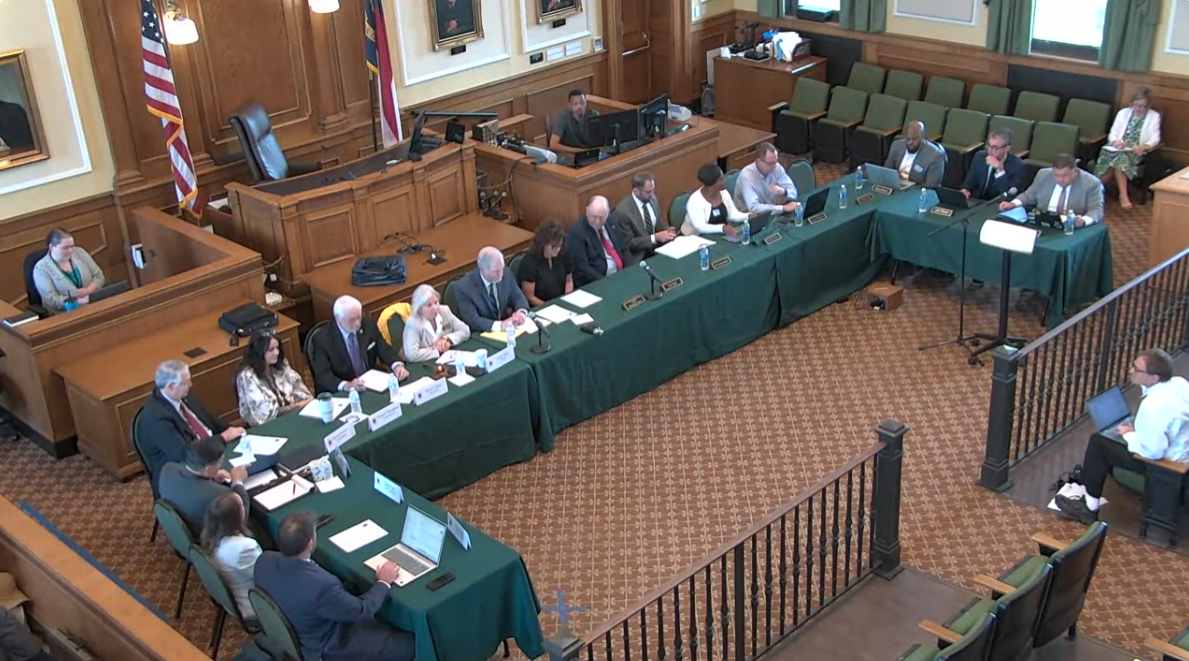
The county held a special meeting on June 18 where they convened a closed session with attorneys. The mandatory, joint special meeting between both boards followed on Monday and went into closed session. After nearly eight hours, both boards reopened the meeting.
Facilitator Greg McGuire, a professional mediator and former judge, said the “parties are at an impasse on current expenditures,” triggering the funding formula. On capital expenses, McGuire said he was “leaving the mediation open” so both boards could continue negotiating that funding another day.
Chair Kelly Allen and Adkins both declined to comment after the meeting.
This isn’t the first time ABSS has challenged the county over funding. Last year, the school board and county leaders held a joint meeting – without mediation – over a similar issue, which ultimately appropriated an additional $2.7 million to ABSS.
Here’s how we got here.
ABSS request vs. Commissioners’ allocation
The budget commissioners passed kept capital outlay and projects the same as the previous year.
Last month, Superintendent Aaron Fleming said the allocations – recommended by County Manager Heidi York – were far short of what was needed.
The funding shortfall, Fleming said, would strain the district’s ability to fund teacher salary supplements and make critical upgrades to school buildings, like HVAC systems and roofing.
Last month, York told The Alamance Fabric that to fill a projected gap and restrict using the county’s savings, the proposed budget included $23 million in cuts from requests across departments, including ABSS.
“[The cuts] get us in a place that gives us some stability and a sustainable course moving forward, where we’re not relying on our savings account,” York said.
During the budget presentation in May, York explained that, like last year, the county would still allocate about 40% of the budget to education while backfilling funds “not provided from the state.”
She highlighted that the school district’s funding was increasing by $1.5 million, or 2.5%, for operating expenses, even as enrollment had gone down by 212 students (1%) in the last year. The proposed budget also includes a $76.61 increase in local per pupil spending for a total of $2,328, she said.
What happens next?
The largest difference in funding requested and funding allocated is about $9 million in capital improvement. The parties are also at odds over about $2 million in capital outlay.
Monday’s mediation meeting to try to resolve those differences over capital funding will remain “open,” McGuire said, but the exact date for this continued meeting has not been announced.
State law defines how a county-school budget challenge is handled once formal mediation is triggered, according to the UNC School of Government:
- Unless both boards agree to make an exception, attendance is limited to the chairs, attorneys and finance officers from both boards, plus the school superintendent and the county manager.
- The county and the local school system split all mediator expenses in half.
- Any mediation meetings are held behind closed doors. By law, any statements made or actions taken during mediation are completely confidential and can’t be used as evidence in future lawsuits.
- Mediation will take place by August 1 unless both sides agree to an extension. If negotiations drag past this deadline, the county is legally required to temporarily fund the school system at the previous fiscal year’s baseline level.
The dispute over about $2 million in operating expenses will move to a calculation known as the default funding formula – the third stage of the dispute process under state law. The formula depends on the employment cost index report for the second quarter in the fiscal year, at the end of June. The final amount has not yet been determined.