

What you need to know
Chemicals called PFAS are widely used in consumer, commercial, and industrial products, and may be found in drinking water systems across the country. They can appear in water, food, air and soil.
PFAS stands for per- and polyfluoroalkyl substances, and they are called “forever chemicals” because they take a very long time to degrade in nature.
Exposure to forever chemicals has been linked to health issues, like increased risk of certain cancers, liver and kidney damage, and reproductive issues for people who are pregnant. Research is ongoing about how these chemicals might affect human health.
How long has this problem been going on?
These chemicals have been used since the 1940s in industrial and consumer products like nonstick pans and plastic containers. They can also be found in food products such as fish from contaminated water and dairy from livestock exposed to the chemicals. Other sources include food packaging, such as fast food containers and grease-resistant paper, and household products, such as stain repellant and water repellant for household cleaning. Paints, varnishes, and sealants may also contain the chemicals. Some shampoos, cosmetics and dental floss have PFAS, according to the Environmental Protection Agency, the federal agency tasked with creating rules around the chemicals.
State and federal regulators have been working to study and create safety standards for forever chemicals. Beginning in 2012, two EPA scientists in North Carolina began taking water samples in the Cape Fear River. Their work laid the foundation for 2017 when The Wilmington Star-News broke the news that a forever chemical called GenX was found in drinking water managed by the Cape Fear Public Utility Authority. The public water utility could not filter the chemical out of the drinking water.
Two Fayetteville area companies — DuPont, and later Chemours — had been dumping GenX, one of the types of PFAS compounds, into the Cape Fear River since the 1980s.
In 2019, The Cape Fear River Watch, a nonprofit advocacy conservation group, sued the state’s environmental agency, called Department of Environmental Quality, for not taking stronger action to regulate the issue. They also sued Chemours for violating federal law. The result was a consent order requiring the company to try to reduce the chemical discharge in the region.
The news in Eastern North Carolina led to mass testing on the Cape Fear River basin and other water sources where the public gets drinking water.
Where in North Carolina should residents be concerned about forever chemical levels?
The Environmental Working Group, a research and advocacy group, identified several water systems in North Carolina that contain high levels of forever chemicals including:
- Piedmont Triad Regional Water Authority
- City of Durham
- City of Greensboro
- Fayetteville Public Works Commission
- Brunswick County Public Utilities
Other regions that are dealing with high levels of forever chemicals include the lower Cape Fear region (near and downstream of Fayetteville), and Pittsboro and Burlington (on the Haw River).
The group also identified military installations that are linked to drinking water contamination, both on and off base. These include Marine Corps Base Camp Lejeune, Seymour Johnson Air Force Base, and Fort Bragg.
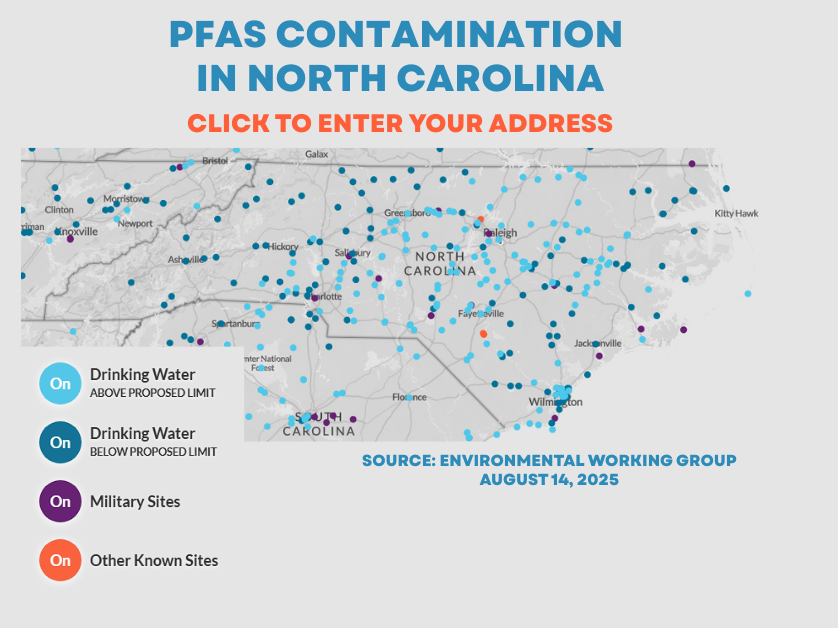
See if your area has contamination by entering your address at this map. Or enter your zip code here.
What are state and federal regulators doing about forever chemicals?
A federal agency, the EPA, establishes rules that govern the levels of forever chemicals that can be considered safe in drinking water.
During the mid-2010’s, manufacturers of some cooking products with PFAS agreed to a gradual market phase out. In the last few years, some companies such as Target and REI have pledged to phase out PFAS use in household items.
The Biden administration introduced stricter rules in 2024 to force water utilities to test for six PFAS chemicals: PFOA, PFOS, HFPO-DA (GenX), PFBS, PFNA and PFHxS.
The Trump administration rescinded some of the Biden-era rules, but EPA Commissioner Lee Zelden said this year the agency will enforce clean water rules and hold polluters accountable.
What can residents do?
- Check to see if you are in an area with contamination. If you are in an area with contamination, consider installing a certified water filtration system that can filter out most forever chemicals. Experts also suggest using alternative water sources (bottled water) for drinking or cooking.
- Replace nonstick pans with stainless steel cookware.
- Store food in glass containers and don’t drink out of single-use water bottles.
- Forever chemicals can be found in freshwater fish, fast food, and processed meats. Learn more about how to avoid eating products that may contain PFAS.
If you get your drinking water from a well, get your water tested regularly. Local health departments will conduct testing of existing wells. Find your local health department contact here.