

Western North Carolina’s 12,000 acres of national forest land set aside for long-term scientific research will be spared from the current federal reorganization that has already put 57 similar facilities at risk nationwide, NC Local has learned.
In total, there are 2 million acres of national forest in WNC, much of which is enjoyed by outdoor enthusiasts, hikers and conservationists.
The U.S. Forest Service announced in March that it will be moving its headquarters and reorganizing state operations, including research stations across the country. Under that plan, Western North Carolina’s four research stations aren’t changing but 57 research facilities are slated for potential closure across the country.
Randy Irwin, national president for the National Federation for Federal Employees (NFFE), called the restructuring plan “awful” and “ill-advised.” He said in April that the plan is “designed to indirectly and illegally carry out reductions in force, dismantle programs and ultimately privatize the critical work of the U.S. Forest Service.”
The reorganization moves the Washington headquarters to Salt Lake City, Utah, eliminates 9 regional offices, and establishes 15 state offices and five service centers. Some research operations are heavily impacted, affecting 2,700 employees across 31 states and numerous experimental sites, according to the NFFE.
What is happening with the restructuring?
In the restructuring, there will be a new regional Forest Service office called the Southern Appalachian State Office based in Athens, GA, which will cover Virginia, North Carolina, Tennessee, Georgia, South Carolina, Kentucky and Puerto Rico.
This restructuring will take place over the next year, according to a USDA spokesperson.
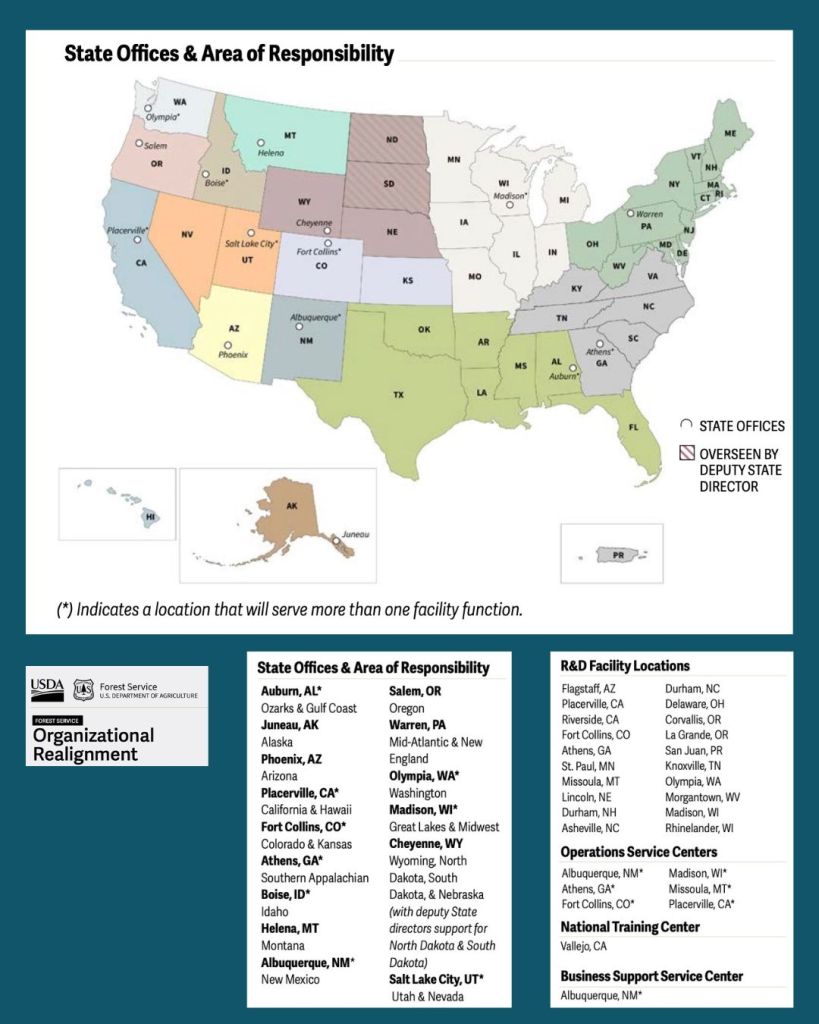
The Forest Service is also planning to consolidate “multiple research stations into a single, unified national Research and Development organization, headquartered in Fort Collins, CO, and led by one research director.”
As part of this reorganization, all Regional Offices will close. These additional facility consolidations and closures for this new organizational model are expected over the next two years, according to the USDA.
What about research facilities and experimental forests?
The Forest Service says it is not shutting down any of its experimental forests and ranges but instead closing “select facilities at some experimental forests.”
“The unfortunate reality is that our facilities footprint has surpassed our congressional appropriations, which is down $37 million from last year, and further complicated by a growing deferred maintenance backlog of $3 billion. By next year, these facility costs are projected to consume our entire program budget,” a USDA spokesperson told NC Local in an email.
“We also owe the American people an agency that is effective and respectful of their hard-earned tax dollars, and why we’re choosing to invest in our mission and our people instead of facilities we can’t afford.”
What about research facilities?
The Forest Service lists two research and development facilities in North Carolina that will continue to operate in Asheville and Durham.
The Southern Research Station Experimental Forests and Ranges Network consists of 20 experimental forests located across the southeastern region. The regional headquarters for 13 states is located at the Southern Research Station in Asheville. Additionally are three research stations in Western North Carolina: Bent Creek Experimental Forest, Coweeta Hydrologic Lab and Blue Valley Experimental Forest.
Here’s some information about each of the facilities.
- The Southern Research Station in Asheville is the headquarters for the USDA Forest Service Research and Development for more than 13 southern states. Its staff is organized into Science Centers and Research Work Units, and employs science technicians and other support personnel. Employees work at various locations throughout the region, including federal laboratories, universities, and experimental forests, according to its website.
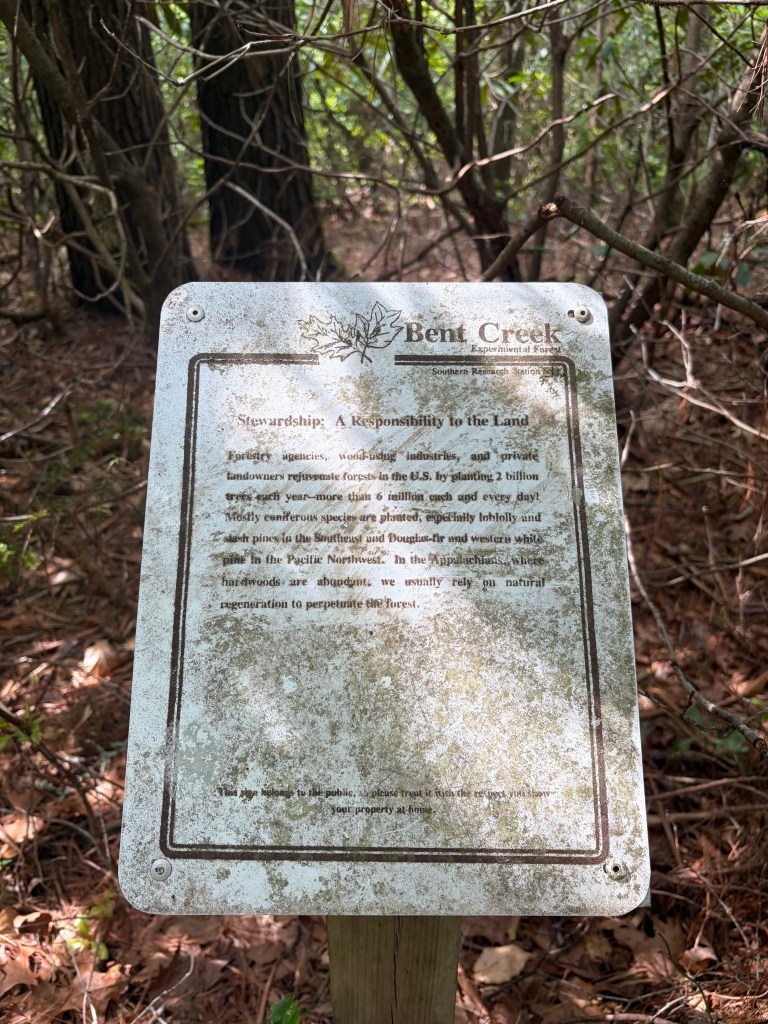
- Bent Creek Experimental Forest is the oldest experimental forest in the East, according to the Forest Service. The 5,242-acre facility was established in 1925 to study the impacts of a forest that had been logged. The forest is a favorite for hikers, mountain bikers, and other outdoor enthusiasts in Buncombe County because of its accessibility and miles of trails.
- Blue Valley Experimental Forest was established in 1964 as a 1,400-acre site for silvicultural research of eastern white pine and associated hardwoods, according to the Forest Service. The facility is located near Highlands.
- The valley where Coweeta Hydrologic Lab is located was first purchased by the Forest Service in 1918 and became part of the Nantahala National Forest in 1923, according to the Forest Service. A 5,482-acre site was set aside as the Coweeta Experimental Forest in 1934. That’s when the Civilian Conservation Corps built the original laboratory buildings, roads, climatic stations, and stream measurement devices to create the lab. It has been collecting weather data since the 1930s.
None of these is listed for closure.
In other states, research facilities that are identified by the federal agency as considered for closure could be impacted over the next two years, according to a USDA spokesperson.
Could the restructuring impact WNC?
Local environmentalists are concerned about the research stations, regardless of the current status of these facilities.
Will Harlan, Southeast Director for the Center for Biodiversity in Asheville, called the potential closures “tragic” in April. He still says that this restructuring could have negative impacts on local research efforts because “some of the people in these research facilities would keep their jobs, but the institutions may be reorganized, combined, or dissolved.”
Mountain True Resilient Forests Director Josh Kelly agrees and sees the reorganization as a misuse of valuable resources.
“The bigger impact is the disruption of the reorganization and the removal of logistical support from the regional office as the reorganization proceeds,” Kelly wrote in an email.
Both organizations were plaintiffs in a lawsuit about the land management plan for the Nantahala and Pisgah National Forests. A judge effectively threw out the 2023 plan in an April ruling.
N.C. Rep. Karl Gillespie (R-120) told NC Local that he has been advocating to keep Coweeta Lab in Macon County, which he represents, open.
“I know the federal government is looking at [restructuring] and making sure that the dollars that are allocated for that are justified. And that’s good. We need to do that periodically,” Gillespie told NC Local.
He agrees with the reconsideration but says that Coweeta’s long-term data is valuable to the nation.
“Being from Franklin, I’m most familiar with Coweeta, and there’s many years of data that Coweeta has provided that has been used on multiple occasions,” he said. “When you look [at the facility] by return on your investment, if that’s the only focus you have, that alone justifies that facility being there.”
He also pointed to the dorms and research facilities as valuable for the county.
“It’s so important that we have those types of facilities and hopefully that one will be there for many years to come.”
Sasha Schroeder also contributed to this report.