
As other counties in Western NC debate surveillance camera use, Buncombe County and Asheville officials continue to build a broadening web of advanced technology for law enforcement.
In May, the Asheville City Council approved a $1.14 million federal grant to expand the use of technology through creation of a real-time intelligence center (RTIC) at Asheville Police Department (APD) headquarters, according to Mountain Xpress.
U.S. Rep. Chuck Edwards requested the federal funding, which is managed through the U.S. Department of Justice.
The grant funding will cover $500,000 to build infrastructure including a “video wall,” $467,602 for Fusus digital intelligence software for 7 years and $173,754.50 for other operational expenses, APD interim chief Jackie Stepp explained in a May presentation.
“A real-time intelligence center is not a technology project. It’s a public safety function. It exists for one reason: to close the gap between what’s happening and what we know about it, so that we can act faster, smarter and more efficiently,” Stepp said at the meeting.
Stepp said Asheville Police Department policy is to purge all data every 30 days. By state law, data must be purged every 90 days unless it is attached to a case, she said. If it relates to a pending case, then the retention rules are dependent on the type of case and other defining factors.
During the May 12 city council meeting’s public comment period, many community members spoke against the additional surveillance.
“These systems are not secure,” commenter Catherine Bakewell said at the meeting. “The data can be accessed by bad actors who’ve been shown in the past to use them for dangerous purposes, and this level of surveillance is an invasion of privacy.”
Resident Dennis Campbell spoke in support of the expansion. Campbell said he has been in Asheville since “before the beer” and is currently part of APD’s Citizen Police Academy.
“I’ve learned that the police face challenges that people who want to participate in criminal behavior do not, such as the need to work within the law and the Constitution,” he said.
North Carolina Attorney General Jeff Jackson sent a letter in support of the intelligence center to Asheville Mayor Esther Manheimer who read part of it aloud at the meeting.
“Public safety and civil liberties are not opposing values and the framework APD has put forward is a serious attempt to hold both at once,” Jackson wrote in the letter.
The council voted 5-to-1 to approve the new center with council member and Asheville mayoral candidate Kim Roney as the sole vote against the measure.
APD spokesperson Rick Rice told NC Local the center will integrate police body cameras, Flock cameras and more.
“A Real-Time Intelligence Center (RTIC) brings our current technology and trained personnel together in one place, a real-time map connected to the dispatch system that helps us see what’s happening as it unfolds. It brings together video from public and private video streams, along with tools such as license plate readers, Axon body and in-car cameras, and drones, all in a single system to improve awareness and response,” Rice said in an email.
The system will also allow private camera input into Fusus through the doorbell registration program.
While much of the community focused on Asheville’s upgraded system, Buncombe County Sheriff’s Office (BCSO) has operated a similar intelligence system since 2023, according to Mountain Xpress.
A Sheriff’s office spokesperson told NC Local that the number of surveillance cameras in the county has “remained mostly unchanged” with 1,600 surveillance cameras in use since 2023.
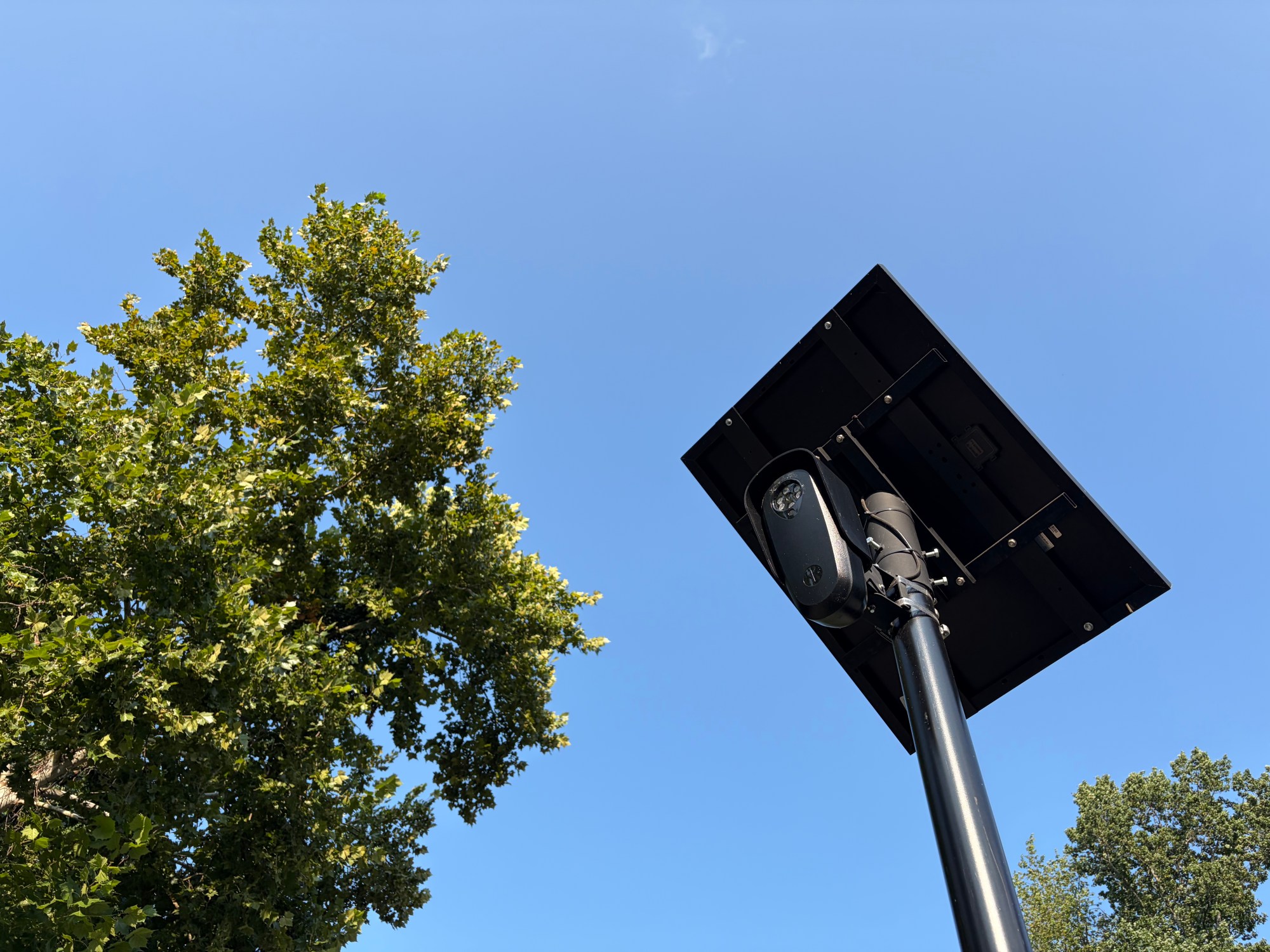
BCSO has 20 stationary and two mobile Flock automated license plate readers as well as 500 Axon body cameras and in-car cameras.
The office now shares access with hundreds of other law enforcement agencies across the country.
Buncombe County Sheriff’s Office confirmed that it has access to data from 3,187 agencies and is able to search within 1,159 other networks — an increase from 1,335 Flock networks in May.
The Sheriff’s office told NC Local it does not have an agreement on sharing access to its Fusus software or Axon technology. Fusus footage is retained for five years, per federal guidelines, according to a spokesperson for the Sheriff’s department.
The county also already operates a registered doorbell camera program which currently has 115 registered doorbell cameras in the county. APD proposed a similar program as part of their Real-Time Intelligence Center, which would be separate from the sheriff’s program.
Last week, Asheville was shaken by two shootings downtown which resulted in three deaths, BPR reported.
Rice said real-time intelligence can “significantly impact violent crimes investigations” but there are limitations.
The amount of impact depends on if the incident happens near cameras that are part of the integrated system or registered with APD.
“Full integration can provide immediate real-time information to responding officers,” Rice told NC Local.
He explained that investigators would be required to request footage from doorbell cameras but that it could eliminate “days of manual door-to-door canvassing.”
“We are currently in the policy development and community engagement phase,” Rice said. The department anticipates the center will reach full operational status in the spring or summer of 2027.
Learn more
The Asheville Police Department is offering bi-weekly Real Time Intelligence Center (RTIC) Tours & Education Sessions on Thursdays from 2–4 PM. If you are interested, please contact 828.259.5881 to schedule an appointment.
Check out part one of the series for more about how other communities in WNC are using surveillance technology.