
Whether you’ve filled up your water bottle or gone for a swim in Western North Carolina’s countless swimming holes, there’s a good chance the water was affected by a rule that local environmental advocates called “the most important rule you’ve never heard of.”
The Trump administration announced a final public comment period this month on the U.S. Forest Service’s plans to rescind the national 2001 Roadless Area Conservation Rule, better known as the Roadless Rule, a policy that received bipartisan support when it was enacted and precludes roadbuilding and development in more than 170,000 acres of North Carolina’s national forests.
The move, which enraged environmentalists and outdoor enthusiasts, could endanger the water supply for more than 1.5 million North Carolinians who get their drinking water from sources affected by roadless areas in national forests.
According to the Southern Environmental Law Center (SELC), if the rule is rescinded, more than 80% of North Carolina’s roadless areas would be open to roadbuilding, logging and development.
The rule keeps roads out of more than 172,000 acres of public lands in the state, mostly in the Pisgah and Nantahala National Forests. A portion of the Croatan National Forest on the coast is also protected by the rule.
A U.S. Forest Service spokesperson for the National Forests in North Carolina said rescinding the rule “will likely have minimal impacts on current management” because “steep terrain, remote locations and statutory limits generally make road construction in many of these areas impractical.”
Former U.S. Forest Service Chief Mike Dombeck, who oversaw the development of the Roadless Rule during his tenure, said rolling back the rule could have major implications not just for recreation, but also for the water supply.
“Particularly for states like North Carolina, the water is of the utmost importance, probably one of the highest values when it comes to the values of protecting roadless areas,” Dombeck said.
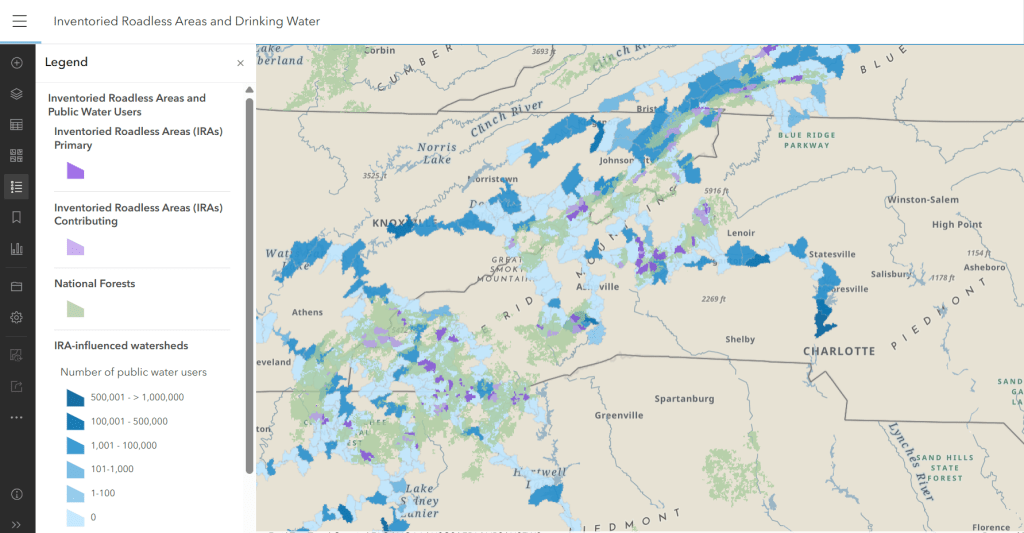
North Carolina is one of five states in the country with more than one million residents that receive drinking water from watersheds influenced by the Roadless Rule, according to a University of Washington study Dombeck co-authored.
“These roadless areas–they influence about 415 miles of streams that provide drinking water for about 1.5 million people,” Dombeck told NC Local.
Areas without roads help protect water sources. Road runoff can affect nearby bodies of water through particles released by wear from tires and pavement, metals from vehicular traffic and treatments for icy road surfaces. In forests, roads are the main cause of water quality degradation because they increase soil erosion and sediment pollution in nearby rivers and streams.
The original 2001 rule came into being because of the Forest Service’s huge road maintenance backlog, Chris Wood, president and CEO of Trout Unlimited, a conservation organization that protects trout and their habitats, said. Wood worked at the Forest Service with Dombeck and helped to develop the rule as thousands of miles of national forest roads were crumbling into nearby water sources.
The federal government is billions of dollars behind on maintenance of existing forest roads. The agency reported a maintenance backlog of $8.6 billion in the 2023 fiscal year, a number captured before Trump was reelected and began hollowing out and reorganizing the agency.
“It just doesn’t make sense to punch roads into these backcountry areas when you can’t afford to take care of the vast majority of roads you already have,” Wood said.
Water sources from within the Pisgah National Forest not only provide drinking water to cities including Asheville, Hendersonville and Charlotte, but also to Huntsville, Alabama, and large swaths of Tennessee. The Croatan National Forest has wells that serve residents in Carteret County in Eastern North Carolina.

Beyond the concerns for the drinking water supply, rescinding the rule could have economic impacts for taxpayers, Wood said.
“One of the major social benefits of roadless areas is that they help to reduce downstream water filtration costs because they act as a sponge, and will filter out nutrients and sediments so that municipalities downstream don’t have to do that,” Wood said.
Earth Economics, an environmental economics research nonprofit, found that Roadless Rule areas provide an estimated $32 million in water quality benefits alone each year in North Carolina.
Reporting from NC Health News found that getting safe drinking water to North Carolinians is already getting more expensive for water utilities because of old pipes, treatment plant upgrades and new pollution threats. Many utilities pass the expenses on to ratepayers.
Dombeck said national forests reduce the cost of providing clean water to people in lots of communities.
“Water is right at the top of the list in their value to the citizens of North Carolina, especially in local communities,” he said.
Why the change?
Trump administration officials said rescinding the rule is needed to facilitate wildfire suppression.
“Our forests can’t afford another decade of inaction,” Secretary of Agriculture Brooke Rollins said in the announcement. “Across the country, we’ve watched preventable conditions – overgrown stands, insect outbreaks and disease – turn healthy landscapes into tinderboxes.”
Rescinding the rule, administration officials argued, would allow for firefighters to move through areas more freely and remove vegetation that could feed fires, a process called hazardous fuel reduction.
But most fires are caused by humans and a recent study showed wildfires are four times more likely to start near a road than in roadless areas. The Forest Service’s research showed “that a lack of roads has not stopped fire prevention measures; fuel management activities in roadless areas have actually been more numerous on a per-square kilometer basis than elsewhere in the National Forest System.”
The Trump administration’s own documentation confirmed the link between roads and fires in the Forest Service’s draft environmental impact statement (DEIS) issued this month.
“Road density is linked to human-caused wildfires, and as the density of roads increases so does the probability, number, and frequency of wildfire ignitions,” the statement said.
The statement also said not all the roads would be open for public access, and the risks could be mitigated through “wildfire prevention programs, including public education efforts and road-access restrictions,” and that “the high cost of road building and declining budgets for road construction and maintenance” mean the overall increase in wildfire prevention treatment capacity “would be modest.”
“They indicate that from an economic standpoint, there’s no gain at all, in fact it’s a loss,” Dombeck said. “If it’s not broke, don’t fix it.”
‘A way of life’
Some environmental advocates said the wildfire risk is a pretext for a larger agenda.
The whole purpose for getting rid of the Roadless Rule is to expand timber production, Sam Evans, senior attorney and leader of the national forests and parks program at SELC, said.
Last year, Trump called for a 25% increase in timber production in national forests.
“We’re not going to let all of them be developed for those kinds of extractive uses so that people who don’t even live there can increase their shareholder value,” Evans said.
In response to the Forest Service’s claim that rescinding the rule will likely have minimal impacts because steep terrain and remote locations would make road construction impractical, Evans said the agency has logged on terrain that is much steeper than the land found in most roadless areas, like at Courthouse Creek.
Supporters said losing the rule will fundamentally alter the landscape in Western North Carolina, bringing about negative changes for outdoor enthusiasts.
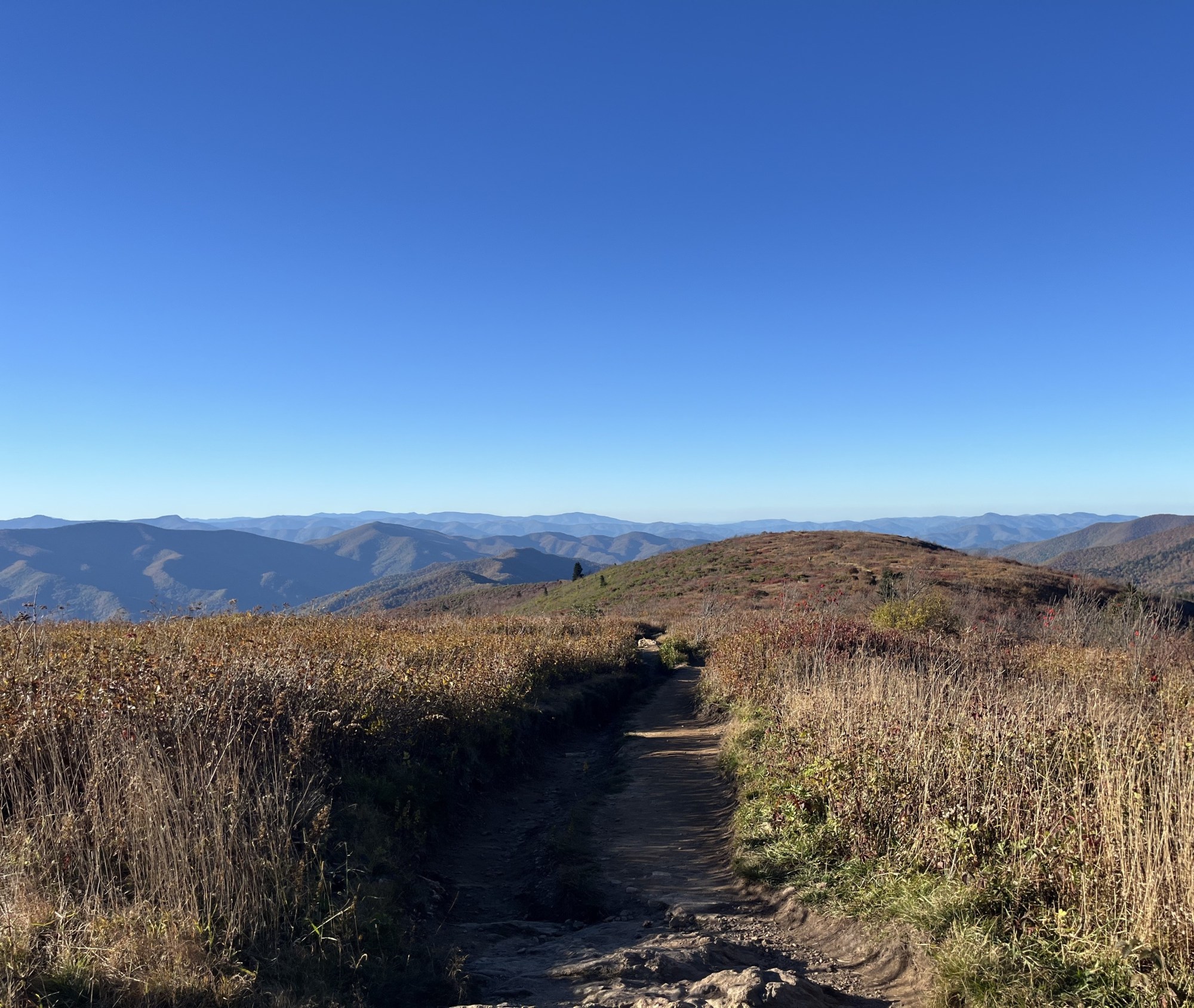
“The roadless rule is really what created the backdrop for Western North Carolina’s outdoor economy,” Evans said. “If you’ve ever driven on the parkway past the Pisgah Inn and sort of looked out at that beautiful rolling terrain at the funnel top overlook or any of those overlooks on the Blue Ridge Parkway, you’re looking at a roadless area. And the reason that it looks the way it does, the reason that you could park your car and hike for hours without hearing motors or seeing people driving by, that’s because of the roadless rule.”
Roadless areas are enjoyed by thousands of outdoor enthusiasts, who flock to the national forests to hike, bike, fish, and hunt. Dozens of at-risk species make their home in North Carolina’s roadless areas, and according to the Wilderness Society, roadless areas support 260,000 jobs and bring in $1.3 billion in state and local tax revenue in NC.
Western North Carolina environmental advocacy nonprofit MountainTrue has been holding “People’s Public Hearings” around the region to educate the public about the rule and encourage people to submit official public comments.
Beyond the importance of the national forests for recreation and the economy, MountainTrue Organizer Donovan Green said the rule protects spaces that represent a way of life for many in Appalachia.
“I was raised in Appalachia. My grandpa taught my dad how to hunt on the same mountains that my dad taught me. And there are a lot of people in Appalachia who are so deeply connected to the land in that way, and this is a way of life for them,” Green said. “Without being able to have any say over what we do with our own public lands, I feel like it’s just a slap in the face.”
Wood said that for him, being able to get out into the backcountry is important to the basic identity of what it means to be an American.
“These are what’s left of the lands upon which the character of the country was hammered out,” he said.
How can I weigh in?
The final comment period on the proposed rescission is open through September 21. The Forest Service is legally required to respond to significant, relevant comments.
Electronically (preferred)
Through the Federal eRulemaking Portal, or go to regulations.gov and enter docket number FS-2025-0001 or RIN 0596-AD66.
By mail
You can mail a postcard to this address:
Director, Ecosystem Management Coordination
201 14th Street SW, Mailstop 1108
Washington, DC 20250-1124
Read more
- USDA statement
- Read other comments
- MountainTrue developed roadless.org, a comment writing tool that educates people about the arguments made for and against the rescission and guides users through making substantive comments.