

A limit on the ability of local governments to levy property taxes could become enshrined in the state constitution this November when voters opt to approve or reject a proposed amendment: “Constitutional amendment requiring limits on property tax increases by local governments.”
The measure doesn’t specify the cap, leaving it to the legislature if it is adopted. Property taxes are a key funding stream for county governments, but mounting property values in recent years have caused a spike in costs for homeowners.
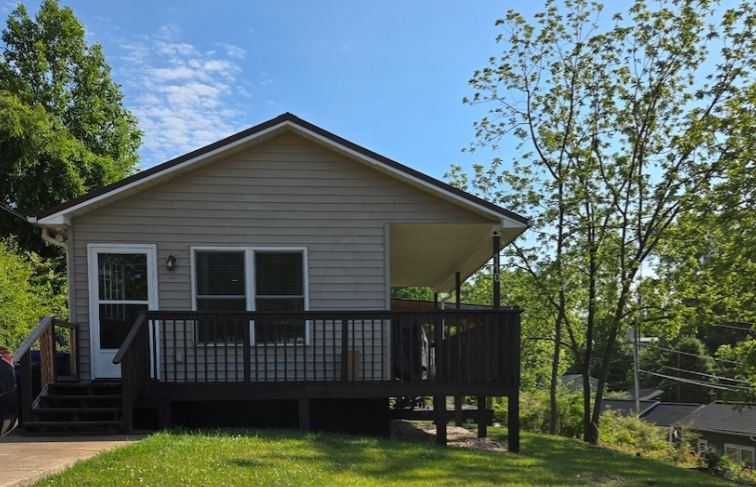
Randy Stallworth, a Transylvania County resident, has been fighting a case linked to property tax reappraisal since 2025. He is poised to lose his late mother’s house, in part, because of the increased property value.
He told NC Local he paid off the mortgage, but the increased property taxes remain a burden such that he still isn’t sure if he will be able to keep the house.
He said Medicaid filed a claim against the new property value to repay her medical debt.
“We won the case then they filed an appeal. So it ain’t over yet,” Stallworth said.
“I don’t know. It’s just it’s all a little too much, but I’m still fighting,” he said.
Stallworth told NC Local he hadn’t heard about the property tax levy limit constitutional amendment. He isn’t sure how this will affect his day-to-day struggle to keep his family home.
“They don’t even know the stress they got me going through, because I don’t know if I’m going to have a place to live and then if I’m going to be able to afford something else. You know what I’m saying? After being here damn near all my life,” Stallworth said.
How are property taxes used by local governments?
Property taxes are the primary source of unrestricted revenue for counties and municipalities, professor Chris McLaughlin, a local taxation and property tax expert at UNC-Chapel Hill, explained.
“They’re supporting the spending of local governments. In general, property taxes provide about 50% of your average county revenue and somewhere between 25% and 40% of municipalities’ revenue,” he said.
Property taxes are determined by taking the appraised value of the home and multiplying it by the tax rate.
Every local government is permitted to levy property taxes. All 100 counties levy property taxes and about 90% of municipalities also levy property taxes, McLaughlin explained.
Under current state law, local governments are limited “generally to a maximum rate of $1.50 per $100 of value,” and no local government has set its tax rate that high, according to the North Carolina Housing Coalition.
“Oftentimes, some of those small municipalities levy at a very small level, just a few cents perhaps. They are taxes that are termed ad valorem taxes. They are based on the value of our property,” he said.
At present, Scotland County has the highest rate at 99 cents for every $100 of appraised value, while Macon County has the lowest rate at 27 cents for every $100 of appraised value.
Properties in North Carolina are generally required to be revalued every eight years. The state Department of Revenue recommends counties revalue properties at least every four years. Since 2020, property values in most areas of the state have jumped, causing a spike in property taxes for longtime homeowners.
The more to put the property tax measure in the state constitution comes in the midst of several legislative measures to address rising property taxes.
“I do think the driving concern, frankly, was local government spending. That there are people at the General Assembly who don’t approve of some of the spending decisions being made by local governments,” McLaughlin said.
In December 2025, the N.C. House of Representatives formed a special study committee to look at issues related to property taxes.
This summer, Republicans moved forward with Senate bills 889 and 474 to limit the ability of local governments to increase property taxes.
“The thought among the legislators who put that forward was that would give the legislature time to possibly come up with other measures about limiting the amount of a tax increase there could be and maybe, to put that on the ballot that if it were over a certain amount to make sure that voters had the ability to weigh in on that,” Sen. Kevin Corbin, R-Macon, told NC Local in May.
In the bills, counties that revalued properties in 2025 would be unable to use the new valuations in order to keep property tax costs lower for property owners.
Corbin added the exemption that allowed Clay County and two small coastal counties to use their updated revaluation because they planned to pass a revenue-neutral budget. The move left Buncombe as the sole county in the region that was impacted.
In July, Buncombe County commissioners had the choice to vote to pursue the exemption or fall under the property appraisal moratorium, despite the fact that the county budget had already been passed.
If the county fell under a property appraisal moratorium — it would be prevented from using 2026 reappraisal values — or it would have had to pursue an exemption by passing a revenue neutral budget. This would have resulted in an expected loss of $24 million in revenue, the Asheville Citizen Times reported.
Commissioners opted to use the previous 2021 valuations under the moratorium with a property tax increase to make up the difference.
Commissioners unanimously voted during a special meeting to increase the county’s property tax rate to 61.54 cents per $100 for fiscal year 2027, the Asheville Citizen Times reported. This maintained the expected property tax revenue with the prior values.
The county’s tax bills were sent out to property owners in August.
What a constitutional amendment would do
The constitutional amendment language doesn’t clarify any details about what the property tax limits would be, leaving it to the legislature.
“If it passes, that simply says, okay, it now enshrines in the constitution our agreement with the General Assembly to act at some point,” McLaughlin said. “That might be next year. It might be 10 years from now. Who knows? So we don’t really know what action they would take.”
The John Locke Foundation, a conservative think tank, released a report showing if a limit had been placed on taxation five years ago, property owners would have saved more than $5 billion.
Jackson, Swain, Cherokee, McDowell and Mitchell counties stood to save the most had taxation been capped five years ago, the report showed.
The progressive North Carolina Budget Center issued a statement opposing the measure, saying a cap “will likely erode public services, fail to address unaffordable property tax bills, and exacerbate inequities.”
McLaughlin said the proposed measure attempts to address a complex issue.
“Because by voting through a statewide cap, we’re trying to apply the same solution, the same rules in terms of limitations across the entire state when the issues might be very different from Murphy to Manteo,” he said.
At the ballot box
Want to weigh in on the amendment? Every NC ballot will include the proposed amendment language:
[ ] FOR [ ] AGAINST
Constitutional amendment requiring limits on property tax increases by local governments.
Make sure you are registered to vote. Check your status here.