

The N.C. governor’s advisory committee on Helene recovery met in Mars Hill to mark the second anniversary of the storm and assess the recovery process.
“You all live in your communities. You know that the work isn’t over. That’s why you’re here because you want to do everything you can for your neighbors, your friends, your family members, your business community,” Gov. Josh Stein said as he addressed the committee and attendees on Friday.
He said recovery would take years but that this should not be a reason not to move fast.
“We have got to maintain our focus. We’ve got to maintain our urgency so we accelerate this as fast as possible, because there’s a big difference between three or four years and six to eight years,” Stein said. “We want to make sure that we’ve done everything we can, as quickly as we can — and you all are doing just that.”
Here are five takeaways from the committee’s work:
1. Nearly all of the drinking-water systems impacted by the storm have been fixed.
Those living in Asheville vividly remember living without drinking water for 53 days after Hurricane Helene. Fixing the water systems across the region has been a key component of recovery.
During the meeting, Gov. Josh Stein reported more than $1 billion has been given in water and wastewater grants across the region. Additionally, 99% of affected drinking-water systems have now been repaired.
Stein explained how he sees GROW NC’s role in Helene recovery calling director Matt Calabria the “general contractor” whose job it is to “make sure that each agency is getting whatever pot of money, whether it’s from the federal government or from the state government.”
“Money in a community helps recovery,” Stein said.
He said that through the Department of Environmental Quality, the state has awarded more than $1 billion dollars for wastewater grants “to ensure the communities have clean, safe and reliable water.”
2. A new Helene recovery plan will focus on rebuilding the region’s economy.
Last week, the Governor’s Recovery Office for Western North Carolina (GROW NC) unveiled a new Helene recovery plan. The long-term plan for the 28-county region, Western North Carolina Economic Recovery Plan, focused on highlighting the unique assets in communities across Western North Carolina to reinvigorate the local economies.
The plan acknowledged that many local businesses relied on tourism after the loss of manufacturing jobs across the state over the last 30 years.
Former N.C. Secretary of Commerce Sharon Decker serves as GROW NC’s senior advisor for long-term recovery. Decker shared new the plan at the meeting.
“It’s not a new conversation but what I hope and I literally pray is that it will give us new wings and new lift to do it,” Decker said. Decker said the plan is “place-based, asset-based and community-based.”
Decker led development of the plan with the Long-Term Economic Recovery Subcommittee of the Governor’s Advisory Committee on Western North Carolina Recovery. David Jackson, president and CEO of the Boone Area Chamber of Commerce, and Dr. Laura Leatherwood, president of Blue Ridge Community College, co-chaired the subcommittee, according to the Governor’s office.
Decker said the projects outlined in the plan build on funds that have already been appropriated.
3. GROW NC said Helene recovery is going faster than recovery from any other U.S. hurricane in the last 20 years.
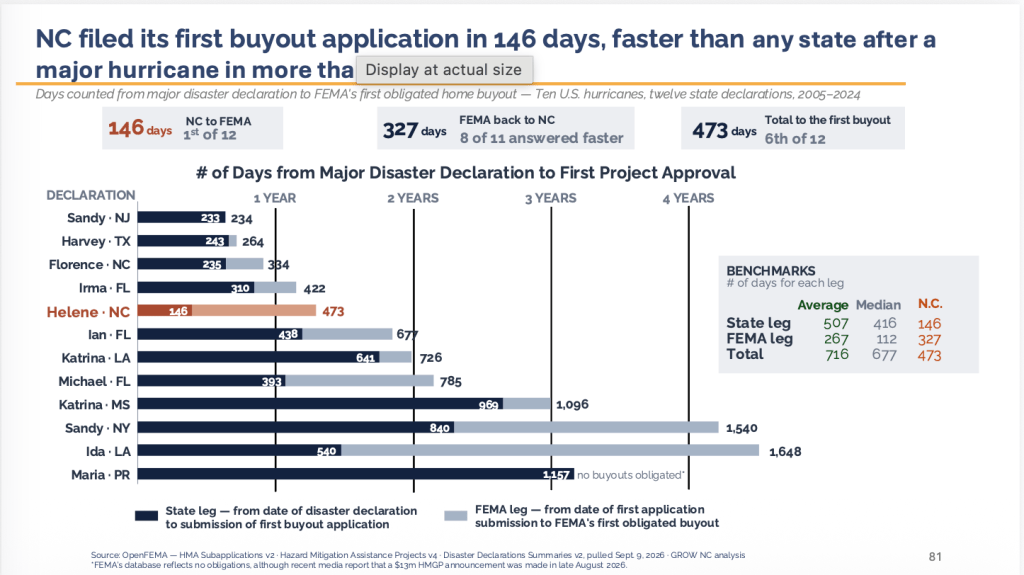
Calabria pointed to the speed that the state submitted its first buyout applications as an improvement over comparable storms in the U.S. over the last two decades. This chart highlights a dozen similar storms and how long it took until the first project was approved.
States typically take a year or more to start submitting the applications to the federal government, and then it takes FEMA a year or more to start approving and green lighting the applications before work begins, Calabria explained.
“By cutting more than half of that typical timeline off of [the state’s] portion, that enables people to get relief so much faster than they otherwise might have,” Calabria said.
However, he mentioned that for survivors on the ground, recovery can still feel too slow.
“We’re always mindful of that paradox that we know that we are moving as fast or faster than just about any program in the national experience. And yet, we know that it is still slow for folks who are waiting for assistance,” Calabria said.
4. Proposed programs require more funding than is currently available.
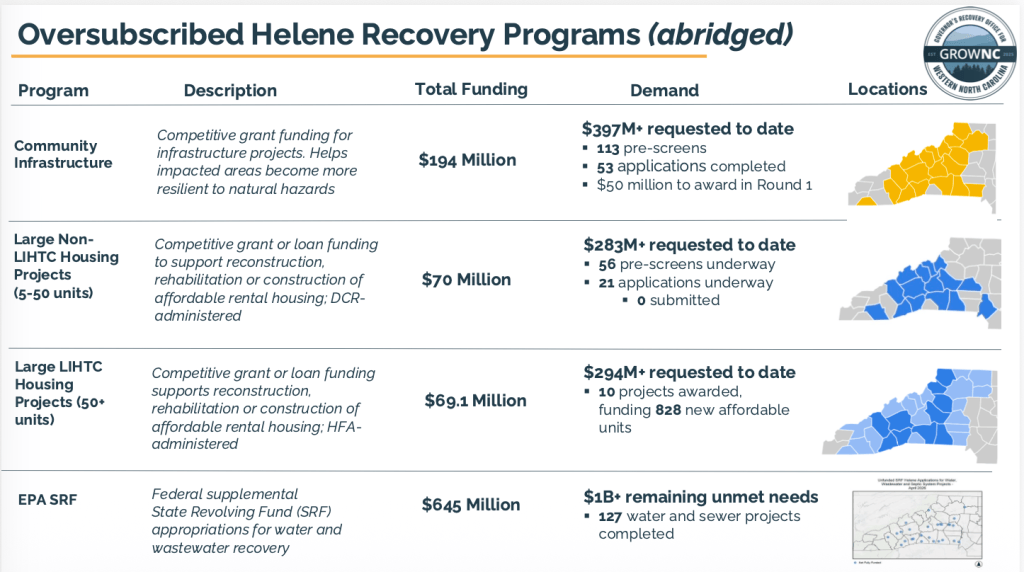
GROW NC shared a list of programs with more than $1 billion in needs. The chart highlighted millions of dollars in outstanding need in infrastructure and housing.
The 2024 storm caused more than $60 billion in damages across North Carolina. The General Assembly allocated $700 million for hurricane relief in the most recent state budget, and Stein said during the meeting that more than $3 billion has been allocated so far. Reporting on the total percentage of recovery funding has been unclear because while some money has been allocated, not all of it has reached the hands of people in Western North Carolina.
The Asheville Citizen Times estimated about $6 billion in recovery funding has been spent in the region so far, or about 10% of the total damage.
NC Local recently offered an analysis of federal funding received for home repairs, including $1.4 billion from the U.S. Department of Housing and Urban Development’s Community Development Block Grant Disaster Relief program, and $800 million for Renew NC Single Family Housing Program.
5. The region that encompasses the Foothills and Asheville was the only one in the state that saw a decline in tourism in 2025.
Visit NC, part of the Economic Development Partnership of North Carolina, divides the state up into 11 marketing regions including three regions in the western part of the state. The region with the storm’s greatest impact, which included Asheville and counties in the Foothills region of the mountains, experienced a 0.7% decline in tourism in 2025, according to Visit NC. Ten out of the state’s 11 regions experienced visitor spending growth last year. The High Country saw a 2.5% increase in tourism, a rebound for the area, but the region didn’t see an increase in jobs.
Marlise Taylor, director of tourism research at Visit NC, explained tourism in 2025 was a bit “sluggish” overall with visitors spending about $37 billion directly in North Carolina, a roughly 1% increase from the previous year.
“We know that some of that was probably hurricane-related, but you know, with other economic concerns, geopolitical things going on,” Taylor said during the meeting. Job numbers still aren’t back to pre-pandemic levels in the state, she added.
Far-western North Carolina was the least impacted by the storm. Visit NC found that Cherokee and Macon counties saw an increase in visitor spending during 2025 with about 14% and 11% increase respectively.
Visit NC expects an increase in tourism this year as more attractions have reopened, including the Blue Ridge Parkway. Much of the parkway is open, but there are still a few dozen miles that are closed for reconstruction. The entire parkway is set to be reopened at the end of 2026.