

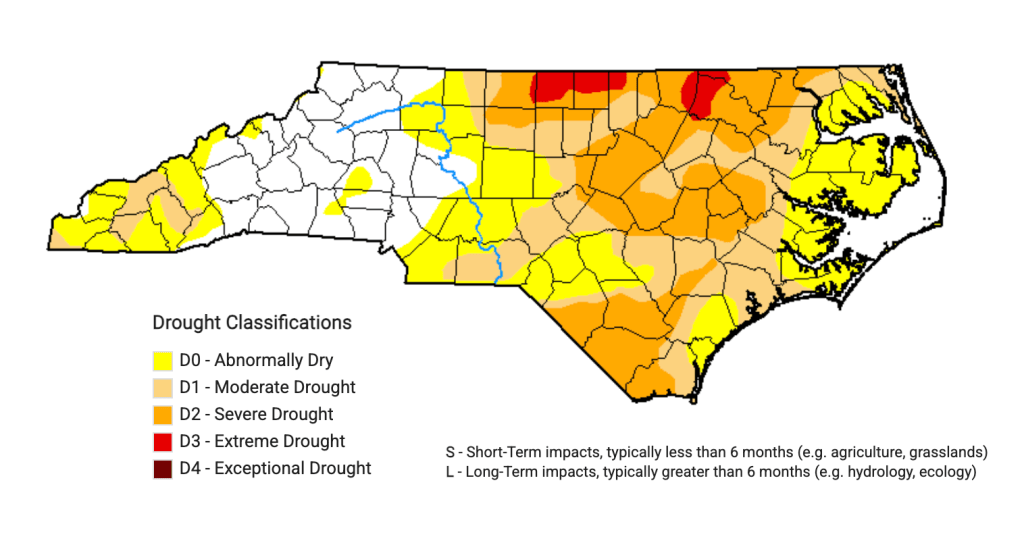
Four North Carolina counties are facing extreme drought conditions, prompting state and local leaders to ask residents to conserve water by using it for critical needs only.
Residents in Caswell, Halifax, Person and Warren counties are experiencing the worst drought conditions in the state. But almost every county in the state — nearly 80 in all — is also in need of more water, ranging from severe drought to abnormally dry conditions.
In Guilford County, Greensboro city leaders enacted Stage I of voluntary water conservation measures beginning Oct. 14. Water levels in the city’s reservoirs had declined to 63% of total storage capacity, according to WFMY News 2.
Greensboro residents have been asked to make several changes, including limiting showers to five minutes or less, turning off faucets while rinsing dishes or brushing teeth, using disposable dishes when possible and installing water-saving showerheads and other water-efficient devices, among other changes.
In Durham County, the Lake Michie Park and Marina has been closed to public recreation and boat launches for nearly four months as the drought has exposed much of the lake’s shoreline, WTVD reported.
Drought coverage from around North Carolina:
- North Carolina farmers struggle as drought, diesel prices, and tariffs threaten 2027 planting season (WFMY)
- Remnants of Hurricane Isaias wash away drought in foothills (WUNC)
- Greensboro begins Stage 1 water conservation as extreme drought strains supply (WXII)
NC Local spoke with Klaus Albertin, chair of the state’s Drought Management Advisory Council, to get the latest updates on North Carolina’s water needs. The council meets weekly to submit its recommendations for the U.S. Drought Monitor map.
The group monitors things such as rainfall, streamflow, groundwater levels, soil moisture, water storage in reservoirs, municipal water restrictions and more. Each member has expertise in different areas, such as meteorology, hydrology, water system management or emergency response.
NC Local’s conversation with Albertin has been edited for length and clarity.
What is the current state of the drought in North Carolina?
I would say we’re in a moderate drought, with a few exceptions. It’s gone on so long, even though our current rainfall has been fair. Obviously, Kerr Lake (along the north-central border of North Carolina and Virginia) is down. It’s about 10 feet down. Falls Lake (in Durham, Granville and Wake counties) is a little bit over four feet down. So for those areas, it’s still pretty severe.
Most of the impacts from the drought, especially to agriculture in eastern North Carolina, made themselves known in the spring and the summertime. So agriculture, they’re just getting into the harvest period for a lot of crops, and so they’re going to start assessing exactly how bad it was.
What have you been hearing from farmers about how this is impacting them?
They knew that yields were going to be less than normal, just because some places put off planting for as long as they could, hoping that the patterns were going to change. Soil conditions were already dry by March and April, so they didn’t want to spend a lot of money planting if there wasn’t going to be any rainfall coming up.
Some places just didn’t end up planting. Some kind of switch crops to things that they could plant later or that didn’t need quite as much water. But, definitely, yields are going to be lower, mostly in eastern North Carolina.
Are there certain parts of the state that you’re most worried about right now that are experiencing some of the worst drought conditions?
Yeah, the north Triad and north Triangle haven’t gotten some of the heavier rains. July was a good month. It really improved most of the state. But August and September have been drier than normal, so those are areas of concern.
Different utilities get water from different places, and so we’ve had a situation since July where Jordan Lake got some higher rains, and they’ve got a bigger drainage area that comes in. So Jordan Lake actually got back up to normal in July. They’ve kind of come down a little bit since then, but systems that get water from Jordan Lake are actually in decent shape.
Systems that get water from Falls Lake [Raleigh and surrounding areas] are in a little bit worse shape because they didn’t get that water. So that’s why it’s really important for people to look at their utility to see how things are.
How do you make decisions about what level of drought we’re in, whether it’s extreme, exceptional, moderate, etc.?
[It depends on] what kind of impacts we’re seeing, how long an area’s been in drought and how big a deficit they’ve gotten. So, it develops over time. We don’t go from normal to severe drought automatically. You have this progression of normal to abnormally dry to moderate to severe.
Say an area’s been in moderate drought for a month, and they’ve gotten half of the normal rainfall that they expect for that given month. And we start to see streamflow impacts. We get reports from agriculture, things like that. Then that will put things into the next category.
How are water restrictions determined?
So, as part of the 2007-08 drought, there’s a requirement that all public utilities and private utilities that have more than 1,000 connections – and I think that covers about 80% of the population [in the state] – have to develop a water shortage response plan. That plan actually says, depending on what their water supply is, if we get to, say, 80% of our reservoir, then we go into this conservation category, and this is what it means.
Different towns will have different sources, so if they have a stream or a river intake, then if the river is at this level, then we’ll go into this category of conservation. Or if they buy water from a different system, if the seller goes into a different level of conservation, then they have to follow. So the utilities actually are the ones that define what the conservation measures are and when they go into them.
Is there anything that you wish more people understood about droughts?
I think a lot of people kind of understand it, but it’s not a quick thing. It takes over a month or months to go into a drought, and we’re not going to come out of it quickly either, except if we have a hurricane or a major storm.
If we get even above normal rain, that’s going to improve conditions a little bit. But we typically get an inch of rain a week anyway, so if we get an inch and a half, that’s not really moving the needle a whole lot. It’s an improvement. One rainfall typically does not get us out of a drought.
Does the council predict what North Carolina’s future drought conditions might look like?
For the drought map, we can’t look forward, but we do talk about it and just so we kind of know where things are heading. The forecast [is predicting] a wetter than normal winter because of the El Niño and just looking at the long-term projections from the NOAA (National Oceanic and Atmospheric Administration) and weather service, that’s still the projection. The long-term projections do suggest that we’re going to come out of [the drought] this winter.
Water-saving tips for homeowners
The N.C. Department of Environmental Quality recommends homeowners conserve water the following ways:
- Check your local water system’s conservation status, and follow any conservation measures or restrictions.
- At homes with private wells, watch for the pump cycling when no water is being used or tap water that looks muddy, as these can be signs the well is running low. DEQ’s Drought Indicator Wells can provide insights into local groundwater conditions.
- Limit outdoor watering to before 10 a.m. to reduce evaporation.
- Fix leaky faucets or toilets, and wait until dishwashers and washing machines are full before running them to save both water and money on utility bills.
- Use dishwashers rather than washing by hand. Dishwashers are more energy- and water-efficient, and they typically don’t need dishes to be heavily pre-rinsed.
- Use a broom instead of a hose to clean sidewalks and driveways.
- Hold off on washing your car until the drought eases, or visit a commercial car wash that recycles and treats its water.