
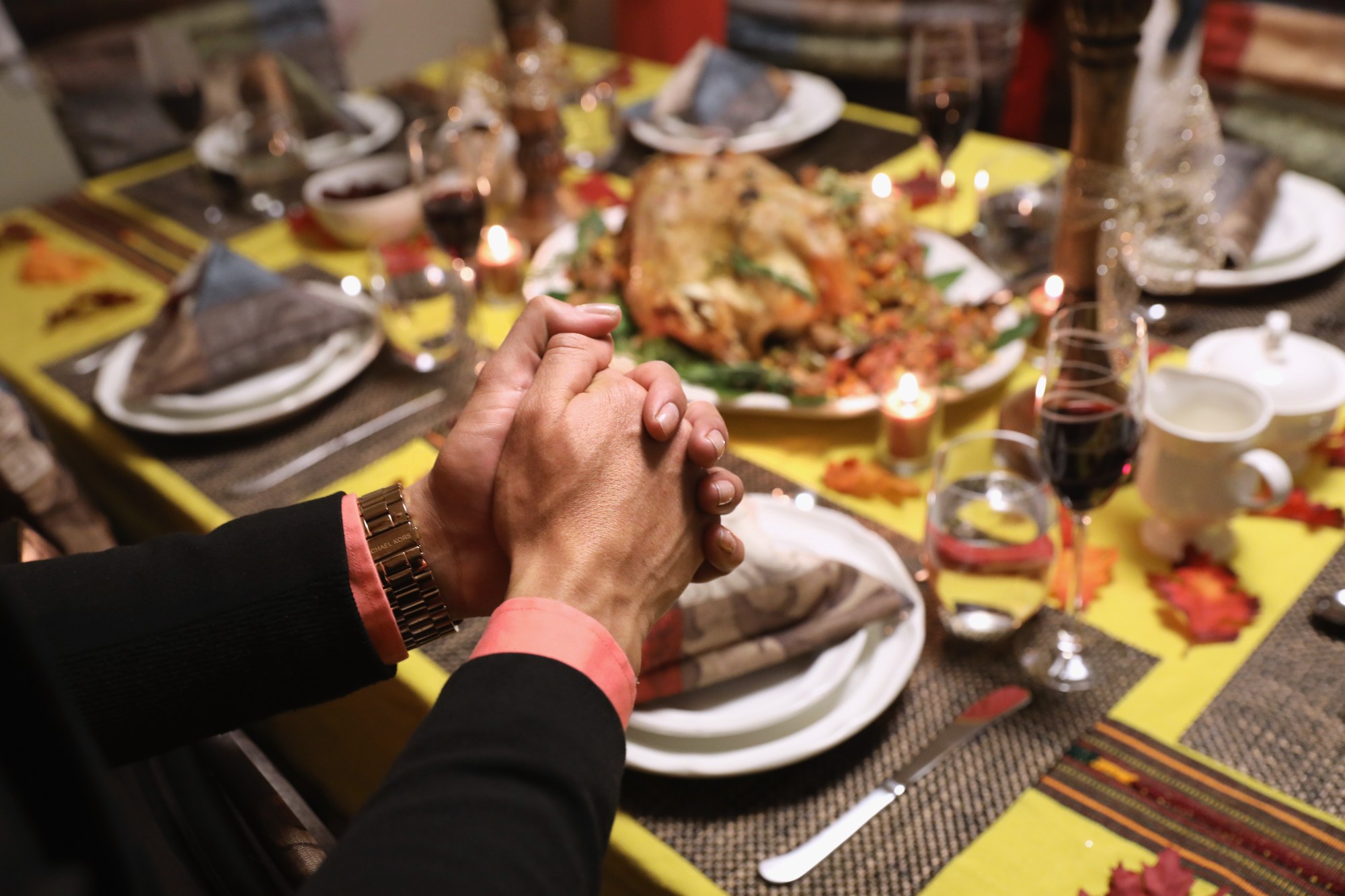
Imagine you’re sitting at Thanksgiving dinner. A family member brings up the recent election and shares views you vehemently disagree with. How do you respond? Do you roll your eyes, sigh loudly, argue or yell? Do you disagree politely, change the subject, listen quietly or walk away?
Think about which reaction seems most like you. How you respond in stressful situations says a lot about your ability to regulate your emotions, according to Triangle-based psychologist Tina Lepage, Psy.D., who has a doctorate in clinical psychology and specializes in family relationships.
As the founder of Lepage Associates Psychological Services in Durham and Raleigh, Lepage is well versed in helping people handle political conflicts with loved ones, especially around the holidays.
Studies show relationships can become strained when politics are involved. One in five Americans has become estranged from a family member (21%), blocked a family member on social media (22%) or skipped a family event (19%) due to disagreements on controversial topics, according to a 2024 American Psychiatric Association poll.
With Thanksgiving around the corner, NC Local asked Lepage to share some helpful strategies to prevent holiday gatherings from getting heated. This interview has been edited for length and clarity.
Political differences at the dinner table
NC Local: Your psychology practice has been around for 25 years. So, you’ve been through a few election cycles.
Tina Lepage: Yes, many. Although, honestly, it was really just the 2016 election and forward where it’s become a more prominent psychological issue that comes up in therapy. Not that it never came up before then, but [President Donald] Trump’s election in 2016 was the first time it came up as a prominent feature for many people coming to therapy.
There was more anxiety than usual among people and some depression related to it. There started to be a lot bigger arguments and people that were saying, “We can’t agree to disagree. We can’t have a discussion.”
Family members and friends even stopped talking to each other. That was unusual before. There’s something about the way the rhetoric got so ramped up in 2016 and hasn’t really gone down. So that’s a long time. We’re talking about a decade.
NC Local: What questions have you been hearing from clients after this most recent election?
Lepage: Well, it’s interesting because, to some extent, people are almost used to it. They’re used to the divide. Years ago, when it started to be that people were going to Thanksgiving and Christmas and having big blowups, people were shocked by it. And now people are less shocked by it because they anticipate that these things might be a problem.
The good thing about anticipating it is that maybe you can cut it off before it happens. One way is to proactively reach out to others and say, “Let’s just agree that we have all kinds of different people with different personalities, different values and different ways of thinking coming to this holiday gathering. We all love each other, and we’re going to focus on family.”
The most important thing is positivity and relationships, and if that means there are certain topics we can’t talk about, that’s fine. We don’t need to talk about these topics every day of the year. We can talk about who’s having a baby or who’s in college.
For some families, that works. For some families, that doesn’t work well. If people want to talk about those things, you really have to check yourself and your reactions because you’re only in control of yourself. You can’t go in saying, “I want everybody else to behave.”

NC Local: Do you think the holidays amplify political disagreements? You might be around people you don’t see as often and who may feel differently than you.
Lepage: We very much surround ourselves with people who agree with us, even politics aside. That gives us a lot of comfort and is normal, but sometimes it doesn’t give you enough experience in pushing your own thought process a little bit outside of your comfort zone. Just being able to politely hear other people’s process without being really negatively responsive to it [is an important skill].
Social media has made that so much worse, because our feeds give us back what they see that we’re already in tune with. Before social media, you chose your friends based on shared values and shared interests, and so you might not get a lot of differences, but you certainly got some. But what you didn’t get was this constant reaffirming of your own way of thinking. People are still so entrenched in their own belief system and find it really hard to open themselves up to what other people are thinking.
Bring your best self to holiday debates
NC Local: If you know political conversations are going to happen, how can you handle your own discomfort?
Lepage: You can prepare yourself mentally going into the situation. That begs some questions as to who you are as a person when people say things that you don’t agree with, and recognizing that sometimes we allow our worst selves to come out with our family. We reserve our better selves for people we don’t know well or in the work environment.
If somebody at work says something that you disagree with, do you immediately feel the need to disagree with it vehemently or to talk in a certain way? Most of us understand the concept of having a disimpassioned self in certain environments where it wouldn’t be appropriate to sort of go off.
Ask yourself, “Do I actually have emotion regulation?” Hopefully, the answer is yes. If you don’t have the ability to regulate your emotions, then you really should be having a conversation with yourself about how you can improve that life skill, because it’s a pretty important life skill.
If you can’t sit through a Thanksgiving dinner and hear people say things that you completely disagree with, that’s a problem. You should, as a grown up, be able to do that. It doesn’t mean you won’t feel somewhat irritated, but if you feel over-the-top irritated, it does say something about your ability to self-soothe and emotionally regulate.
Also ask yourself, do you have the skill to be a positive force in a negative situation? Can you stay calm? Do you have the ability to communicate in a situation where people are disagreeing without being loud and angry or sarcastic? Can you have a serious disagreement with somebody in a respectful way?
NC Local: If the answer to all those questions is ‘No,’ what do you recommend for that person?
If those are all a “no” for you, this goes beyond the Thanksgiving dinner. You could use work on some personal growth.
There’s nothing wrong with recognizing at some points in life that personal growth would be a good endeavor. It’s how we all evolve as human beings. It doesn’t say anything negative about you. It actually says something insightful about you if you realize that, at this point in my life, I could use a little personal growth in some of these areas.
Psychotherapy is a helpful thing. For some people, [it can be] just going to a therapist for one session [before a family gathering] and saying, “I don’t think I’m going to get through this meal.” You might do coaching with a therapist one or two times and find that you get through that holiday much better.
If you don’t have time to fit that in, you can always come up with other plans for yourself. If you really start to feel irritated, remove yourself from the situation or change the topic. If you’re comfortable with some honesty and self exposure, you can say, “I realize that you guys seem able to have this conversation and it does not get to you. But I notice that I’m starting to feel upset, and I’d appreciate it if we could change the conversation. How about we talk about ‘x’?” That’s very different than saying, “You guys are being so loud and so nasty that it’s upsetting me.” It’s offering a solution.
NC Local: Do you ever recommend not inviting somebody who might cause conflict or creating a seating chart to get certain people away from each other?
Lepage: Seating charts are not a bad idea. In terms of who you invite, there can be a lot of hurt feelings if somebody’s left out. I find it a sad evolution in American politics that we’re at a point where families literally talk about, “Maybe so-and-so shouldn’t come.” I think that is unfortunate. Holidays are times that really bond families. These types of relationships, lifelong relationships, are important.
I mean, look, if you’ve got a great gathering of people and there’s a couple of people that would blow it all up, and especially if those people have other places that they can go, [then maybe don’t invite them]. But I would be careful about it.
Choose relationships over being right
NC Local: Are there any things you advise clients not to do during heated arguments?
Lepage: Yes. With the way that things are in the U.S. right now, the worst thing you can do is bring up the topic of politics at Thanksgiving dinner. Why are you even bringing it up? There are so many things to talk about with your family. If somebody else brings it up, why are you disagreeing? Is it really that important to have that disagreement at that moment? Are you looking for an argument?
If somebody gets heated, it’s not a great idea to tell them that they’re a problem. Usually, yelling at somebody and telling them they’re wrong, or that they’re following somebody who’s an idiot, that usually doesn’t change people’s minds. If you are interested in the true art of persuasion and actually making change, that doesn’t do it.
You can try to bring the temperature down with what you say next. You can say, “I hope we can keep this conversation calm. I respect every individual’s right to have their own belief system. I think differently, but I don’t need to argue with you about it.”
NC Local: If the conversation goes off the rails and people get angry, how can you come back and repair the relationship?
Lepage: You can certainly try in the moment to name the change that you want. You can say, “I’m noticing that this conversation is really heated, and I would like us to switch the conversation. I’m hoping people agree with me.”
If it’s off the rails and everybody goes their own way, then the best way to fix it later is to initiate an apology. That’s hard for some people, because they will leave the situation feeling like they were right and the other person was wrong.
Now, if somebody else was really horrible to you, and you really were not doing anything wrong, you can just go to the person and say, “That didn’t feel good, but I would like for us to repair the relationship. I wonder if we can do that.” Then you’re not apologizing, because you didn’t do anything wrong, but you’re still reaching out.