
About The Hub
The Hub connects the NC local news and information ecosystem through our weekly newsletter, in-person convening and a member-only Resource Directory.
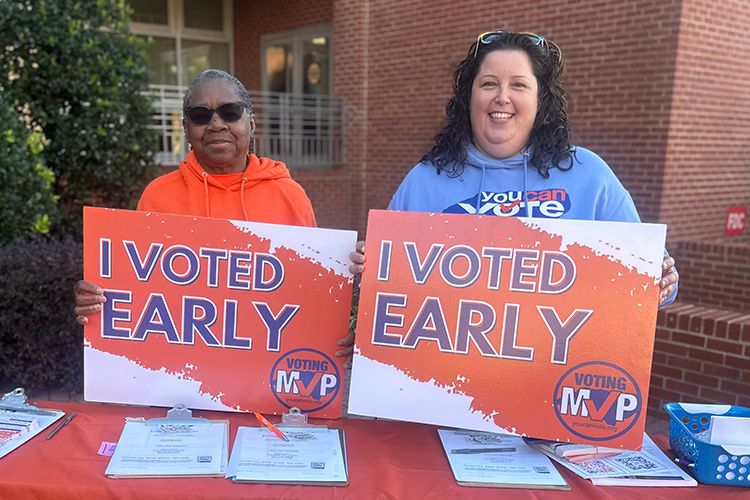
With early voting beginning February 12, we reached out to You Can Vote, the North Carolina nonprofit focused on voter education and outreach across the state. With a presence in 60+ counties and lots of on-the-ground community engagement, they’ve learned a lot over the last 12 years. One big takeaway: most people need information about the basics of voting: how do you register? How do you find your sample ballot? How do you make your voting plan? What are the election dates and deadlines?
To help make this information accessible, each election You Can Vote creates a series of guides, graphics and tools. All are available for news organizations to use and republish, with many available in Spanish.
We called up Deputy Director Caitlin Metzguer to learn more about some of the key messages news organizations should highlight this primary and what You Can Vote resources you can put to use.
Primary Day is Tuesday, March 3rd. What changes should news organizations highlight for their audiences?
Caitlin Metzguer: The one big change for absentee voting is that the request for anyone who wants to vote by mail is due a week earlier. So February 17th is the deadline to request a ballot, if people are voting by mail.
This is not new for ’26, but there is also no longer a grace period and that might catch some people off guard. Meaning, if people vote by mail, the ballot has to arrive by 7:30 pm on Tuesday, March 3. There’s no grace period if it arrives a couple days later.
Early voting is generally the best option for the most people. What news organizations can help share is the sites and dates and locations. Early voting sites change based on the election. There are more sites of early voting for the primary, but less hours, because not everybody has weekend hours.
So, I would push information out about early voting sites, which we have the link on our voter guide page to those. And make sure that folks know that the 2026 primary early voting schedule is the only thing that they should be using, because those dates, times, locations do vary by election.
Is that something you recommend news outlets specifically mention: “the place you voted in the last election may have changed?”
Caitlin Metzguer: Right, exactly. I think it’s very helpful to say, don’t assume that you’re going to go to the same spot as in ‘24, or even ‘25. Make sure you know the latest sites, and that is either on the county board websites or on our voter tool.
What are your recommendations for alerting people about the Registration Repair Project?
Caitlin Metzguer: The Registration Repair Project is still causing a little bit of confusion. The best thing to do if you find yourself on the list is to update your registration, which you can do at early voting. So, the message hasn’t really changed since ‘25. If you’re on the voter Registration Repair list, take care of that by taking action with your county board of elections. Now that we’re past the voter registration deadline, the best thing to do is utilize same-day registration and go vote early between February 12th to 28th.
There’s definitely been a lot of press coverage about Registration Repair, and there are still about 70,000 people on the list. That’s a small percentage compared to over 7 million voters, so I wouldn’t lead with that. I don’t think that’s the takeaway from this election. But because it rolled out in 2025, and more people will vote in 2026 because it’s a bigger election, there’s likely going to be people who find out that they’re on the list when they go to vote. That’s okay, don’t panic, just take care of it right then, and don’t go home without voting if you are an eligible voter.
We’ve seen a lawsuit by students challenging the rollback of early voting sites on several campuses. What are your recommendations here?
Caitlin Metzguer: There’s been a lot of press coverage of course on not picking campus sites for early voting. However, we still want to promote early voting, and I know the campuses are doing a great job of supporting their students to go out and vote.
It’s unfortunate that those campus sites were not picked, and there’s another round of early voting advocacy over the summer, so if folks want to see more access in the fall for the general election, there’s time to take action. I would say go to your local board of elections meeting, once they start talking about early voting again, and just start advocating for the sites that you want to see.
What guides are you offering for the primary, either new ones or existing ones?
Caitlin Metzguer: We have a communications toolkit, which is similar to the ones we’ve done in the past with sample emails, sample social media, sample graphics that groups can use, including newsrooms if you wanted.
We also have a high school toolkit that is specifically focused on supporting young voters and an updated campus toolkit for college-age students. People can download those and use that content.
Also with regard to young voters, one thing to highlight about the primary is that voters who are 17 right now, but will be 18 by November 3rd, can vote in the primary as a 17-year-old. So, there are some great messages to share specifically with those young voters who might think they have to wait, but they are eligible, as long as they’re 18 on or before November 3rd, Election Day.
You Can Vote is on the ground, talking to voters and would-be voters all year round. What have you learned about the best ways of reaching people with information about voting?
Caitlin Metzguer: Our Voter Guide is the best snapshot of resources and also our Ballot Builder. But it’s really having conversations with people about what’s on the ballot. It’s not an effective message to say, “Go vote, go vote, go vote.” It’s more effective to say: “the Primary is on March 3rd. That’s when we whittle down a whole bunch of candidates who voters want to see on the general election ballot.” It’s really helpful to explain what a primary is.
And talking to people about what’s on the ballot in terms of the issues they care about. That’s always going to be the most effective conversation. If you’re interested in education, we’re voting for school board, we’re voting for county commissioners which fund our schools. We’re voting for the legislature, which is supposed to fund everything in our state, right? If you’re interested in public safety, there are sheriffs on the ballot, district attorney, clerk of courts; the state Supreme Court is back on the ballot this year. Meeting people where they are by matching their interest with the office that impacts that issue is always going to be the most effective conversation that we can have.
Anything else you’d like to share that’s important for news organizations to be thinking about, or to be communicating to their audiences about how to vote this primary season?
Caitlin Metzguer: I will mention Voter ID, which is still required in North Carolina. You do not need a Real ID to vote. A normal driver’s license works, if that’s what you have. There’s a full list of accepted IDs, and it’s not too late to get one from the county boards of elections if you still need one. Each county board offers a free photo ID to anyone registered in that county. Finally, if people do not have photo ID, there is an exception form, and people should still go vote and ask to use that exception form. They’ll need to give a reason why they don’t have an ID, but will still be offered a ballot.
Lastly, I’ll just mention there’s an Election Protection Hotline, and so if anyone has questions, problems, issues, they can always reach out to 888-OUR-VOTE, which is the North Carolina nonpartisan Election Protection hotline, and it’s run by trained volunteers and election attorneys who answer questions. They’ll be available starting today, right as early voting begins.