
What you need to know
You might have seen smoke on the horizon across Western North Carolina this week. Don’t call the authorities. They already know, and the smoke you see might be from fires they set.
It is prime season for prescribed or controlled burning, according to the local Forest Service.
Controlled or prescribed burning, or when government firefighters intentionally set fire to specific land in order to get rid of leaves, downed trees and small plants in the forest to reduce wildfire risks, is essential, especially in parts of the region with vast, dense forest land that are prone to wildfires this time of year.
Over the last week, the U.S. Forest Service has conducted 15 prescribed burns across the state in the Nantahala, Uwharrie, Pisgah and Croatan National Forest.
In Western North Carolina, almost 6,000 acres have been burned in five prescribed fires since March 4.
Why do we need prescribed burns
The U.S. Forest Service said fires like these are crucial for the management of local forests, but since Hurricane Helene it’s more dangerous than ever to execute these plans.
“Since Helene, I would say overall planning has been different. There are definitely places that we cannot burn right now. There are places where the fuel load is so high, there is no way we could burn our way out of that problem safely,” Jenifer Bunty, disaster assistance recovery team member for the U.S. Forest Service in the National Forests in North Carolina, explained.
While the land management needs have changed, prescribed burning is statistically safe, Bunty said, because of the years of prep and science behind each plan.
How do forest management organizations do prescribed burns?
Prescribed burn planning happens years in advance, and a lot of science goes into the modeling of how the fire will behave in each area, Bunty explained. This modeling happens up until the moment the fire is lit.
The work in the region is further complicated this year by Helene fallout in areas with washed out roads, entire hillsides of downed trees or nearby homes that need to be protected from the fire.
Just like wildfire season, prescribed burns happen in the fall and spring because the conditions are right in the local “wet humid forests” of the region, Bunty said.
What about the wildlife habitat?
The Forest Service also burns forest areas based on the needs of local wildlife.
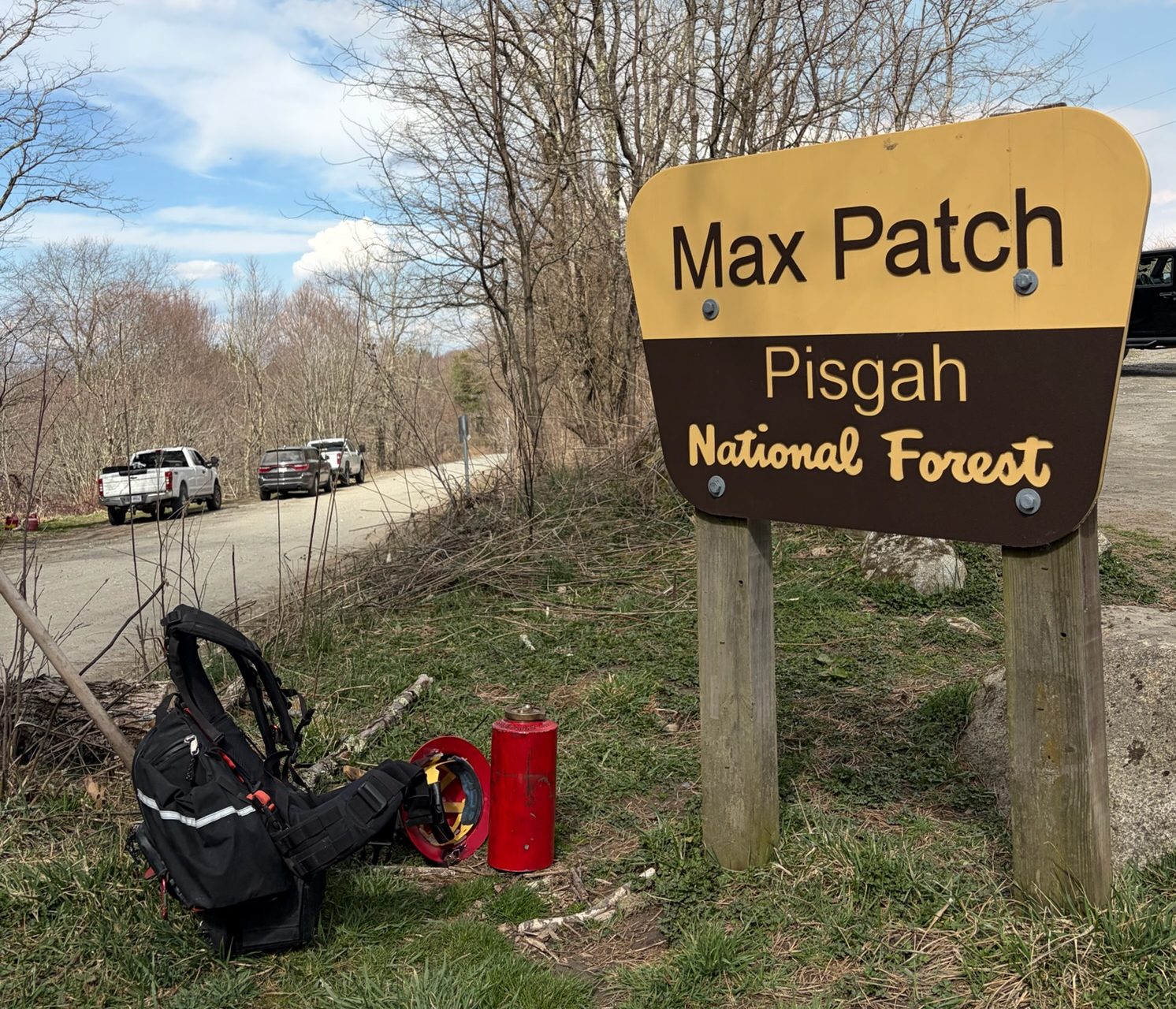
NC Local visited a 372-acre prescribed burn at the Max Patch Short Loop, in the Appalachian Ranger District of the Pisgah National Forest in Madison County. The area is burned intentionally every three to seven years.
On the grassy knoll, a line of fire wrapped around the hill and slowly moved down, scorching the undergrowth.
“This specific unit hasn’t been burned since before 2008, so we’re really excited to have the chance to burn here,” Forest Service Public Information Officer Kylie Wilkinson said at Max Patch.
The prescribed burn will get rid of grasses and shrubs known as the midstory, or areas of low-lying vegetation. The burn also helps fires spread up trees, known as ladder fuel.
Managing the area can also help maintain the habitat for specific species, depending on the area. For example, the field at Max Patch is the home of the golden-winged warbler, a near-threatened species.

(Golden-winged warbler Photo credit: Ryan Mandelbaum, Creative Commons)
“[The birds] like a successional forest, and so being able to use fire to meet those conditions is something that the Forest Service is able to do,” Wilkinson explained.
Burning the midstory opens up the field so that the golden-winged warbler is able to fly more easily through the meadow between the trees where they like to nest.
Other animals like grouse and deer also need open grassland, known as early successional habitat, to thrive. Bunty recalled a coworker at the nature commission referring to prescribed burns as “putting groceries on the ground.”
“Fire actually regenerates all those really nutrient-dense plants that deer and a lot of our wild animals love,” Bunty said. She has seen turkeys quickly head into a burned area looking for food.
“Sometimes within hours of the fire moving because they go in and they get all the little bugs and the little plants that are springing up,” she said.
How did Hurricane Helene change the need for prescribed burns?
Hurricane Helene caused an estimated 190,000 acres of blown-down trees in the Pisgah and Nantahala National Forests alone, Bunty said. These areas are now too dangerous for traditional prescribed burns.
Prescribed burns are just one tool in their land management toolbox, Bunty said.
The number of whole trees on the ground post-hurricane has increased the fuel for potential wildfires, limited access for firefighters and changed the way that waterways can be used as fire lines.
The changes require a new analysis of where fire lines need to be set up to protect homes, she said.
“It’s changed at the board how we’re managing and how we’re thinking about our burn overall,” Bunty said.
The U.S. Forest Service works in partnership with the N.C. Forest Service, the Nature Conservancy and other organizations on recovery efforts, including prescribed burning.
Bunty said experts from across the country have taken part in this week’s recovery efforts, including experts following the weather, the impacts on local camp sites, infrastructure and more.
That doesn’t include the approximately 250 firefighting personnel working on prescribed fires on the Nantahala and Pisgah National Forest this week. About one third of those are permanently located in western North Carolina, according to the Forest Service. The rest were brought in from out of state to support prescribed firefighting efforts here in western North Carolina.
Some environmental groups have voiced concerns about the transparency of Helene recovery efforts such as a logging project in the Nolichucky River.
Recovery efforts continue to move forward. Last month, the Forest Service and the North Carolina Wildlife Resources Commission have entered a new $290 million agreement to work together on recovery efforts. The N.C. Forest Service is hoping for additional funding in the state’s legislative budget to improve staff shortages before spring officially moves into the mountains.
How does the U.S. Forest Service use drones during prescribed burns?
At Max Patch, the fire was set, in part, using an unmanned air system aircraft system (UAS) drone of PSDs. PSD stands for plastic sphere dispenser. The drones are stocked with ping-pong-sized balls of chemicals that start the fire more evenly and safely than if the fire were started by hand.

(This is the drone used to light the prescribed burn at Max Patch. Sasha Schroeder/NC Local)
“That helps us burn the unit more evenly and more successfully,” Mary Grace Bedwell, an issues manager for the Forest Service who came from Wyoming to help with the prescribed burns.
The technique has increased as drone technology has improved over the last few years, Bunty said. Drones can also be used to more effectively survey the thousands of acres that could be part of a prescribed burn.
What should you do when there is prescribed burn in your area?
The Forest Service recommends that when driving, slow down and turn on your headlights if you encounter smoke on the road. Check on the Forest Service’s Facebook page here to find local burns.
Smoke in the air can be unhealthy to breathe. Check air quality conditions in your area on AirNow.gov, which shows satellite images of fires along with air quality conditions.
During prescribed burns, a fire will temporarily close the area, like the Max Patch Short Loop on the Appalachian Trail. The trails reopen when the fire is safely out.
The prescribed burn season is also wildfire season in North Carolina. Check out this list of tips to make sure your home is prepared for fires.