
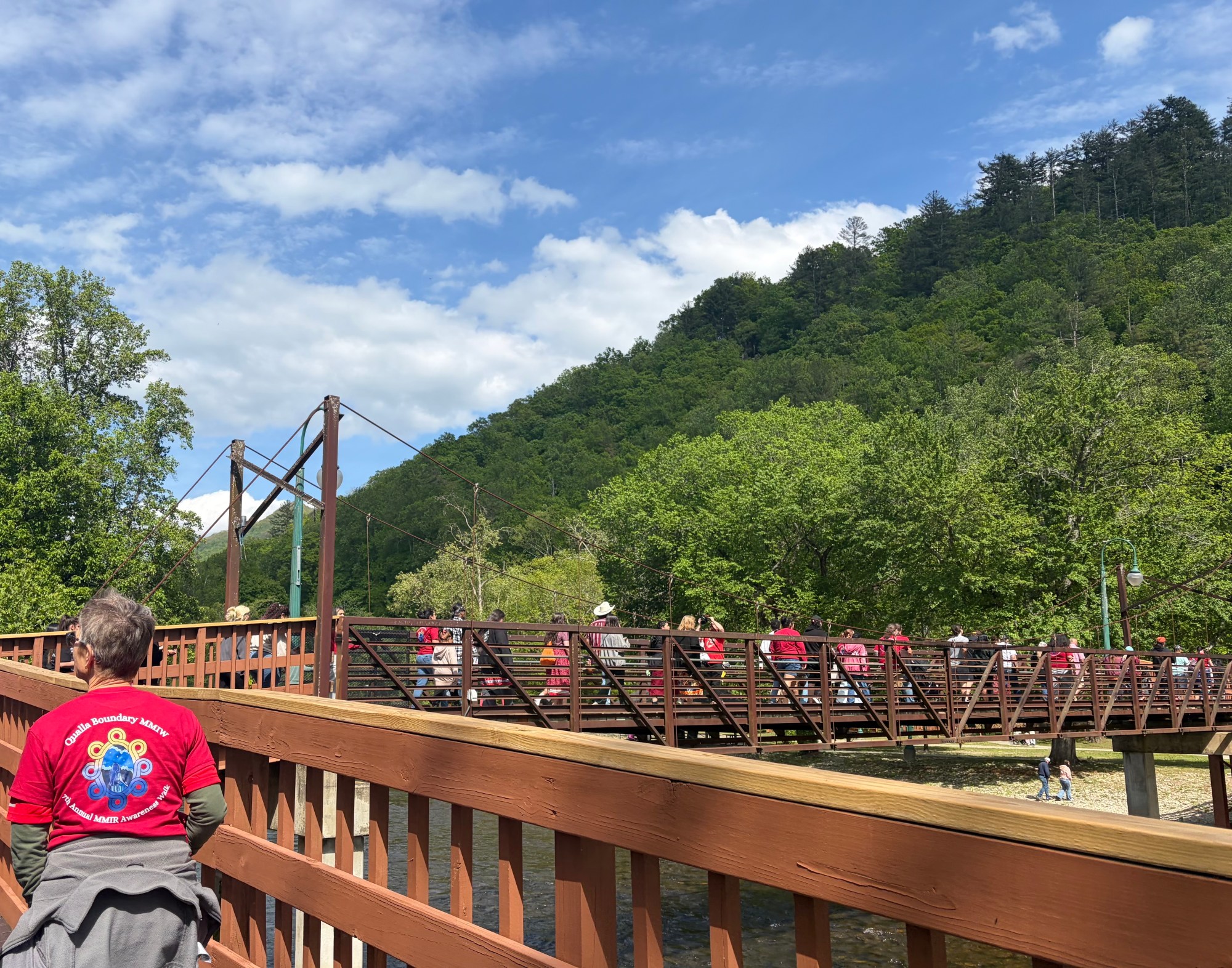
Community members on the Qualla Boundary gathered in red this week to honor Indigenous community members who are missing or who were murdered. The march is a time for grief and reflection on the crisis.
“It’s important to acknowledge that we are one. We are all here together, and we feel the loss together, and that is not any different than other indigenous communities,” said Tribal Council Member Shennelle Feather, who has two family members on the list of Missing and Murdered Relatives (MMIR).
Native American and Alaska Native rates of murder, rape, and violent crime are all higher than the national averages, according to the Bureau of Indian Affairs (BIA).
The BIA also said that there is no reliable count of how many Native women go missing or are killed each year. Women are often misclassified as other racial categories on missing-person forms, and “thousands have been left off a federal missing-persons list.”
The BIA estimated approximately 4,200 missing and murdered cases that have gone unsolved, with less than half logged in a federal database.
On the Qualla Boundary, the list of those who are missing and murdered has expanded over the seven years since Loretta Bolden first started the local march. Bolden still remembers how it felt to make the first list of names.
“I mean just doing the signs, putting their names out there to show that they aren’t forgotten, that they are remembered,” Bolden said. “And then when I got that list of men, I was like, oh my goodness. I knew a few of them that had been killed.”
The number of people honored each year has increased as more research has been done. In 2022, there were 23 women and children on the list. About four years ago, the list expanded to include men and all relatives.
Bolden said she took basket weaving classes from Gabriel Crow, who has been missing since 2024.
“When [Hurricane] Helene happened I thought, if he was buried somewhere, he’s not going to ever be found now because the floods just came and washed everything out,” Bolden said.
This year, 66 tribal members were honored on the remembrance story walk with banners sharing photographs and details about their lives.
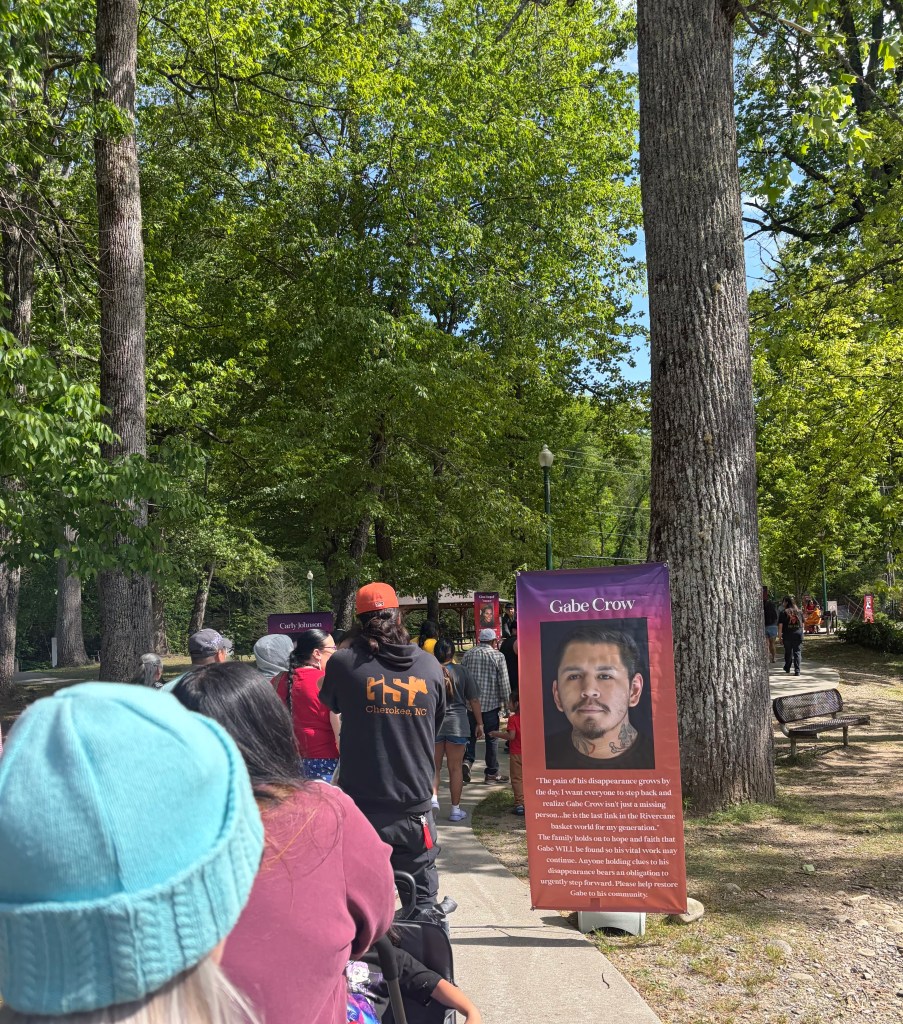
“It’s really the families that guide how they honor and remember their loved ones. We reach out to them as we can. Some banners don’t have any information on them; that’s because we haven’t gotten information yet,” Maggie Jackson, current co-chair of the Qualla Boundary MMIW/R organization, said.
The organization has been able to do a lot more research, she said, but that there is still more to do.
She said she sees the need for a better national database because not all of the cases that are on the remembrance walk are in the BIA database.
Beyond that, Jackson hopes this march highlights the need for domestic violence to be taken more seriously across the nation.
“A lot of times interpersonal violence comes at the hands of someone you love or that you thought you loved or that you thought loved you,” Jackson said.
“So [I want to see] more education about domestic violence, more protections for the victims of domestic violence, and just overall more awareness that domestic violence is dangerous.”
A tribal database and other solutions
Cherokee Indian Police Chief Carla Neadeau shared that the tribal police department partners with local and federal law enforcement to combat this issue, but that there is a long road ahead.
“We understand that the issue of missing and murdered indigenous people is not just a law enforcement matter. It is a crisis that demands attention, understanding, and action by all across Indian country. For far too long, Indigenous people have suffered in silence, subjected to violence, neglect, and systematic failures that have failed to protect them,” Neadeau said at the march.

“The emotional and mental scars are left by decades of abuse and are undeniable, and the pain runs deep within our people. That is why we, alongside the community, are committed to seeking justice, offering protection, and creating new pathways of healing.”
One piece of that work is a database that is currently being developed by tribal leadership. This database will allow the tribe to have an official list of all of the murdered and missing relatives.
The principal chief’s office recently shared a survey for community members to share their thoughts and opinions about the database.
Principal Chief Michell Hicks told NC Local that his office is working through the survey responses.
“We’re trying to make sure that we create as much analytical information as we possibly can, and that sounds easy, but it’s really not,” Hicks said on Saturday. He said the next step is to visit the tribal community clubs to gather additional information in person for the database.
This is separate from the work the Qualla Boundary MMIW group has been doing. Hicks said he is thankful both organizations are working to find information about unsolved cases.
“Looking at this from a united effort is the better way. It’s really how we as Cherokee and our communities operate – everybody kind of chips in. Finding the answers is something that we all want to do,” Hicks said.
He added that he thinks it is important that children who died at boarding schools are included in the database.
By 1900, there were 20,000 Indigenous children in boarding schools across the country, according to ICT. Often, the children were taken without the knowledge of their parents. The U.S. hasn’t kept documentation of the true number of boarding schools, but historians believe there were more than 350 — twice as many as in Canada, according to KALW.
The first boarding school in the U.S. was the Carlisle Indian School in Pennsylvania. There are 186 marked graves on the grounds of students who died while attending the school, according to the Carlisle Indian School Project.
“I’m not sure you know what their circumstances were, whether it was disease or some other potential conflict that they were involved in, so it breaks your heart. You can see the hearts continue to grieve, and there’s nothing easy about it at all,” Hicks said.
He said he sees this database as a potential framework for other tribes to implement.
N.C. Rep. Anna Ferguson (R-119) also attended the event. She said she was happy to be with friends and family, but sad and angry at what it meant to hold this remembrance walk.
“I’m mad because we still have to have an event and we still have to rally and we still have to stomp our feet and say when our people go missing, it matters, it matters just as much,” Ferguson, who is a member of the Eastern Band of Cherokee, said.
Anyone may participate in the event next year, Jackson said.
“We welcome any ally. We welcome anyone who wants to learn, participate and just be here and honor these people. You don’t have to know someone who’s fallen victim to violence to come here to honor them,” Jackson said. “You just have to be here in a healing and respectful way to come here and make a difference.”
Bolden said she still feels there is a lot to be done to help stop this crisis.
“I’m glad I heard them say that they’re going to be working on things. Seeing it happen is going to be the big thing because I don’t feel like justice is being done,” she said.