

Two years ago, Hurricane Helene caused widespread devastation across Western North Carolina. Flooding and landslides left thousands without housing, water, power and communications. More than 100 people died.
The state of North Carolina estimated Hurricane Helene caused nearly $60 billion in damage and mitigation needs. Federal and state funding directed toward recovery falls short, covering about $14.4 billion, roughly 24% of total needs.
As we enter the third year of recovery, NC Local is partnering with more than a dozen news organizations across the region to collect your questions about the recovery, funding and what work remains. Where answers are available, we’ll offer them here.
Where questions still need to be posed to officials, we’ll keep seeking answers. Submit your questions here.
Questions and answers on recovery
Continue reading to learn more about recovery funding, housing, displacement, small businesses, flood zones and other issues. Use the menu below to navigate to answers.
NC Local will continue to update this page as we answer new questions. Thanks to all the community members who’ve submitted questions and shared their experiences.
- What areas are still struggling to address and repair damage from the storm?
- Have jobs returned to hard-hit areas?
- How many homes have been rebuilt, and how much funding has gone to housing?
- FEMA’s temporary housing and rental assistance expires September 30. Has FEMA said whether it’s extending that deadline again?
- Has NCDOT performed a detailed review of the WNC roads and bridges? How much money has been spent and how much work is left?
- How are water systems being rebuilt?
- How are the new flood maps made? Can we trust them? What is the difference between 100- and 500-year floodplains? How often are they updated?
- How are we preparing for future disasters?
- How can we, as a community or community members, help?
General recovery

What areas are still struggling to address and repair storm damage?
Rural mountain communities remain further behind in repairs than the Asheville area.
In Chimney Rock, all 45 of the village’s businesses were affected, and 15 were destroyed. Roads, bridges and other critical infrastructure also had catastrophic damage. Mountain Xpress looked at the village’s rebuilding in June, when town officials said tourism revenue was down roughly 50% and visitation was down 60%. Read the village’s five-year recovery plan here.
Nearby Lake Lure reached a milestone earlier this year, refilling the popular lake. Carolina Public Press reported restoration took more than a year because of the massive amounts of sediment and debris.
Hickory Nut Gorge communities in Henderson County, including Gerton, Bat Cave and part of Edneyville, are also slowly recovering. The area experienced widespread flooding damage and about 170 landslides, and some roads are still closed to non-local traffic.
Heavy rains this year washed out some of the repairs, according to Blue Ridge Public Radio. A community-driven long-term recovery plan was approved earlier this year, which includes strengthening emergency management, investing in resilient infrastructure and ecological restoration.
In Madison County, Hot Springs has seen a slow recovery after many businesses experienced delays in state and federal funding, and relied on donations to rebuild. “The businesses, most of them, are reopened at this point,” Rebuild Hot Springs board president TJ Phillips told WUNC last January. “But people need to be here. Particularly this summer and fall, we’re a far cry from what it normally looks like here.”
Marshall, where floodwaters inundated the entire downtown, is also gradually rebuilding. Some businesses on Main Street have reopened, and the County recently broke ground on a new Public Service Complex, according to 828 News, and the Post Office is slated to open in the coming months.
While there has been progress in Buncombe County recovery, some hard-hit areas like Swannanoa are still rebuilding. The Board of Commissioners is scheduled to consider the Swannanoa Small Area and Resilience Plan in November.
In Watauga County, the Watauga Democrat reported debris removal work is wrapping up, and reimbursements have started arriving. Out of about 600 private road and bridge repair requests, 117 are complete and about 400 are in the estimate, design and construction process. Watauga County Emergency Services Planner Kristi Pukansky told the Watauga Democrat that the pace of recovery has slowed significantly due largely to federal processes. Some of the acquisition projects have been funded, though not completed. Construction on home elevation projects has not yet begun.
A Watauga Democrat interview conducted with Watauga Long Term Recovery Group Executive Director Steve Marks highlighted how a second wave of storm-caused damage, including failing wells, backed-up septic systems, and mold from unaddressed water intrusion, is only now surfacing, two years after the storm. The group’s active caseload has grown past 130, which staff attributes to word-of-mouth trust-building with residents who hadn’t previously engaged with recovery.
Go deeper
bLUE Ridge Public Radio
A hard rain reveals the slow road to recovery in Hickory Nut Gorge.
Mountain Xpress
Amid ongoing repairs, Chimney Rock Village’s shopkeepers and elected leaders find reasons for hope.
Have jobs returned to hard-hit areas?
According to the NC Department of Commerce, Western North Carolina lost about 19,000 jobs in the month following Helene, including about 13,000 in Buncombe County. Avery County had the steepest percentage of jobs lost, about 13.5% or 1,000 jobs, followed by Yancey County with a decline of 11.4%.
The hardest-hit industry was leisure and hospitality, losing more than 14,000 jobs as the region’s tourism came to an abrupt halt.
While many areas recovered, Buncombe County (where most jobs are located) continues to decline, losing about 3,100 jobs between March 2024 and March 2026. About 1,700 of those jobs were in accommodations and food services, driven in part by a loss of tourism. Lodging sales remain about 5% below their 2024 levels, according to the data from the Department of Commerce.
While Haywood, McDowell, Mitchell and Watauga counties also lost hundreds of jobs, some counties, including Ashe, Avery, Henderson, Madison, Rutherford and Yancey, experienced net gains in jobs since the storm.
Housing
How many homes have been rebuilt and how much funding has gone to housing?
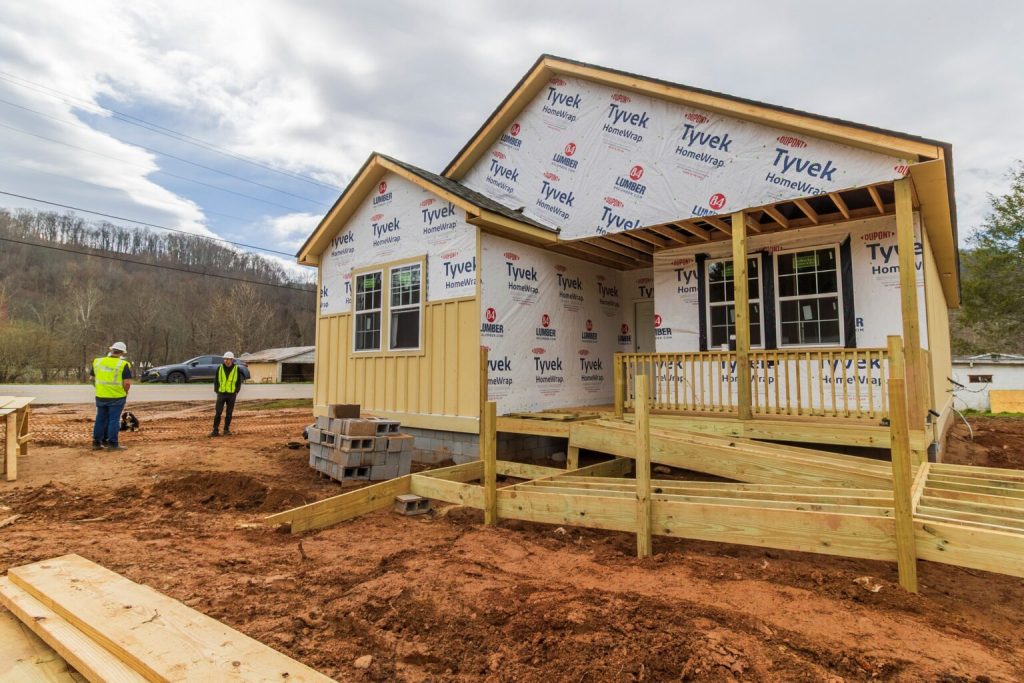
About 3,800 households were destroyed or severely damaged, according to FEMA data cited in an GROW NC report in July 2025. More than 34,000 had moderate damage. No single database tracks rebuilding or repairs for all these households, but data exists about various housing recovery programs funded by $1.4 billion from the U.S. Department of Housing and Urban Development’s Community Development Block Grant Disaster Relief program.
The Renew NC Single Family Housing Program, which prioritized rebuilding and repairs for households with low to moderate incomes, has about 2,200 active applications. Of those, 159 are in the construction phase, and 153 are completed, according to the program’s dashboard. The program receives and distributes about $807 million in federal funding.
The Small Rental Rehabilitation Program is for properties with one to four affordable rental units. As of August, about 95 applications were under review for rebuilding or repairs. The majority of applications are for one unit. About $50 million in federal funding is available for this program.
About $70 million in federal funding is available for multi-family housing construction and repair. Awards will range from $500,000 to $15 million. The application window closes November 2, 2026. Additionally, about $53 million in federal grant funding is available for the Workforce Housing for Ownership program. The deadline for those applications is December 14, 2026.
The City of Asheville was separately awarded $225 million in HUD Community Development Block Grant Disaster Relief funding. The city initially set aside just $3 million for single-family home repair, enough for only eight homes. Blue Ridge Public Radio launched an investigation that found more than 100 eligible families had no path to home repair funding.
In June, City Council voted 6-1 to add $19.2 million to the program which is expected to help 55 to 65 of the roughly 150 eligible households. A coalition of local housing nonprofits and both of the city’s own recovery advisory boards opposed the additional funding, arguing the money would do more good building new affordable units.
The remaining Asheville CDBG-DR funds are going toward new affordable multi-family housing, including three affordable housing developments that will add about 330 rental units.
FEMA’s temporary housing and rental assistance expires September 30, 2026. Has FEMA said whether it’s extending that deadline again?
FEMA extended the temporary housing and rental assistance in March, giving participants another six months to repair their homes or find permanent housing, Blue Ridge Public Radio reported. The agency, which has experienced major leadership upheaval and organizational changes under the Trump adminstration, has not issued any information about a possible extension.
GROW NC’s Director Matt Calabria doesn’t anticipate this deadline will be extended beyond September. “They obviously pushed it back to the 2-year mark, which is comparatively long compared to how long that program lasts elsewhere,” Calabria said.
He said GROW NC is trying to work with families to transition, including connecting them with nonprofits and disaster case management resources. According to FEMA, zero families are living in FEMA-provided housing units and only a small number are still receiving rental assistance.
Go deeper
Blue Ridge Public Radio
HUD gave Asheville $225M for Helene repair. Why is there only enough money to fix 8 houses?
THe News & OBSERVER
Asheville may run short of money to cover all who need homes rebuilt post-Helene.
ASHEVILLE CITIZEN TIMES
For some Helene survivors, home is still out of reach two years later.
Infrastructure

Credit: Gerard Albert III / BPR News
Has NCDOT performed a detailed review of the WNC roads and bridges? How much money has been spent and how much work is left?
According to the State Auditor’s dashboard, about $2.2 billion has been spent on transportation out of a $7.9 billion budget.
NCDOT identified about 9,500 damaged sites, which included about 5,000 miles of state-maintained roads, as well as about 700 bridges and 700 culverts. Another 7,000 private roads, bridges, and culverts were also severely damaged, according to the NC Department of Commerce.
The estimated cost to repair all the transportation infrastructure, both public and private, is about $10 billion. View the status of transportation repairs on NCDOT’s Helene dashboard.
About 99% of state-maintained roads have reopened. But as Blue Ridge Public Radio reports, officials said that doesn’t mean that all repairs are complete. Some of the largest projects are years away from completion.
Repairs to private roads, bridges and culverts are happening more slowly. As of June 2026, about 3,000 private roads and bridges approved for repairs are currently in the “program queue” for the North Carolina Private Road and Bridge Program. Repairs at about 120 sites are complete, and those at another 143 sites are in progress.
The total repair cost is about $380 million, according to GROW NC’s latest quarterly report. The program is no longer accepting new applications, but GROW NC’s Director Matt Calabria said they will try to connect people who weren’t able to apply with other resources.
“Ultimately we know it’s a need that’s unusual in the national experience because of Western North Carolina’s unique topography,” Calabria told NC Local. “I would encourage folks to get in touch with volunteer organizations that may be state-funded because depending on the circumstances, they may be able to get help that way. There may be some other funding opportunities that we can connect folks with.”
Contact GROW NC at wncrecovery@nc.gov or call 919-814-2000. You can also submit an online comment here.
Go deeper
How are water systems being rebuilt?
Statewide, the NC’s Governor’s Office and NC DEQ have awarded more than $1 billion for water/wastewater/septic resilience projects across 28 counties. The funding required flood-resilience upgrades, not just like-for-like repairs.
As of July 2026, Governor Stein said 98% of damaged water systems have been restored, though an estimated $750 million of repairs remain, according to reporting by Blue Ridge Public Radio.
Asheville’s water system rebuild is being redesigned rather than restored to its old form. Blue Ridge Public Radio reports the city is building a $25 million pre-treatment system in Swannanoa. FEMA is covering about 75% of the costs, and construction is slated to begin in Spring 2027 and take two years. The City is also pursuing federal funding for a pre-treatment system and a new alternate bypass line at the North Fork Reservoir.
Haywood County is linking three separate water systems together, according to The Mountaineer, so if one system fails in a future disaster, the others can supply it with potable water rather than leaving a community dry. Haywood has also begun acquiring open land along the river, including several repurposed empty lots in Clyde, to give floodwaters somewhere to go next time, rather than into homes and businesses.
In Ashe County, $740,000 in state funding will go toward rehabilitating downtown sewer lines, according to the Ashe Post & Times.
How are the new flood maps made? Can we trust them? What is the difference between 100- and 500-year floodplains? How often are they updated?
Flood maps have a technical name: Flood Insurance Rate Maps. They are produced through a partnership between FEMA and the state, known as the NC Floodplain Mapping Program. The maps are made using several data points: elevation, historical rainfall and streamflow records, and hydraulic modeling. LiDAR, or Light Detection and Ranging, is used to get precise elevation measurements.
Post-Helene, North Carolina is running a remapping effort using new LiDAR scans that capture Helene’s actual damage and channel shifts. According to the GROW NC state quarterly report, that data was still being processed into updated flood-hazard maps as of mid-2026, with full completion (requiring FEMA sign-off) taking longer.
100-year vs. 500-year floodplain: These are probability labels, not timelines. A “100-year flood” has a 1% chance of being equaled or exceeded in any given year, which works out to roughly a 26% chance over the life of a 30-year mortgage. A “500-year flood” has a 0.2% annual chance. Neither means “this only happens once every X years.”
Can we trust them? The Washington Post analyzed data from First Street, an organization that conducts research and models physical climate risk and financial impact. The analysis showed only about 2% of properties in the mountainous WNC counties hit hardest by Helene fell inside FEMA’s mapped flood zone areas, despite the catastrophic widespread flooding.
First Street’s independent modeling found North Carolina’s actual flood risk roughly three times greater than FEMA’s maps show. FEMA’s maps are built to model large, known river systems and coastal storm surge, and routinely miss smaller creeks and steep-terrain flash-flood risk, which is what devastated WNC.
“The big difference between our flood models and FEMA’s models,” First Street’s Jeremy Porter told the Asheville Watchdog in 2025, is “due explicitly to the fact that FEMA does not include heavy precipitation in their models, and they do not climate-correct the other sources of flooding.”
How often are they updated? FEMA reviews maps every five years and may conclude that no updates are needed. There’s no legal requirement to revise maps on that schedule, which is why some counties like Buncombe, Yancey, Avery, and Burke are working from data nearly two decades old.
Go deeper
Blue Ridge Public Radio
Department of Environmental Quality spends $1B on repairing water infrastructure post-Helene.
Ashe Post and Times
Ashe County gets boost from storm recovery grants amid ongoing struggles.
Asheville wATCHDOG
‘Dreadful’ and ‘hopelessly behind’: FEMA flood maps reveal their flaws in a time of warming and extreme storms.
Preparedness
How are we preparing for future disasters?
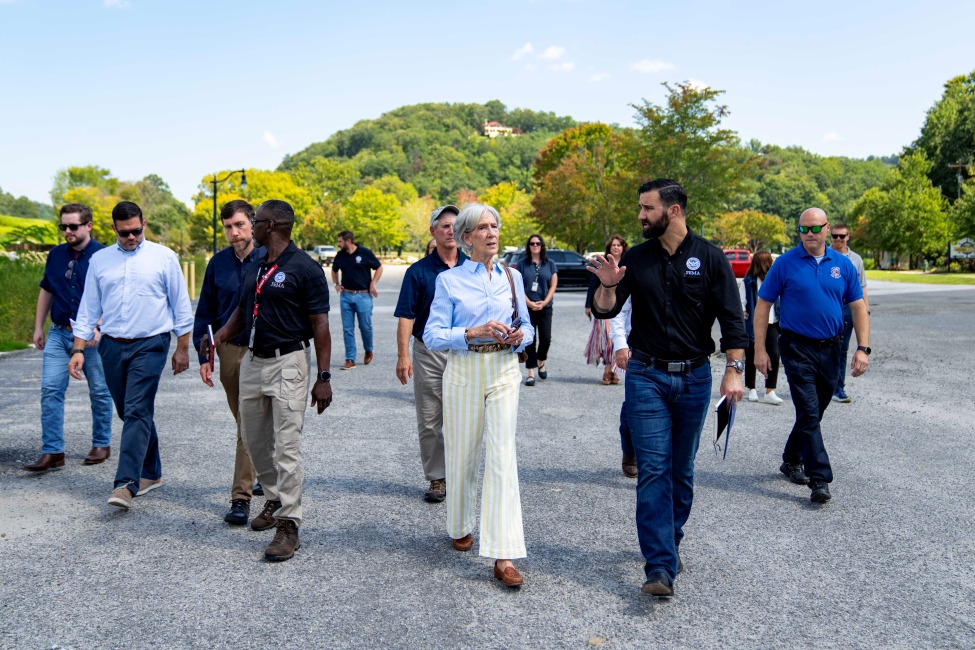
Statewide, North Carolina held its first-ever Landslide Preparedness Week in August 2026, a joint effort that included the National Weather Service, NC Emergency Management and other agencies.
The NC Geological Survey also launched a landslide website, which includes preparedness and safety tips, along with a mapping tool to help people identify if they live in an at-risk community. Helene caused an estimated 2,000 landslides, killing dozens of people and destroying hundreds of homes, roads and other infrastructure.
A number of local governments are working on preparedness for future disasters. The 2026 Buncombe Madison Regional Hazard Mitigation Plan, according to Mountain Xpress, outlines several priority areas including flood mitigation, slope stabilization, backup power and reducing downed trees, which can become fuel for wildfires.
In Haywood County, The Mountaineer documented detailed local preparedness, including new flood-warning sirens tied to upriver gauges that now automatically alert downriver communities as water rises, replacing the near-zero warning many residents had in 2024. In direct response to the storm’s week-long communications blackout, such as no landlines, cell service, or internet, the county stood up a network of old-fashioned community bulletin boards so residents have a known physical location to check for news when every digital channel goes down.
First-responder communications got a parallel upgrade in Haywood. The Mountaineer detailed a new emergency shelter that is being outfitted with satellite communication technology for use when internet and phone networks fail, funded in part through state grants bolstering Canton’s emergency communications and Waynesville’s move to solar power at a town building.
On the community-readiness side, Enlace Latino NC built a dedicated bilingual resource called Prepárate NC, created after the outlet identified a specific gap: most NC counties don’t issue emergency alerts in Spanish. The outlet has kept the effort active in preparation for the 2026 hurricane season, including a June 2026 Facebook Live event on disaster-emergency rights.
Go deeper
Asheville Citizen Times
From radio towers to hospitals, lessons learned during the crisis are driving new investments in redundancy, staffing and resilience.
Enlace Latino NC
This guide seeks to respond to the information needs expressed by Hispanic families affected by hurricanes in different regions of North Carolina.
Ongoing support and resources

Credit: Walker Livingston / Carolina Public Press
How can we, as a community or community members, help?
Community members can help in several ways across Western North Carolina.
Organizations are still accepting financial donations. Monetary support can go to the NC Community Foundation Disaster Relief Fund or, more directly, to county-specific long-term recovery groups such as Watauga LTRG and Ashe County Recovery & Restoration. Samaritan’s Purse continues its relief and building work in Buncombe, Yancey and Watauga counties. These entities are still actively distributing grants that support resident needs, including housing repair, well/septic replacement, and furniture.
Volunteer with a recovery group. Groups such as Baptists on Mission have completed 1,155 Helene home rebuilds, with 190 in progress and 60 awaiting assessment. They’re still soliciting skilled construction labor to support their rebuild and recovery efforts, pivoting away from general supply drop-offs. Gov. Stein acknowledged their efforts, alongside Habitat for Humanity for Buncombe and Madison Counties, for their critical role in long-term rebuilding.
Attend Watauga LTRG’s “Recovery to Readiness” Resource Fair on Saturday, Sept. 26, 1 – 4 p.m., at Appalachian State’s Leon Levine Hall. Free and open to all of Watauga County, not just those still recovering. Resource vendors include the Salvation Army, Red Cross and High Country United Way, along with two free 30–45 minute Red Cross emergency-preparedness classes. Up to 60 attendees will receive take-home preparedness kits.
Support grassroots/mutual-aid groups directly. Some mutual aid groups, such as BeLoved Asheville and Foscoe Home Team in the High Country, still take both cash and specific in-kind donations. Foscoe recently opened a new, larger location and is hosting a paid, ticketed event called a Celebration of Community Connections on Sunday, September 27, 2026, from 5 p.m. to 8 p.m., with proceeds going directly to helping local friends and neighbors.
Give food. Donate to your local county’s food pantry or Community Kitchen. Manna Foodbank, which provides food and resources for more than 200 partners in the WNC region, offers opportunities to volunteer or donate. The Community Kitchen in Canton (Haywood County) is still rebuilding food collection and distribution capacity after Helene flooded it twice.
NC Local, in collaboration with regional and statewide news organizations, sent surveys to dozens of community organizations to gather these questions and strengthen understanding, transparency, accountability and preparedness as we enter year three of rebuilding. If you still have questions, please submit them here.
More Hurricane Helene stories



Something went wrong. Please refresh the page and/or try again.