
Last Spring, the Journalism + Design Lab put out the call for community colleges across the Southeast to pitch their ideas about how they could play a role in strengthening local news and information in their communities. The ideas from the winning teams in the Community College Civic Info Challenge are both inspiring and practical. Here’s a sample:
The Community College of Baltimore County is taking a twofold approach: a podcasting initiative called ForReal Media to teach students audio and storytelling skills while amplifying their voices through partnerships with local media outlets and the News Literacy Institute, weaving media literacy workshops and classroom modules across disciplines to help students and faculty become trusted messages.
Florida State College at Jacksonville’s project ELEVATE aims to equip students with civic literacy and leadership skills so they can become peer information ambassadors through student-led podcasts, bulletins, and community briefings.
Jones College in Ellisville, Mississippi is responding to widespread news deserts across the state and the need for more trained journalists to work at small, community news outlets. Their goal is to develop an eight-week, non-credit certificate in digital community journalism skills that could expand across the state and form a Mississippi Community College Journalism Coalition.
Working in an academic environment, the teams know there are some unique challenges to address:
How can we best support community college students—many of whom balance work, family, and study—in becoming consistent creators and consumers of credible local information?
What equipment do we need? What technology & tools are freely available?
Could the program be run through workforce development? And what opportunities are available for them after they complete the program?
How can you fund programs that allow them to be independent? How do you navigate political hot-topics?
How do we sustain these projects long term?
Journalism + Design Lab will guide the teams as they set out to answer these questions and address some of the issues many of us are facing as we work to build sustainable news organizations that are responsive to community needs. We chatted with J+D’s Valerie Popp to learn more about the program and what opportunities might exist for the 58 North Carolina community colleges serving the state’s 100 counties.
When did J+D begin working with community colleges & what roles do you see them playing in strengthening local news and information?
Valerie Popp: The J+D Lab has been working with community colleges since 2017, hosting workshops and readings for faculty and staff. Our first deep collaboration, with the Community College of Philadelphia and Resolve Philly, resulted in the creation of “Community Journalism for Civic Power,” a free, noncredit certificate program that teaches participants how journalism and design practices can help them find and share information that their communities need to thrive. That certificate program, which has trained more than 100 people to date over three iterations, became the model for other community colleges across the country.
J+D’s work has proven that it’s crucial to activate and integrate civic institutions like community colleges, libraries and arts organizations into local news infrastructure. Community colleges in particular are important because they are everywhere, with more than 1,000 campuses in the US; embedded in their communities; accessible; and have a tradition of serving and centering populations whose perspectives have often been overlooked, underresourced, and exploited by traditional media systems. Because of that, they are uniquely positioned to become news-and-information hubs for their regions: spaces where people can learn to produce local journalism, engage with what is happening in their communities, and amplify voices that are often underrepresented.
You are working with teams across the South on the “Community College Civic Info Challenge.” What are you hoping teams accomplish during this program?
Valerie Popp: The Civic Info Challenge represents a valuable opportunity to amplify and connect community college faculty and staff who are working to bolster local news infrastructure across the South. The Challenge application posed the question: “How might your campus equip more people to get, share, and discuss reliable information about what’s happening in the places where they live?” The eight colleges in the Challenge cohort offered incredibly innovative, collaborative, and above all, diverse answers: now our job is to incubate those ideas; support the colleges in operationalizing them (which can be tricky!); and create in-person and virtual spaces for the teams to work through challenges together, share strategies for success, and tap into the broader movement to equip more people to participate in local news. By summer 2026, we are hoping that the teams will be in a place where they have identified key action steps and collaborators for launching their projects and have started testing and refining their ideas.
The Challenge is also teaching us so much about the different needs and opportunities for activating community colleges as local news infrastructure. We’re hoping to learn more about what is needed for community members to go from participating in free programs about journalism to claiming sustained roles in their local news systems. What are the incentives and disincentives? Are there common elements consistently leading to either participating or dropping out? Most importantly, what are the strategies and models for sustaining these programs and partnerships: what is required, how much do different approaches cost, and what are the opportunities to fund them? Having so many different projects in one cohort will allow us to start to identify and categorize best practices for this work–which we’ll in turn share widely.
What is J+D’s role in supporting teams?
Valerie Popp: A little bit of everything, to be honest! Depending on the program stage and where college teams are in their project design, we function as:
- program officers, helping them navigate J+D’s grant applications and turn their ideas into proposals and budgets
- thought partners, working alongside them to shape their project ideas, ask difficult questions, and offer suggestions and connections for moving forward
- facilitators, designing and running regular virtual and in-person cohort meetings, site visits, and other events where teams come together to learn about specific community journalism frameworks and tools, hear from experts with relevant lived and learned experience, and practice putting their ideas into action;
- weavers, connecting them to institutional partners and individuals in their regions and beyond who can help strengthen, sustain, and even fund their work; and
- cheerleaders/shoulders to cry on, celebrating their wins and offering strategies and just plain support when they encounter roadblocks.
All of these roles are equally important in building and nurturing cohorts.
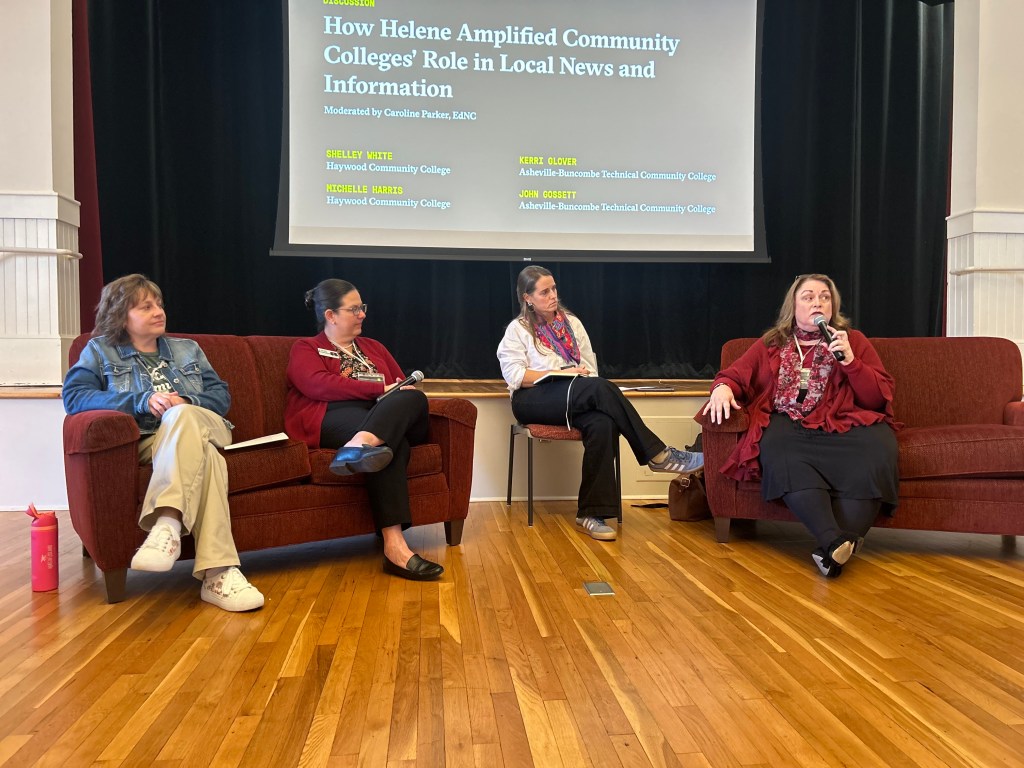
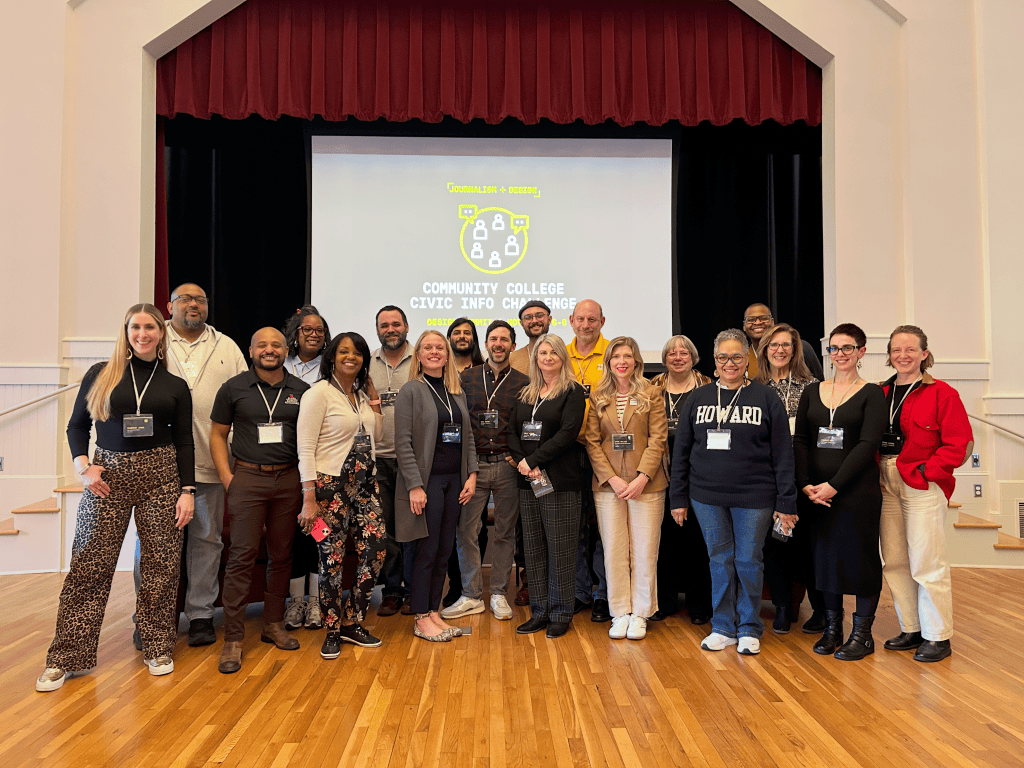
You just brought teams to Asheville for a Summit. What are some of your takeaways from the gathering and the projects teams are working on?
Valerie Popp: One of the main takeaways from the gathering was that people doing the work of community journalism are so hungry to connect with and learn from one another. Having dedicated spaces where people can meet each other and learn from what’s happening in institutions and networks beyond their own is really critical, both for morale and for sparking new ideas. Moving ahead, the J+D Lab team will be working together to build more channels and tools to enable everyone across our network–the Challenge cohort as well as our college, media, and community partners across the country–to connect in accessible and meaningful ways. So stay tuned for that!
The other takeaway is something that emerged from the Summit breakout on curricular innovation. In today’s world, acting journalistically isn’t optional: it’s a “survival skill.” At a moment when we’re constantly receiving and sharing information, in all sorts of formats and with varying degrees of reliability, we all need to do our part to keep ourselves–and our communities–better informed. J+D’s community journalism collaborations with colleges and media partners are designed to help people feel like they aren’t just surviving the news ecosystem, but that they are thriving within it. So coming out of the Summit, it will be important for us to collectively tap into that sense of urgency, to build a movement around what “journalism as survival skill” can look like at community colleges, but to do it from a place of empowerment and inspiration rather than fear. And we really believe that the cohort colleges’ projects will be exemplars for how to do just that.
What are some challenges and opportunities when it comes to community colleges working on local news and civic info projects and programs?
Valerie Popp: The community college landscape can be quite bureaucratic, both at the level of individual colleges and within state college systems (in the places that have them). Faculty and staff often aren’t incentivized to work across silos–and even when they are personally motivated to do so, existing structures can get in the way. But bureaucracy can be an opportunity, too! For instance, we’ve seen how it can motivate college teams to look beyond their on-campus peers and seek out new collaborators beyond campus, which ultimately can lead to richer college-community connections. Project lead burnout is also something to watch and operationalize for. Many community college faculty and staff already do so much on their campuses: teaching heavy loads, advising student clubs, joining committees, contributing to their disciplines through service and research. So we try to support teams with tools and strategies to help them with project management and succession planning.
We don’t have any NC teams participating in this current cohort but we do have some initiatives happening, including JMPro Community Media‘s partnership with AB Tech and McDowell Technical Community College on a Community Reporter course in WNC. What other potential do you see for community colleges in North Carolina?
Valerie Popp: We haven’t had the opportunity to meet the JMPro team yet, but we are really inspired by the partnerships that they’ve built with AB Tech and McDowell TCC! Their Community Reporter courses are a great example of what can happen when a trusted community media partner–like JMPro–teams up with community college campuses: you get locally-led trainings that genuinely respond to community needs, are designed and offered in the languages that people in the area speak, and ultimately create more pathways for people to become local information leaders and strengthen the flow of trusted, accessible news where they are.
In addition to AB Tech and McDowell, the Summit–and especially our collaboration with you at NC Local!–taught us that there are so many other community colleges in North Carolina that are already doing the work of meeting local information needs and training people in their communities to be info leaders. Hurricane Helene especially brought those efforts to light. As Blue Ridge Community College President Laura Leatherwood recently wrote in a Community College Daily op-ed: “More than ever, community colleges in our region are paving the way toward recovery, providing the knowledge, skills and people who rebuild our communities and safeguard our future.” We see a real opportunity for the community colleges that were involved in Helene response and recovery to educate all of us about how moments of crisis can lead to more resilient news and info systems.
Will there be future opportunities for NC community colleges and/or resources you can point them to if they’d like to learn more?
Valerie Popp: Yes! We encourage NC community colleges to get in touch with Challenge co-leads Cole Goins (goinsm@newschool.edu) and myself, Valerie Popp (poppv@newschool.edu) if they are interested in learning more about the Challenge cohort and expanding or building a community journalism program on their campus.
Resources:
- Community News Networks page: an overview of our approach, interventions, and network to date
- Civic Info Challenge 2025 Cohort: learn more about the program and cohort’s projects
- Community News Roles framework: a new resource which outlines a set of actions that anyone can play in their community to produce, share, and act on reliable information. We’re so excited about this framework and hope it can be a tool for anyone working to enable more people to participate in their local news ecosystems! You can access the full framework, including visuals, descriptions and examples of community news roles at the link above. We’d love for NC community colleges and others in the NC local news space to engage with the framework and help spread the word.